default

2021-02-24 Mann’s Opinion Article On Climate Change Way Forward

This is an opinion article in Newsweek by Michael Mann, climate scientist.

https://www.newsweek.com/right-path-forward-climate-change-opinion-1571169

Quote:

<<

But perhaps the two paths are beginning to converge.

In his new book, Gates prioritizes many of the same objectives that I do. He emphasizes the importance of putting pressure on our elected officials to support climate-friendly policies. He advocates for a plan that will lead us toward zero net carbon emissions by mid-century, a goal that’s critical if we are to limit warming below dangerous levels. >>

and

<< Gates’ arguments in favor of nuclear energy are similarly unconvincing. Current generation nuclear energy is not competitive with renewable energy in the free market—it is only viable with massive government subsidies, and it carries unnecessary proliferation and safety risks. And it could take several decades for the “next generation” nuclear technology advocated by Gates to pass regulatory review, calling into question how this technology can help us decarbonize our civilization by 2050 as necessary. >>

But Gates says (p.97)

<< Keep in mind that although we need to pursue all these ideas, we probably don’t need all of them to pan out in order to decarbonize our power grid. Some of the ideas overlap each other. If we get a breakthrough in cheap hydrogen, for example, we might not need to worry as much about getting a magic battery.

what I can say for certain is that we need a concrete plan to develop new power grids that provide affordable zero-carbon electricity reliably, whenever we need it. >>

default

2021-02-23 Plastic Waste To Engine Fuel

This guy lives on an island in Nicaragua and gathers plastic waste on the beach. He puts the plastic into a metal tank that is sealed, and builds a fire under it. The plastic pyrolyzes and the fumes are piped through a few condensers where the liquids are drawn off. Some liquids are like diesel and some are like gasoline. He runs his electric generator engine with the gasoline.

In an industrial setting the heat could be what is left over from a gas turbine exhaust. Or some of the plastic could be used to make the fire.

https://youtu.be/TFuTCpCVSbM

Other similar

Waste plastic to oil/fuel improved pyrolysis reactor

https://youtu.be/_BfjaVbLb8I

I watched the 1st one and YouTube showed more videos with similar pyrolysis systems. What is mysterious is we have millions of tons of plastic waste that is polluting the environment yet no one seems to have used this pyrolysis process on an industrial scale to eliminate much of it. The plastic waste stays in the environment until it is pyrolyzed when it turns into fuel and ends up creating CO2 in the atmosphere, but which is worse? Plastic waste or CO2? But the CO2 could be captured and sequestered.

default

2021-02-23 Trans-west Express,Breakthroughenergy.org

From Gates’ book p.82

<< Construction on the Trans West Express, a transmission project designed to move wind-generated power from Wyoming to California and the Southwest, is scheduled to begin in 2021. The project is supposed to become operational in 2024—some 17 years after planning began.

But if we could pull this off, it would be transformative. I’m funding a project that involves building a computer model of all the power grids covering the United States. Using the model, experts have studied what it would take for all western states to reach California’s goal of 60 percent renewables by 2030, and for all eastern states to reach New York’s goal of 70 percent clean energy by that same year. What they found is that there’s simply no way for the states to do it without enhancing the power grid. The model also showed that regional and national approaches to transmission rather than leaving each state to its own devices — would allow every state to meet the emission-reduction goals with 30 percent fewer renewables than they would need otherwise. In other words, we’ll save money by building renewables in the best locations, building a unified national grid, and shipping zero-emissions electrons wherever they’re needed.*

* This model is available online for the public. See breakthroughenergy.org for more information. >>

default

2021-02-23 Green Premium

From Gates’ book p.74

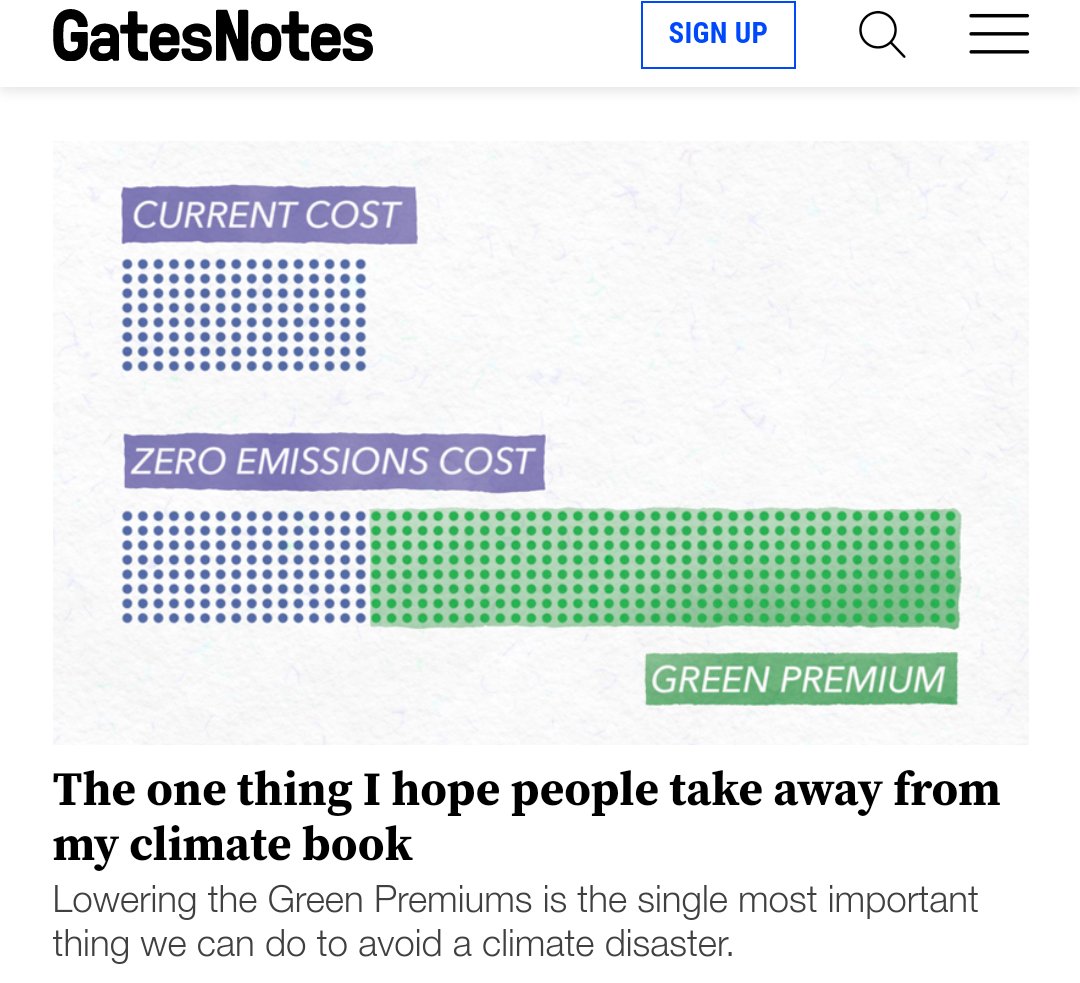
<< It’s not immediately obvious why there’s such a thing as a Green Premium in the first place. Natural gas plants have to keep buying fuel as long as they’re running: solar farms, wind farms, and dams get their fuel for free. Also, there’s the truism that as you take a technology to broad scale, it gets cheaper. So why does it cost extra to go green? One problem is that fossil fuels are so cheap. Because their prices don’t factor in the true cost of climate change — the economic damage they inflict by making the planet warmer — it’s harder for clean energy sources to compete with them. And we’ve spent many decades building up a system to extract fossil fuels from the ground, get energy from them, and deliver that energy, all very cheaply.

Another reason is that, as I mentioned earlier, some regions of the world simply don’t have decent renewable resources. To get close to 100 percent, we’d have to move lots of clean energy from where it’s made (sunny places, ideally near the equator, and windy regions) to where it’s needed (cloudy, windless ones). That would require building new transmission lines, a costly and time-consuming task — especially if it involves crossing national borders—and the more power lines we install, the more the price of power goes up. In fact, transmission and distribution are responsible for more than a third of the final cost of electricity. And many countries don’t want to rely on other countries for their electricity supply.

But cheap oil and expensive transmission lines aren’t the biggest drivers of the electricity Green Premium. The main culprits are our demand for reliability, and the curse of intermittency.

The sun and the wind are intermittent sources, meaning that they don’t generate electricity 24 hours a day, 365 days a year. But our need for power is not intermittent; we want it all the time. So if solar and wind represent a big part of our electricity mix and we want to avoid major outages, we’re going to need other options for when the sun isn’t shining and the wind isn’t blowing. Either we need to store excess electricity in batteries (which, I’ll argue in a moment, is prohibitively expensive), or we need to add other energy sources that use fossil fuels, such as natural gas plants that run only when you need them. Either way, the economics won’t work in our favor. As we approach 100 percent clean electricity, intermittency becomes a bigger and more expensive problem.

The clearest example of intermittency is when the sun goes down, cutting off our supply of solar-generated electricity. Suppose we want to solve that problem by taking one kilowatt-hour of excess electricity that’s generated during the day, storing it, and using it that night. (You’d need much more than that, but I’m picking one kilowatt-hour to make the math easy.) How much would that add to our electric bill? >>

<< That depends on two factors: how much the battery costs, and how long it’ll last before we have to replace it. For the cost, let’s say we can buy a one kilowatt hour battery for a $100. (This is a conservative estimate, and I’ll ignore for a moment what happens if we have to take out a loan for this battery.) As for now our battery will last, let’s assume it can go through 1000 charge and discharge cycles.

So the capital cost of this one-kilowatt-hour battery will be $100 spread out over 1,000 cycles, which works out to 10 cents per kilowatt-hour. That’s on top of the cost of generating the power in the first place, which in the case of solar power is something like 5 cents per kilowatt-hour. In other words, the electricity we store for nighttime use will cost us triple what we’re paying during the day-5 cents to generate and 10 cents to store, for a total of 15 cents.

I know researchers who think they can make a battery that lasts five times longer than the one I’ve described here. They haven’t done it yet, but if they’re right, that would drive the premium down from 10 cents to 2 cents, a much more modest increase. In any case, the nighttime problem is solvable today, if you’re willing to pay a big premium, and with innovation I’m confident we can reduce that premium.

Unfortunately, nighttime intermittency isn’t the hardest problem to deal with. The seasonal variation between summer and winter is an even bigger hurdle. There are various ways to try to deal with it — like adding in power from a nuclear plant or a gas-fired electric plant fitted with a device that captures its emissions — and any realistic scenario will include these options. I’ll get to them later in the chapter, but for the sake of simplicity for now I’ll just use batteries to illustrate the problem of seasonal variation.

Say we want to store a single kilowatt-hour not for a day but for a whole season. We’ll generate it during the summer and use it in the winter to run a space heater. This time, the battery’s life cycle isn’t an issue, because we’re charging it only once a year. >>

<< But suppose we have to finance the purchase of the battery. Now we’ve tied up $100 in capital. (Obviously you wouldn’t finance a $100 battery, but you might need financing if you were buying enough to store several gigawatts. And the math is the same.) If we pay 5 percent interest on the capital, and the battery costs $100, that’s an additional $5 cost to store our single kilowatt-hour. And remember how much we’re paying for solar power during the day: just 5 cents. Who would pay $5 to store a nickel’s worth of electricity?

Seasonal intermittency and the high cost of storage cause yet another problem, especially for big users of solar power—the problem of overgeneration in the summer and undergeneration in the winter.

Because the earth is tilted on its axis, the amount of sunlight that hits any given part of the planet varies across the four seasons, as does the intensity of the sunlight. Just how big the variation is depends on how far you are from the equator. In Ecuador, there’s essentially no change. In the Seattle area, where I live, we get about twice as much sunlight on the longest day of the year as on the shortest day. Parts of Canada and Russia get about 12 times more.”

To see why this variation matters, let’s do another thought experiment. Imagine there’s a town near Seattle — we’ll call it Suntown — that wants to generate a gigawatt of solar power year-round. How big should Suntown’s solar array be?

One option would be to install enough panels to produce a gigawatt during the summer, when sunlight is plentiful. But the town would be out of luck in the winter, when it’ll get only half as much sunlight. That’s undergeneration. (And the town council is well aware that storage is excessively expensive, so they’ve ruled out batteries.) On the other hand, Suntown could put up all the solar panels it needs for the short, dark days of winter, but then by the time summer arrives, it would be generating way more than necessary. Electricity would be so cheap that the town would be hard-pressed to recoup the expense of installing all those panels. >>

<< Suntown could deal with this overgeneration problem by turning off some of its panels during the summer, but then it’d be sinking money into equipment that gets used only for part of the year. That would raise the cost of electricity even more for every home and business in town; in other words, it would add to the town’s Green Premium.

The situation with Suntown isn’t merely a hypothetical example. Something similar has been happening in Germany, which through its ambitious Energiewende program set a goal of 60 percent renewables by 2050. The country has spent billions of dollars over the past decade expanding its use of renewables, increasing is solar capacity nearly 650 percent between 2008 and 2010. But Germany produced about 10 times more solar in 2018 than it did in December of 2018.in fact, at times during the summer, Germany’s solar and wind plants generate so much electricity that the country can’t use it all. When that happens, it ends up transmitting some of the excess to neighboring Poland and the Czech republic, whose leaders have complained that it’s straining their own power grids and causing unpredictable swings in the cost of electricity.

There’s another problem caused by intermittency, and it’s even harder to solve than the daily or seasonal variety. What happens when an extreme event forces the city to survive several days without any renewable energy at all?

p.83 << Deploying today’s renewables and improving transmission couldn’t be more important. If we don’t upgrade our grid significantly and instead make each region do this on its own, the green premium might not be 15 to 30%, it could be 100% or more. Unless we use large amounts of nuclear energy (which I’ll get to in the next section), every path to zero in the United States will require us to install as much wind and solar energy power as we can build and find room for. It’s hard to say exactly how much of America’s electricity will come from renewables in the end, but what we do know is that between now and 2050 we will have to build them much faster — on the order of 5 to 10 times faster — then we’re doing right now. >>

breakthroughenergy.org

default

2021-02-22 Bill Gates On PBS Newshour

PBS Newshour’s Judy Woodruff interviews Bill Gates. I also saw Gates on Colbert’s late show. He’s promoting his book How To Avoid A Climate Disaster.

https://youtu.be/BMbb4MR66Qk

Tags:
default

2021-02-22 Facebook Group Scientists Warning

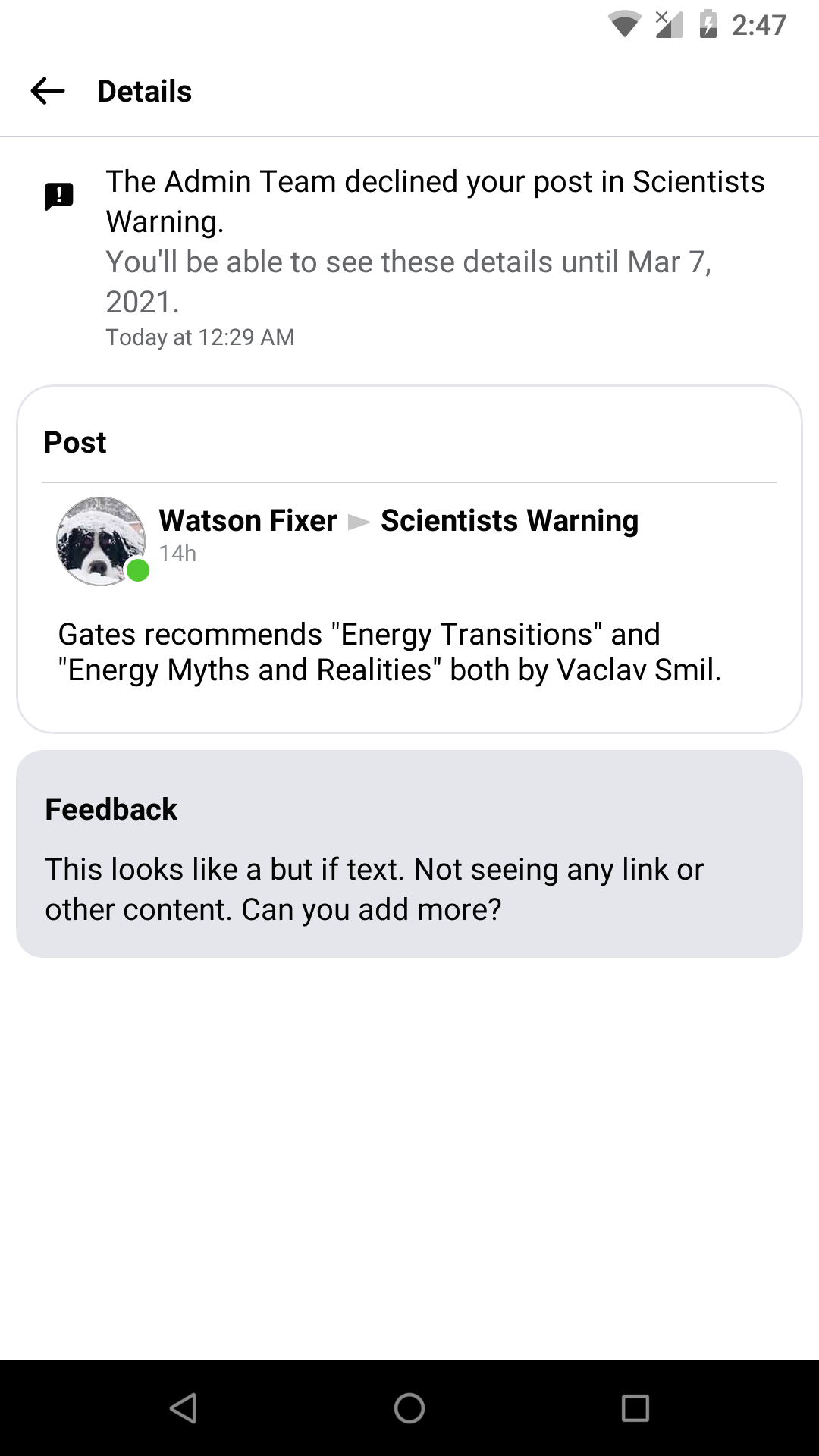
I joined this Facebook group a few weeks ago and found the admins censor the posts. One such example is below (screenshot). I don’t know what they mean by a “but if text” but I didn’t do anything other than attempt to post two recommended books by Vaclav Smil. I searched for “but if text” and I found a lot of stuff that applied to spreadsheets.

What other hoops am I supposed to jump through to get this past the censors who don’t explain why they’re censoring? They seem to want links but I don’t have a preference for book dealers, and I don’t have Amazon Prime. Just search on eBay or online and the sellers will be there.

There are numerous anti-Gates people who are telling everyone that Bill Gates is “too rich” among other things and is bad for climate change. Perhaps the admin who censored me has this problem?

I think I’m dealing with a bunch of narrow-minded people who are not actually doing anything for climate change.

Tags:
default

2021-02-22 Tesla PowerWall, Megapack, StorEn Price Info Per kWh

This article gives an idea of how much a Tesla PowerWall will cost.

This StorEn company has only a few employees. They are crowdfunding and have not yet sold a flow battery. They’re supposedly in the business of making vanadium redox flow batteries.

https://cleantechnica.com/2020/10/05/tesla-megapack-powerpack-powerwall-battery-storage-prices/

https://www.startengine.com

https://www.storen.com

Update Feb 23 – TSLA was down to $632 a share, from well over 800 earlier. Looks like it’s time to buy some more.

default

2021-02-21 Gates Says …

Jennifer Mary Tess
This is an opinion article. Here is a paragraph:

<< Another issue is that wealth limits the perspectives of even the best-intentioned people. This week, Bill Gates argued in an interview with the Financial Times that divesting (ditching stocks) from fossil fuels is a waste of time. It would be better, he claimed, to pour money into disruptive new technologies with lower emissions. Of course we need new technologies. But he has missed the crucial point: in seeking to prevent climate breakdown, what counts is not what you do but what you stop doing. It doesn’t matter how many solar panels you install if you don’t simultaneously shut down coal and gas burners. Unless existing fossil fuel plants are retired before the end of their lives, and all exploration and development of new fossil fuel reserves is cancelled, there is little chance of preventing more than 1.5C of global heating. >>

It said, “It doesn’t matter how many solar panels you install, if you don’t simultaneously shut down coal and gas burners.”

Apparently this guy doesn’t realize that when you install a solar panel array, say 4000 watts for example, that’s 4000 watts that is no longer needed from the fossil fueled power plant. If you install enough renewables such as solar and wind, then you are shutting down the power plant effectively. The power plant can be eliminated when the renewables plus storage puts out the same power.

Why would a company shut down the fossil fueled power plant? Because the power plant uses a huge amount of fossil fuel, usually coal; the renewables us none. One coal burning power plant uses 150 train carloads of coal a day! That’s expensive, $2059 per car — that’s 0.3 million dollars a day. Renewables are free.

default

2021-02-21 U. Mich Climate Change Factsheets

Scroll down to see sections.

http://css.umich.edu/factsheets

default

2021-02-21 Hydropower Life Cycle Assessments

This is something I didn’t know about. I knew that when they build a dam, they cut down the trees on the land that will be underwater. But there are still lots of carbon in the soil.

p.69

<< Hydropower has a lot going for it — it’s relatively cheap — but it also has some big downsides. Making a reservoir displaces local communities and wildlife. When you cover land with water, if there’s a lot of carbon in the soil, the carbon eventually turns into methane and escapes into the atmosphere—which is why studies show that depending on where it’s built, a dam can actually be a worse emitter than coal for 50 to 100 years before it makes up for all the methane it’s responsible for*. In addition, the amount of electricity you can generate from a dam depends on the season, because you’re relying on rain-fed streams and rivers. And, of course, hydropower is immobile. You have to build the dams where the rivers are.

* These calculations are drawn from a life cycle assessment of dams. Life cycle assessment is an interesting field that involves documenting all the greenhouse gases that a given product is responsible for, from the time it’s produced until the end of its life. These assessments are a useful way to analyze the climate impact of various technologies, but they’re pretty complicated, so in this book I will focus on direct emissions, which are easier to explain and generally lead to the same conclusions anyway. >>

© RustyBolt.Info/wordpress
CyberChimps