default

2020-10-21 Wiring Harnesses And Automation

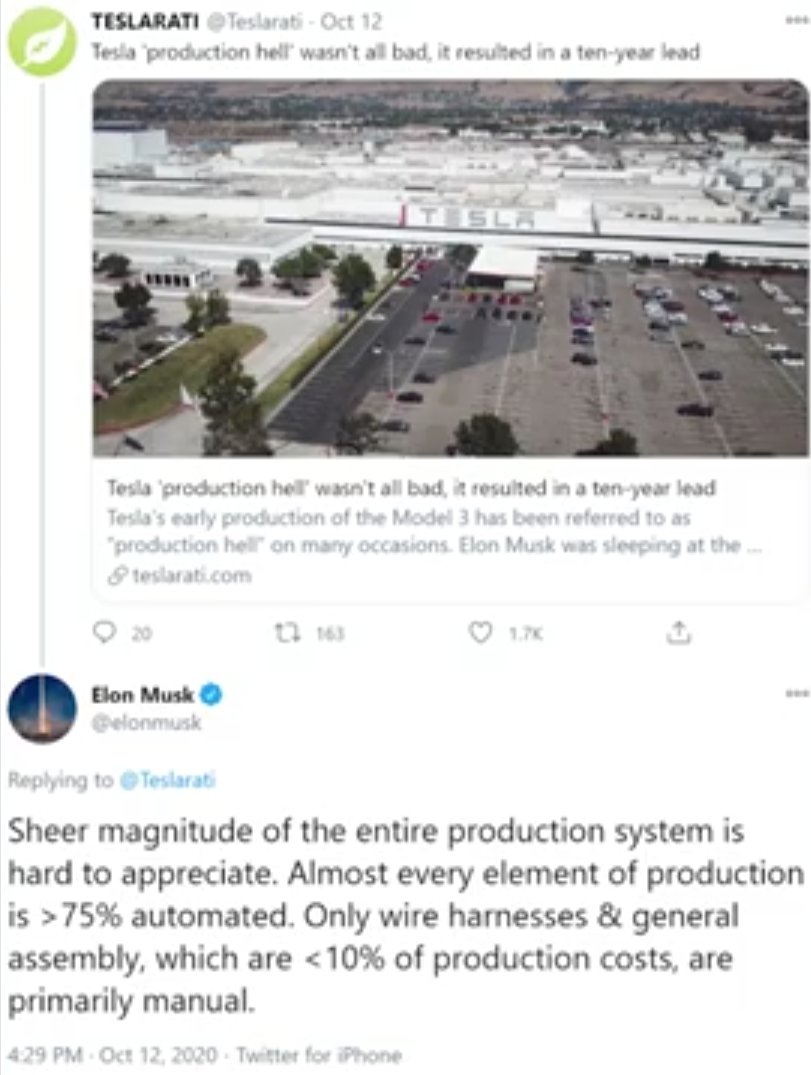
I worked at a company that built automated test equipment for assembling cables and wiring harnesses. During the year I was there they sent reps to Detroit to help GM build wiring harnesses for Buicks. This was in 1980 and GM was using relays to implement the logic system to assure that the wiring harness was assembled correctly. This was when most wiring harnesses were assembled manually on a sheet of plywood with nails driven into it. So changing to our automated harness testers was a big step up from the old way. The whole reason for using our automated harness testers was to speed up assembly.

So I was watching Now You Know which has a lot of information about Tesla and I was kind of surprised when I read this. I would’ve thought that in 40 years the manufacture of wiring harnesses would have become highly automated. But I guess not.

default

2020-10-20 BLM: McRaven Not Voting For Trump!

When I first read the headlines I thought that it was just another article that made much about nothing. But after reading it I had tears in my eyes. It made me ask many questions in my mind.

There is the parable about the wisdom of King Solomon. A woman who lost her child kidnapped a child from its mother. The mother pleaded with King Solomon to have her baby back. The kidnapper selfishly claimed that the mother was trying to steal her child. King Solomon didn’t know who to believe, and made a decision. He told the two women he would cut the child in half and give each woman half.

The kidnapper felt no remorse and said nothing, but the real mother pleaded with the king not to harm the child but give the child to the kidnapper — she couldn’t bear to see her child die. Solomon then knew who the real mother was.

To me, Trump is like the kidnapper. When he tries to steal the truth, the country’s newsmedia puts him on trial. He has no remorse about lying — he just continues to lie. Worse yet, he declares the newsmedia as ‘fake news’ and declares the newsmedia as ‘the enemy of the people’ because they won’t let him continue to tell the lies. The rest of the people who believe his lies, try to defend him. Trump has even declared he could kill someone and people let him get away with it. Why have those people been deceived and can’t see that Trump is misleading them?

He declares “Four more years” and that he must “drain the swamp” when he has done more to fill the swamp by appointing campaign donors and industry lobbyists to positions within the government. He has appointed to Secretary of Education a woman who is hostile to public education.

He has made so many bad decisions that he has been taken to court many times and the courts have decided that he has stepped out of line and tried to do damage, and the courts have stopped him.

Many of the people around him have been convicted of crimes and gone to jail. The latest one arrested is Steve Bannon, his campaign strategist. I suspect that there are many more who have gotten away with criminal acts. The swamp that he claims to be draining is in reality being filled with his slime and filth.

https://news.yahoo.com/black-lives-matter-navy-seal-031036423.html

default

2020-10-19 Only Class War Can Stop Climate Change

The world’s top 1 percent is responsible for generating twice as much as the bottom half.

https://jacobinmag.com/2020/10/class-war-climate-change-overpopulation-carbon

default

2020-10-19 Trump Accused Of Sex With 13 y/o: Court Records

This article shows the names of 18 women he has ‘been with’. The links to the court records accusing him of sex with a 13 year old are in the story.

A quote from the story:

>> It stopped being a political choice a while ago. This is now a moral choice. It has to be because Trump has no political beliefs. Not one considered, passionately-held, factually backed-up, political belief. He believes in nothing, save his own enrichment and survival. If you haven’t figured this out yet then you haven’t been paying attention. Or rather, you have been paying attention to what he says and not what he does. <<

Quote with links:

>> Before his election to the presidency Donald Trump was accused of raping a 13-year-old girl with his friend, Jeffrey Epstein (court documents can be seen here and here. The plaintiff also claimed that she was threatened with physical harm if she did not keep the assault quiet. <<

Article:

https://goodtrouble974588398.wordpress.com/2020/08/08/the-case-against-trump/

default

2020-10-19 What’s Causing Climate Change In 10 Charts

Quote from end of Vox article

>> In the end, the conversation about responsibility leads where all climate conversations lead: The only hope of avoiding catastrophic damage is most every country decarbonizing as rapidly as they are capable, regardless of their histories and rivalries.

Electricity must be rapidly decarbonized to get rid of coal; heating and transportation must be rapidly electrified to get rid of oil and natural gas. Wealthy countries should mobilize to drive down the costs of clean-energy technologies through research and large-scale deployment; developing nations should work as hard as possible to substitute clean technologies when long-term industrial policy and infrastructure decisions are being made. And those with resources should help those with fewer prepare for the turbulent century to come.

Whoever’s fault it is, we either all chip in to solve it or we all suffer. <<

default

2020-10-17 Much More Than ‘Just’ Climate Change – “A Life On Our Planet” Part 1

I was speculating while reading from “A Life On Our Planet” by Sir David Attenborough.

Such revelations as what are in the Part 2 – What Lies Ahead section of this book. The nine parts of the circle he describes are being pushed toward or past the point of stability. Four of these have gone past the point of stability. From what is in my earlier blog I assume that what we should be doing is restricting our consumption of meat, especially beef. The chickens are the least demanding of the domesticated meat supply. One way to curb consumption of meat is to put a tax on it. More tax on beef and dairy products, not as much on chickens and eggs.

***************************

Part 3

A Vision For The Future

How to Rewild the World

Switching to Clean Energy

p.136 >> The living world is essentially solar powered. The Earth’s plants, together with phytoplankton and algae, capture three trillion kilowatt hours [3 petawatt-hours] of solar energy every day. That is almost 20 times the energy we use. And they collect it directly from the sunlight, trapping the energy within organic molecules made from carbon. They obtain this carbon by absorbing carbon dioxide from the air. As they build the organic molecules, they expel oxygen as a waste product. The process is known as photosynthesis. It powers all their life processes, from the growth of their stems and trunks, to the production of seeds to establish a next generation, fruits to persuade animals to transport their seeds, and larders in which to store their food to sustain themselves during hard times. <<

Note 6.

https://ipcc.ch/sr15/chapter/chapter-2/

https://ourworldindata.org/co2-and-other-greenhouse-gas-emissions#future-emissions

p.139 >> Our careless use of fossils fuels has set us the greatest and most urgent challenge we have ever faced. If we do make the transition to renewables at the lightning speed required, humankind will forever look back on the generation with gratitude, for we are indeed the first to truly understand the problem — and the last with a chance to do anything about it. The road to a world powered by carbon-free energy will be a bumpy one, and the next few decades will be extremely challenging for us all. But many working on this problem believe it is possible. We human beings are, above all, the most astonishing problem solvers. We have made difficult journeys before that evolve enormous social change throughout our history and we can do so again.

<<

p.141 >> A second potential barrier is affordability, but this too is falling away. the scanning up of solar and wind power has already brought the price of renewable generation per kilowatt down to levels that outcompete coal, hydropower and nuclear, and it is approaching the cost of gas and oil period in addition, renewables are much cheaper to manage than other power sources. Over 30 years it is estimated that a renewable dominated energy sector would save trillions of dollars in operational costs. Many commentators believe that improving affordability alone will mean that renewables will swiftly replace fossil fuels. But there is a third barrier that they may have been underestimating.

Perhaps the most formidable obstacle we face is the abstract force we might call vested interests. Change is a threat to any invested in the status quo. Currently, six of the ten largest companies in the world are oil and gas companies. Three of these are state-owned, and two of the other four are concerned with transport, But they are far from the only ones reliant on fossil fuels. Almost every large company and government uses fossil fuels predominantly for their power and distribution. Most heavy industry uses fossil fuels for heat or to cool products in its production lines. Most of the large banks and pensions funds have invested heavily in fossil fuels, the very things that are jeopardizing the future we are saving for. To bring about change in a system as entrenched as ours is will take a number of carefully judged steps. Those who analyze energy transition predict that banks, pension funds and governments will increasingly release their coal and oil stock, in an attempt to avoid huge losses. Politicians will be called upon to divert the hundreds of billions of dollars in subsidies that currently go to the fossil fuel sector, to help push for renewables. Local governments have already started to pay attractive rates to households that generate their own electricity for any surplus and to assist communities in creating their own renewable micro-grids. <<

https://www.rethinkx.com/transportation

p.143 >> As the new, clean, carbon-free world comes online, people everywhere will start to feel the benefits of a society run on renewables. Life will be less noisy. Our air and water will be cleaner. We will start to wonder why we put up for so long with millions of premature deaths each year from poor air quality. Poorer nations that still have forests and grasslands would benefit from selling their carbon credits to those still dependent on fossil fuels. They could then build renewables and low-emission life into the design of their development. Perhaps one day their smart, clean cities may become some of the best places on Earth to live, attracting the brightest stars of each generation. <<

p.169 >> Like much of our consumption, meat-eating is not evenly spread across the world. Today, the average person in the United States eats over 120kg of meat each year. People in European countries eat between 60kg and 80kg each year. The average Kenyan eats 16kg of meat, and the average person in India, a nation in which vegetarianism is common because of religious beliefs, eats less than 4kg each year.

A piece of meat at our table requires a huge expanse of land for its production. Today, nearly 80 per cent of farmland worldwide is used for meat and dairy production — 4 billion of our 5 billion farmland hectares, an area that would cover both North and South America. Surprisingly, much of this space has no livestock in it at all. It is dedicated to crops like soy, often grown in a different country exclusively as feed for cattle, chickens and pigs. So, the space that livestock actually requires may be unrecognised. Those living in wealthier nations may order meat raised in their country, but some of the feed for those animals will probably have come from tropical nations that are destroying their forests and grasslands to grow feed crops for those animals. It is largely in these tropical nations that the expansion of farmland is still happening, and the world’s growing appetite for meat is a leading cause.

of all the meats, it is beef that is on average by far the most damaging in its production. Beef makes up about a quarter of the meat that we eat, and only 2% of our calories, yet we dedicate 60% of our farmland to raising it beef production occupies 15 times more land per kilogram than either pork or chicken. it is simply not going to be possible for every person in the future to expect to eat the amount of beef now consumed by people in the wealthiest nations today. We don’t have enough land on Earth to do so.

default

2020-10-17 “A Life On Our Planet”; IPBES Report On The State Of World Biodiversity

We are soiling our only nest — there is no other planet we can go to. It’s not a pretty picture of the future.

From p.105 of “A Life On Our Planet” by Sir David Attenborough.

>> I fear for those who will bear witness to the next 90 years, if we continue living as we are doing at the present. the latest in scientific understanding suggests that the living world is on course to tip and collapse. Indeed it has already begun to do so, and is expected to continue with increasing speed, such that the effects of its decline will become greater in scale and more impactful as they follow one after the other. Everything we have come to rely on — all the services that the Earth’s environment has always provided us for free — could begin to falter or fail entirely. The forecast catastrophe would be immeasurably more destructive than Chernobyl or anything we have experienced to date. It would bring far more than flooded real estate, stronger hurricanes and summer wildfires. It would irreversibly reduce the quality of life of everyone who lives through it, and of the generations that follow. When the global ecological breakdown does finally settle and we reach a new equilibrium, humankind, for as long as it continues to exist on this Earth, might be living on a permanently poorer planet. <<

From p.98 of “A Life On Our Planet” by Sir David Attenborough.

>> 70% of the mass of birds on this planet today are domesticated. The vast majority are chickens. Globally, we eat 50 billion of them each year. 23 billion chickens are alive at any one moment. Many of these are fed on soy-based feed derived from deforested land.

Even more startling is the fact that 96% of the mass of all mammals on earth is made up of our bodies and those of the animals that we raised to eat. Our own Mass accounts for one third of the total. Our domestic mammals — chiefly cows, pigs, and sheep — makeup just over 60%. The remainder — all the wild mammals, from mice to elephants and whales — account for just 4%.

* * *

We have replaced the wild with the tame. We regard the Earth as /our/ planet, run by humankind for humankind. There is little left for the rest of the living world. The truly wild world — that non-human world — has gone. We have overrun the Earth.

<<

This is from the reference notes, p.250 of “A Life On Our Planet” by Sir David Attenborough.

>>

18. The situation in the Arctic and Antarctic is rapidly changing year on year. For the best source of the latest data, both these sites are very interesting and authoritative: National Snow and Ice Data Center, https:// nsidc.org/data/seaice_index/ and National Oceanic and Atmospheric Administration, https://www.arctic.noaa.gov/Report-Card. For more detail, the World Glacier Monitoring Service (WGMS) also collects yearly data of all the world’s monitored glaciers (https://wgms.ch/).

19. The most comprehensive report on the state of world biodiversity is the IPBES Global Assessment (2019). The summary report is available at https://ipbes.net/sites/default/files/2020-02/ipbes_global_assessment_report_summary_for_policymakers _en.pdf. In addition, the WWF’s biannual Living Planet Report offers an authoritative and highly accessible stocktake; visit www.panda.org for the latest edition.

20. The UN’s Food and Agriculture Organisation (FAO) publishes the most comprehensive review on the marine and freshwater fish sector every two years, entitled The State of World Fisheries and Aquaculture. Find the 2020 edition here: http://www.fao.org/state-of-fisheries-aquaculture.

default

2020-10-17 Transistors Should Last For Much More Than Fifty Years

Reply from FB group Vintage Transistor Radios

Jonathan Eastwood
Said, “… never designed to last over 50 years…”
That’s blasphemous. The germaniums were protected by a hermetically sealed package that used leads made out of kovar which has the same coefficient of thermal expansion as the glass they go through so that no air or moisture can seep inside. As long as the case is sealed the transistor should work for scores or hundreds of years. Now that most of the transistorized equipment uses plastic capacitors and the old paper caps are gone, the plastics should last a very long time too. And if the electrolytic capacitors are replaced with MLCCs that don’t dry out, the radio or other equipment should work for a very long time.

The transistors can withstand very powerful mechanical shocks and vibrations. The circuits they’re in are not as tough, and a lot of the equipment failures are not caused by the transistors. One thing that puts stress on transistors is thermal cycling — going from cold to hot and back.

default

2020-10-17 Facebook Restricting Left Leaning Websites

This sounds (again) like Zuck is bending over backwards to please the constantly complaining Right, who believe that everyone is trying to muzzle their mouths.

It looks to me like the internet needs to establish a nonpartisan, independent entity where all statistics from media are aggregated and made transparent to everyone. This will allow the results, good or bad, of what FB, Twitter, et. al. are causing to be visible to the whole world.

The Facebooks or Twitters or Googles or whatever must be transparent to what they are or aren’t doing to cause suffering to all of the newsmedia. As it said, Facebook is causing serious amounts of income to be lost by media companies. Facebook is so huge and dominant in the internet that it doesn’t realize how it’s affecting other companies, or if it does realize, it doesn’t care and doesn’t change.

https://www.theverge.com/2020/10/17/21520634/facebook-reportedly-choked-traffic-mother-jones-zuckerberg

One thing that might happen is other anomalies might be revealed. Like some governments or foreign entities might be causing distortions in the fabric of the internet. Scary thought that the ‘evil empires’ are causing problems in other parts of the world.

default

2020-10-16 Removing CO2 From The Atmosphere

Another thought that I had along with the Irrigate idea from yesterday was about removing CO2 from the atmosphere. The oceans cover 70% of the Earth’s surface but make up 97% of the planet’s inhabitable space due to its great depths. The oceans are already responsible for absorbing 40% of the CO2 from the atmosphere, so what if we helped it absorb more by using the power of the waves and tides to pump the atmosphere down into the ocean to absorb more CO2. I think a float that moves up and down with the waves could be coupled to a compressor pump that sucks in air and gives it enough pressure to be forced down a tube to an aerator like that used in an aquarium. The very small air bubbles would float up from the depths and on the way some or all of the CO2 would be absorbed. The acidified ocean water would be less hospitable to marine life but we have a choice between that and the climate changing to make life worse for the habitable 3% of the land on the planet.

What are the consequences of putting more CO2 into the oceans? There are and have been the same consequences due to the 40% of the CO2 that’s already being put there. There should be more of the same. It’s not good, but if it will combat climate change then the good will have to be weighed against the bad.

On page 146 of A Life On Our Planet, Sir David Attenborough mentions “pumping CO2 down to the bottom of the sea.” So this has already been considered by others.

© RustyBolt.Info/wordpress
CyberChimps