default

2021-11-11 Vaccines vs Non-Covid Related Deaths, Merck Covid Pill

Dr. Seheult of MedCram gives a 24 minute video explaining a large study that shows Non-Covid deaths in vaccinated groups did not increase compared to unvaccinated group.

https://youtu.be/zkVsXOZguLg

Also another MedCram video about the Merck Covid pill, Molnupiravir as a possible treatment option.

https://youtu.be/aI0xGfITaas

default

2021-11-10 Astra Zeneca Nasal Vaccine Possible

Preliminary research is being done on animals and results are promising that the Covid vaccine may be given nasally. There are more advantages than no needles.

https://www.nih.gov/news-events/nih-research-matters/intranasal-covid-19-vaccine-effective-animal-studies

default

2021-11-10 Doubt Is Their Product: Bladder Cancer

BNA & bladder cancer
p.19-
<< In the summer of 1979 I ran the program at the Montefiore Medical Center/ Albert Einstein College of Medicine in the Bronx that introduced medical students to occupational medicine. As part of that curriculum, we placed the first-year students with the International Chemical Workers Union, which represented workers at the old Calco Chemicals (later called American Cyanamid and now Wyeth) plant in Bound Brook, New Jersey. The workers at the factory manufactured, along with many other products, commercial dyes. The students’ assignment was to investigate the hazards the workers faced and to design and implement an educational program to reduce these dangers.

Never allowed into the factory, we would meet with the workers in diners and parking lots. The union members told us that the Raritan River down stream from the factory would run red some days, blue others, and green others, depending on the work product at the time. They also told us about the bladder cancers that were afflicting several of their coworkers and about their lawsuit against DuPont, which produced the chemicals then used in the manufacture of the dyes. These chemicals are known generically as aromatic amines (not that they are particularly fragrant, but aromatic is what chemists call molecular structures that are based on the benzene ring). The workers’ lawsuits had ended abruptly some years earlier, when DuPont’s lawyers produced a letter dated 1947 from a medical director for the company warning the medical director of Calco of the hazards of beta-Naphthylamine (BNA), one of the chemicals in question. The workers’ attorney told them DuPont would have been legally liable only if it had known or should have known of the risk posed by BNA and then failed to tell its customers. Since it had warned Calco of the dangers, their attorneys explained, DuPont was off the legal hook, and under workers’ compensation laws, workers are barred from suing their employer. The men with bladder cancer would have to settle for workers’ compensation payments, which would cover their medical bills and only a portion of their lost wages, with no payments for pain and suffering.

One of the workers gave us a copy of the DuPont letter, which contains information that, to my knowledge, had never been made public. The second paragraph begins this way: “The question of health control of employees in the manufacture of Beta Naphthylamine is indeed a grave one.

As you know, we have manufactured Beta Naphthylamine for many years. Of the original group, who began the production of this product, approximately 100% have developed tumors of the bladder.”

Now that is a smoking gun. Reading the letter for the first time, I stared in disbelief. I knew that the link between the aromatic amines and bladder cancer was well established, but I had never heard of any chemical that caused cancer in every one of a group of exposed workers. Could “100%” have been a typo? Should the number have been 10 percent, bad enough in itself? Either way, the admission by a medical director at DuPont demanded an investigation, and the more I learned, the more appalled I became. The number was not a mistake. The aromatic amines are killers, and the manufacturers knew this and did little until it was too late. In the annals of callous indifference to the health of industrial workers, this story is just as unseemly as the asbestos story, if less well known and affecting fewer people.

The saga begins in 1856, when William Henry Perkin, an eighteen-year-old British chemistry student, was attempting to synthesize quinine, a drug used throughout the British Empire to prevent malaria, from the coal tar that formerly had been a useless by-product of the distillation of coal to produce gas for lighting. Instead of quinine, however, Perkin came up with a delicate purple solution, which he named mauveine, which the French would shorten to mauve. His discovery became the first commercially feasible synthetic dye and the first of a series of scientific and industrial advances relating to dyes achieved in Europe in the second half of the nineteenth century, thereby creating an important new industry that provided the growing textile industry with bright and inexpensive colors.

Armed with the first patents, the English chemical industry dominated the global dye market but not for long, as Germany rushed to catch up. Seeing an opportunity for sustained industrial development, the German government built formidable university laboratories to train scientists and provide the basic research the organic chemical industry needed — perhaps the earliest example of a large-scale “industrial policy.” With the private sector matching the government’s efforts, German scientists soon obtained hundreds of patents. Their nation quickly surpassed the British and dominated the market for decades.

The early dye industry was large and profitable, but its importance in economic history stems primarily from its relationship to the development of the synthetic organic chemical industry; aspirin, sulfa drugs, and phenolic resins were all derived from coal tar. The patents and production processes for the new dyes became the basis for the global expansion of organic chemical production, a vast and incalculably important contributor to modern industry and modern life.

However, a darker downside also existed: bladder cancer. The first cases among dye workers were diagnosed in 1895 by Ludwig Rehn, a surgeon in Frankfurt-am-Main, a center of the German chemical industry. Rehn reported that three of the forty-five workers employed in the production of fuchsine, another early purple dye, developed bladder cancer, an exceedingly rare disease at the time. Ten years later he had identified thirty-eight workers with bladder cancer, and other physicians in Germany and Switzerland soon reported dozens of additional cases among dye workers. In those initial reports, the chemical or chemicals responsible for the cancer were the subject of speculation. Published reports consisted primarily of a listing of cases, accompanied by the names of the chemicals to which each worker was known to have been exposed. Over the course of several decades a consensus developed, as reported in the 1921 International Labour Organization (ILO) monograph Cancer of the Bladder among Workers in Aniline Factories. Examining the accumulated evidence, the ILO asserted that the chemicals most likely responsible for the cancer cases were benzidine and beta-naphthylamine. It urged “the most rigorous application of hygienic precautions” to prevent further cases from developing.
>>

default

2021-11-10 Floating Solar Panels More Efficient

The floating solar farms are 12.5% more efficient than solar on land because the solar panels are kept cooler. The water is also kept cooler.

https://youtu.be/D6VvZCEGJ9w

default

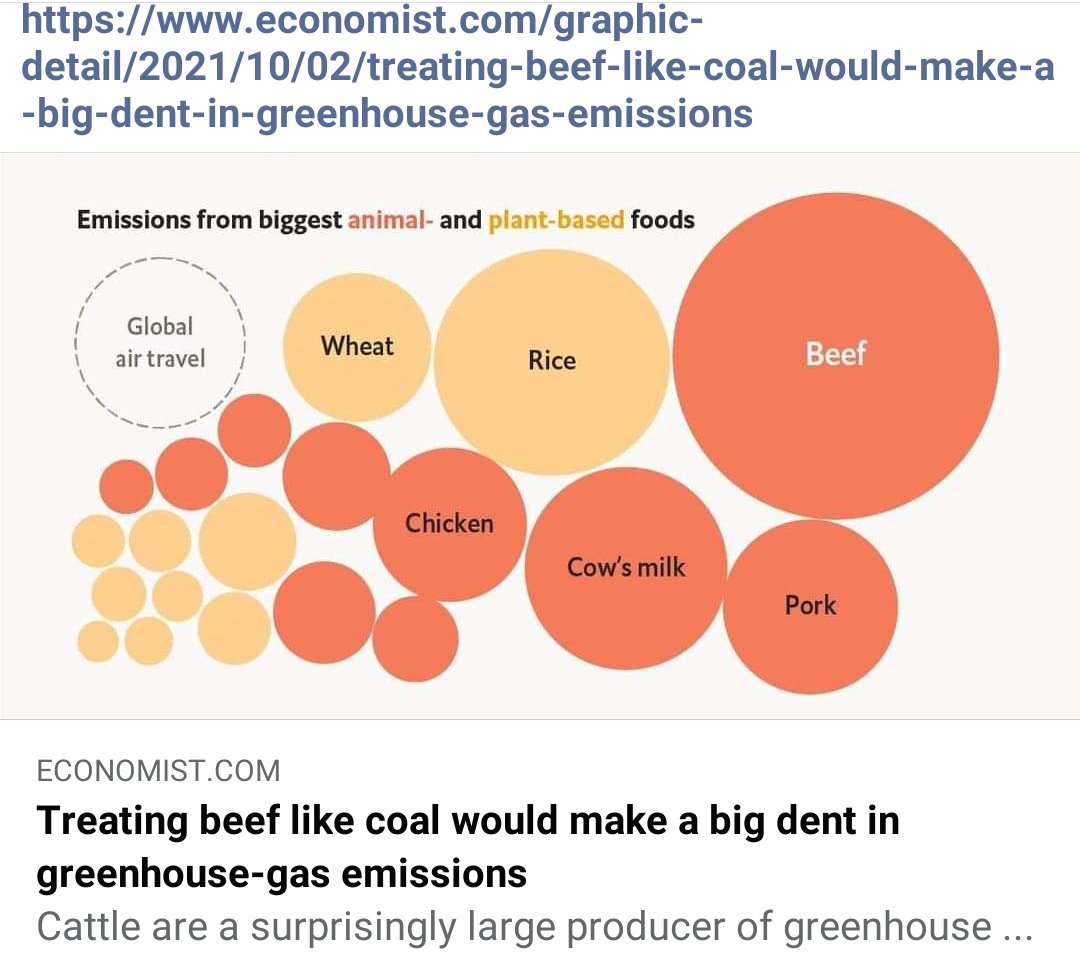
2021-11-09 Treat Beef Like Coal To Reduce GHGs

This article is behind a paywall.

https://www.economist.com/graphic-detail/2021/10/02/treating-beef-like-coal-would-make-a-big-dent-in-greenhouse-gas-emissions

Tags:
default

2021-11-09 Wind Turbine With Storage – BEST

In this video he talks about using BEST – buoyancy energy storage technology – for storage – the buoyancy of a container in a body of water. This is sort of the opposite of the pumped hydro storage. A 12 minute video.

https://youtu.be/EoBPayAyCu0

What I propose is to use a similar system as a part of an offshore wind turbine. The base of the wind turbine would have a storage reservoir to hold pressurized air. The windmill would have a crankshaft that pulls up on a long connecting rod that transfers all of the wind power to the base of the tower. The reciprocating connecting rod would be moving the air pump pistons to compress the air. The pump could have a low pressure stage and a high pressure stage. The air would displace water out of the reservoir below the water surface. The depth of the reservoir determines the pressure.

With a single connecting rod, the blades and nacelle can rotate freely around the connecting rod. The rod’s up and down motion is not dependent on the direction of the blades. It would be best to have three rods pulling every 120 degrees of blade rotation. But the mechanism becomes more complicated in order to allow the nacelle to freely rotate around to point toward the wind. There would need to be some kind of slip rings to allow free rotation around the three connecting rods.

With three rods pulling every third of a rotation, each blade would be pulling the same load. Maximum power would be transferred to the pumps. Three stages of pumps to give high pressure to the reservoir. The depth of the reservoir determines the pressure. The reservoir would be best if it was shallow and wide to minimize the difference between empty and full pressures.

default

2021-11-09 Felling Burned Out Wind Turbine

Controlled Demolition fells a ‘thermally damaged’ 2.4 MW wind turbine in Texas. Video is 2.5 minutes April 2021. Texas has 30 plus gigawatts of wind turbines.

https://youtu.be/N3lxm-l5SSY

default

2021-11-07 Wood Gasifier Runs Generator

This 17 minute video shows a homemade wood gasifier that puts out enough gas to run a small generator. This is his second version with some improvements. The gasifier can use wood chips, sawdust, leaves, paper, etc., but he is using wood pellets which are already dry.

The gasifier produces syngas when wood is pyrolyzed in a low oxygen environment.

The 12 volt blower squirrel cage fan from a car heater provides airflow. But it requires a battery and the battery must be kept charged. Maybe the generator has a 12 volt output? Or else run a 5 amp charger off the 120VAC from the generator. He injects the gas directly into the air intake of the carburetor. It needs to have a fine screen filter in front of the carburetor to prevent damage to the engine.

https://youtu.be/AyTqo4mCUUY

Another similar gasifier.

https://youtu.be/a6e3CprVTi8

default

2021-11-07 Climate Change Deniers False Narratives

Michael Peck

Gregory Stanley how climate deniers “use numbers to deceive.” This commenter would have us believe that manmade CO2 in the atmosphere is insignificant. Of course this is a absurd statement. He’s basically telling us that all the climate scientists at our national laboratories, at our research institutions, and that our private institutes, along with the thousands of scientists at the 13 US government agencies that study climate have all gotten together and decided to “use numbers to deceive you”.

Further, he’s claiming that all the scientists that work at the national laboratories and research intensive universities at every other country in the world are also in on the lie.

Rather than science finding an unintended consequence of use of fossil fuel, and doing their best to give us a warning to change our behavior before catastrophe, this commenter would like you to believe that it’s all made up.

Let’s review a little basic math and science. We can calculate the amount of man-made CO2 using high school stoichiometry. We can determine how much CO2 comes from a tank of gas or a ton of coal. We can also measure that CO2 as it’s collecting in the atmosphere. We know that since the beginning of the industrial revolution that it’s increased from about 180 ppm to about 420 ppm.

We’ve also known for about 100 years that CO2 and other greenhouse gases absorb infrared radiation. The spectrum of CO2, methane, water vapor and other greenhouse gases is published in my 1970 addition of the “handbook of chemistry and physics.”

We also can apply the first law of thermodynamics to determine the effect of IR absorption has on the Earth’s energy balance.

Most of us learn how to do all these things in our undergraduate chemistry class in college. In other words, there’s no mystery to why the earth is heating up. And the relationship to manmade greenhouse gases.

It’s unfortunate that climate science has become politicized. Climate denial has actually worked this way into the far right subcultural belief system. This is rooted in a combination of conservative politicians accepting large donations from the Koch brothers, Exxon Mobil, and the petroleum institute. Far right media, mainly Fox, routinely broadcast misinformation concerning climate science and order to maintain the conservative basis support of those lawmakers who chose to put money over our future. The Koch brothers even went so far as to pledge to finance a primary challenger against a Republican who actually acknowledged climate science.

Climate denial is about a “belief system,” not about science or fact. Although, as shown on the figure above, deniers will often use pseudoscience in an effort to recruit others into this false narrative.

default

2021-11-06 Lithium Sulfur Battery Startup Lyten

The cells will have 900 Wh/kg, more than double the li-Ion cells. Cells were tested for 1400 charge/discharge cycles. Lyten is on San Jose, CA and has been making batteries for the government, military.

https://youtu.be/9LfaIppP1Us

© RustyBolt.Info/wordpress
CyberChimps