


Peter Bergmann, A pen pal of mine from Germany, emailed this short Christmas song he made to me. With his permission, I’m uploading this to my blog. I’m not sure if I can do it, since I’ve never uploaded a video and it’s over 17 megabytes. Here goes.

2015-12-25 Joule Thief In Mainstream Media
Merry Christmas! Happy Holidays, too.
I found this article, to my surprise, in a summer issue of Pop Sci magazine. I was surprised because when it came to mainstream media, I thought that the Joule Thief was a best kept secret; hardly anyone other than ‘techies’ knew about it. But here’s proof otherwise.
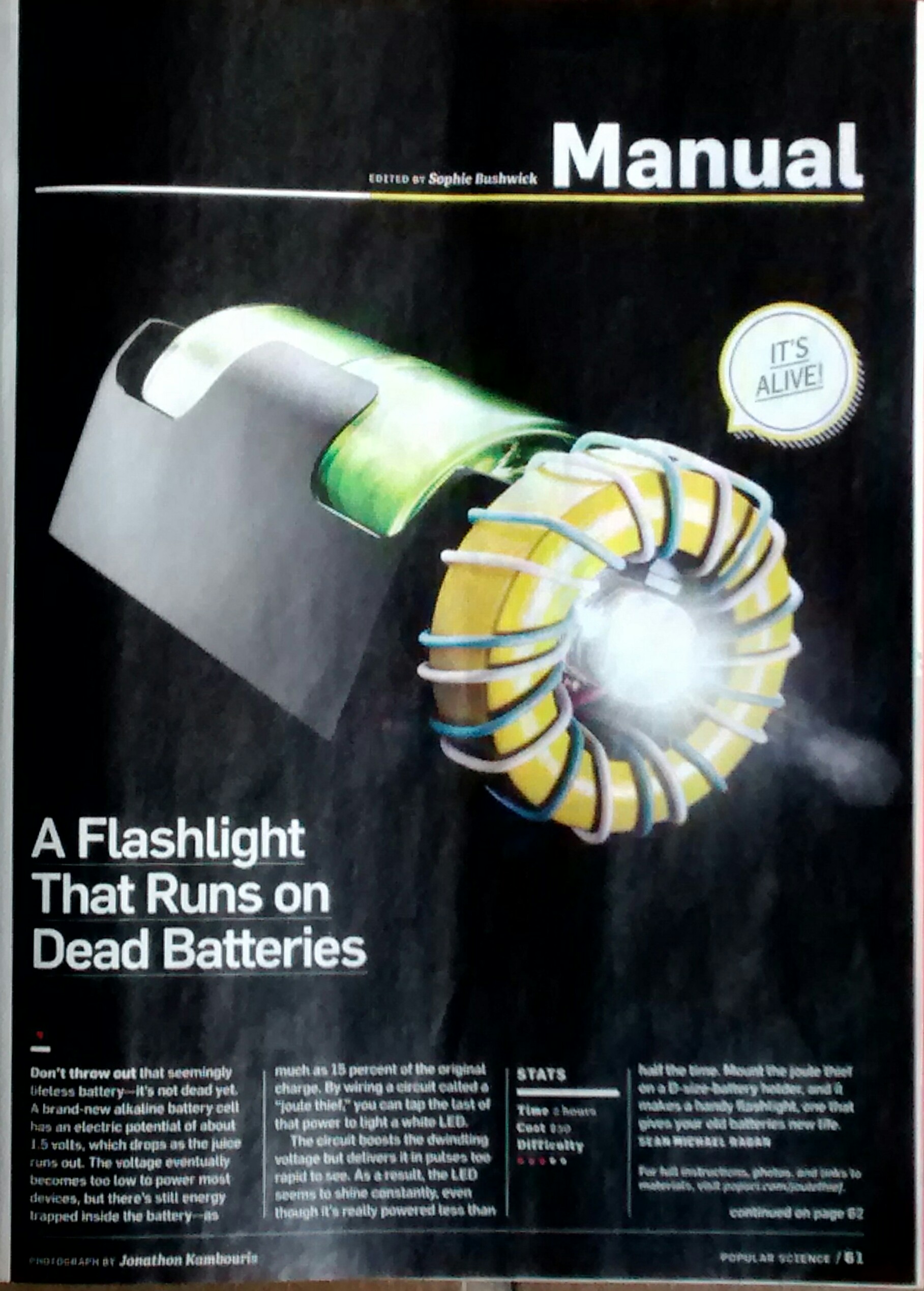
I think that they should have used an AA cell, which is much more common. But at least it’s being published in a magazine with a reasonably large audience.
The article says the project is at http://www.popsci.com/joulethief but I haven’t seen it yet.


2015-12-16 JFET Joule Thief
I captured this off a video and tried to make it a bit more readable. I think it was from Sanjev.
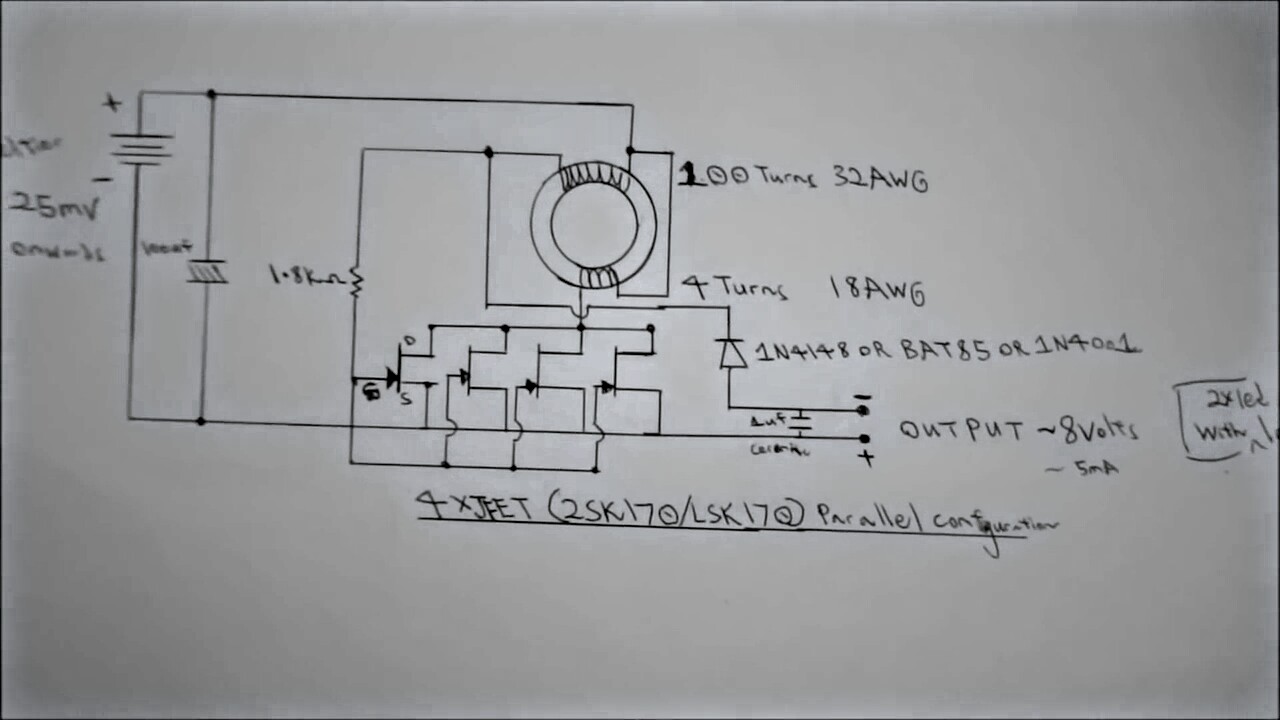
I built it and it does work at 40 millivolts. The 2SK170 JFETs are not common, and may be difficult to obtain. Other JFETs can be used, but I haven’t tried them. I wrote about this in the updates in a previous blog. The reason there are so many turns on the feedback winding is the input voltage is very low, and the JFET’s gate is controlled by voltage, not current like a regular BJT transistor.
2015-12-11 Legacy Direct Himedia IPTV Box
Last night I attended a demonstration of the Legacy Direct BeyondTV streaming IPTV ‘system’ which apparently uses a Himedia box. The Legacy Direct company charges $400.00 for the system, and is sold by MLM (multi level marketing) methods.
According to some (this discussion says it all), it uses a Himedia box, which has a quad core processor and Android KitKat OS, among other things. The software apparently is free Kodi software customized to show the LD logo.
This box competes with Roku, Fire Stick, Apple TV, etc. It has an advantage: it is not limited to commercial TV content. It can stream any content, which includes pirated or illegal content such as FREE Netflix or pay per view.
The two concerns that I have is that it can be used to stream pirated TV content, which means that, besides it being illegal, it could be shut down at any time. And that it is sold by multi level marketing, which means that someone downstream loses money in order to pay the upstream supplier. After a number of complaints to authorities, the company is faced with legal action, which is what happened to Amway – they had to pay $150 million dollars US to settle a class action lawsuit.
2015-11-30 Low Power Joule Thief With Daylight Shutoff
This has been blogged, here and here. I added a CdS photocell (resistor with a circle around it) to shut it off during daylight, thus conserving the AAA cell. I used a 100k resistor for the base bias, so it draws very low current from the cell. I can then call this a low power Joule Thief.
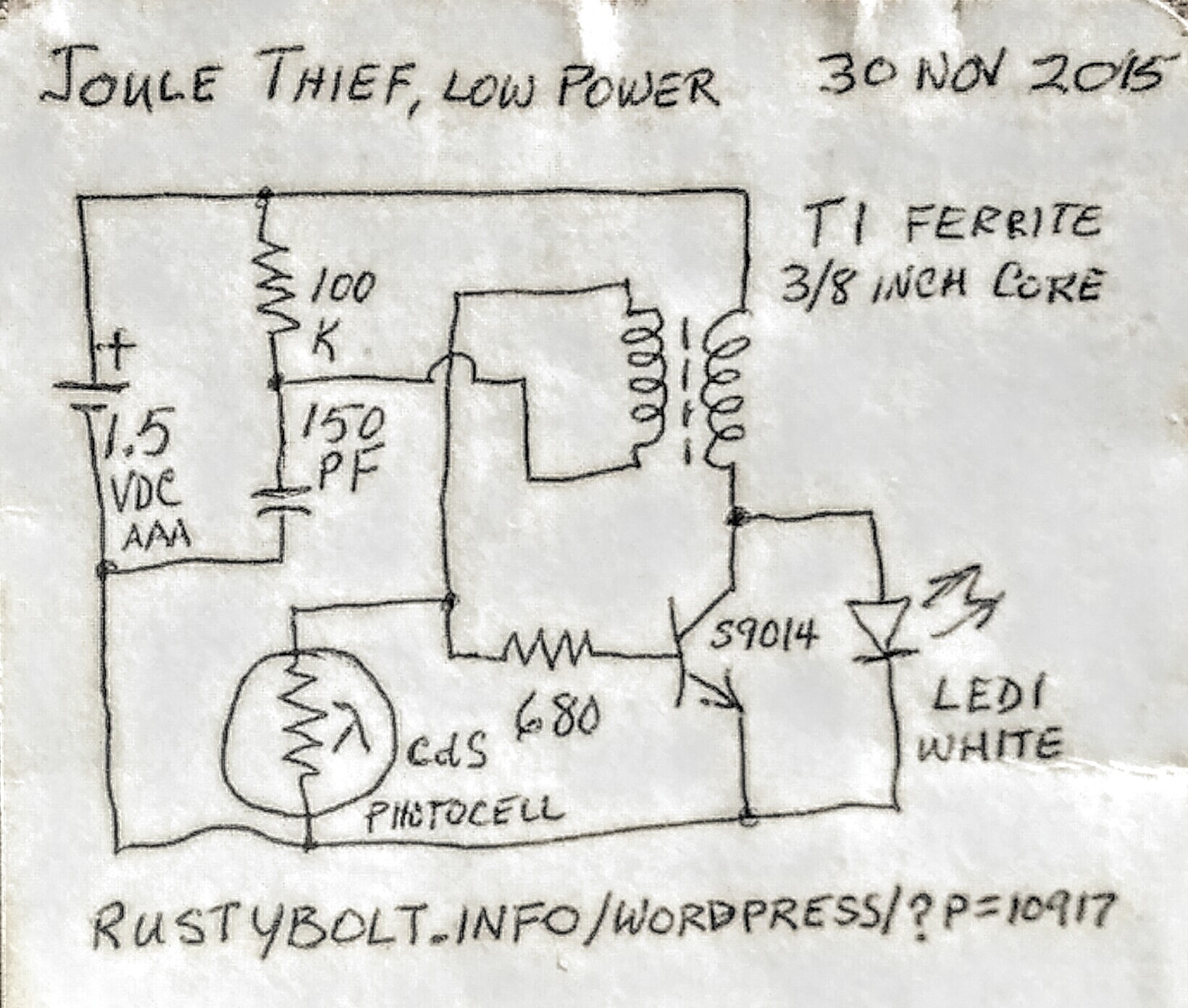
The T1 ferrite toroid core is 3/8 inch or 9 mm O.D. with about twenty turns of 30 AWG wire for both the primary and secondary windings. The 150 pF capacitor bypasses the secondary winding so the high value of the 100 k resistor doesn’t reduce the feedback. The typical value for a Joule Thief is 1k.
The “high energy” aka zinc carbon AAA battery I’m using has dropped below 1.25 volts, so it doesn’t have much life left. The circuit has a lot of hysteresis. The LED will stay on until the photocell gets well lit, then it will turn off. Then to turn back on, the light has to get quite a bit dimmer than it was to turn off. The hysteresis seems to be greater than when I started, possibly because the cell voltage has dropped.
The transistor is S9014 D, which is similar to a 2N3904 or BC547, but the D on the end means it is very high gain, 600 to 1000. This is why the LED is bright even though the base resistor is 100k. A 2N3904 would put out less current to the LED with that resistor, or the resistor would have to be lowered to about 33k to get the same LED current.
2015-11-28 Recharging From Used Alkalines
I have often seen schematics of Joule Thief chargers for use in charging Ni-MH rechargeables from used alkaline cells. The idea is to boost the voltage of the used alkaline cell up to high enough to get current the flow into the Ni-MH cell. One setback is that conventional JTs are only 50% efficient, so half the power is lost in the conversion. That’s very wasteful and there should be some other way to solve the problem.
One way is to change the JT to my Supercharged Joule Thief circuit. This increases the efficiency to 70 to 80%. That’s a substantial gain, but why do we need a JT to begin with, if the voltage of the alkaline is higher? We can connect the alkaline to the Ni-MH, positive to positive and negative to negative, and current should flow, with no external losses at all.
But eventually the alkaline will eventually be depleted and the voltage will drop to the same as the Ni-MH. The current will drop to zero, and eventually will go negative as the alkaline cell takes charge from the Ni-MH cell. This is the time when they should be disconnected. The problem is how to do this automatically, without human intervention.
One simple way is to use a diode between the two cells. The cathode or banded end will go to the Ni-MH cell. We can’t use a regular diode. A regular diode has a forward drop of .5 or more volt, which is too much, and will stop any current from flowing. A Schottky diode such as the 1N5817 will be much better, with about .25 volt drop, and will let some current flow, but will still leave charge in the alkaline cell.
A better solution, I think is to put two alkaline cells in series. First, connect the two alkalines, one at a time, until each has discharged most of its charge into the Ni-MH cell. Then connect the two alkalines in series until they are discharged.
Again the problem is how to determine when the alkaline cells have given up most of their charge. In the case of the two alkalines in series, again a Schottky diode can be used with minimal loss. A higher current Schottky diode can be used, such as the 1N5820, which is 3 amps, or even higher current if you can find a cheap one.
An ‘ideal diode’ with no voltage drop would be even better. I’ve been thinking about how to control a reed relay, with a coil of low resistance and low voltage drop, so that it will act like a diode. The major problem is that any circuit is going to waste some power and reduce the efficiency. My Supercharged Joule Thief with the diode on the output may be the best solution, given its simplicity.
I would like to hear from anyone who has an idea how to make a magnet close the reed relay, and then using the coil, keep it closed until the current gets low. I think that this is at least one way to get the job done.
2015-11-24 AT&T or at&t Article
The day after tomorrow is turkey day, and I have been trying to read some online things but I keep getting distracted.
One article I found on Investopedia is about at&t, as its logo is now spelled, but was known as AT&T for more than a century. The article gives a bit of at&t’s history as it quickly skips by many important setbacks. The article fails to mention the first antitrust action the government took against AT&T in 1949. Then in 1947 when the transistor was invented, Ma Bell could have had a monopoly on this patented groundbreaking device, but due to its concern about another government intervention, decided to license the transistor to any company for a relatively small fee. If it wasn’t for this, all of the technology that has made today’s computers possible would have been set back for decades.
Another AT&T setback was the Carterfone decision. This allowed other companies to connect equipment to AT&T telephone lines without AT&T’s equipment and subsequent high rental costs. That is how the personal computer modems became usable on the telephone network. Before this they were not allowed.
But the major financial setback was when AT&T had to declare bankruptcy as its long term debts and old, outdated technology weighed it down. After that, SBC got its assets and name, to become what it is today.
The last paragraph says:
” The Bottom Line
AT&T has enjoyed one of the most successful runs in the history of American business, yet still manages to stay technologically up-to-date, relevant and vital. That’s tough for any company to pull off, but any one that does can assure itself of huge profits for the foreseeable future.”
I worked as a computer and telephone technician for decades and almost all of that time our college was a customer of AT&T and/or one of its baby bells. I know from experience that it is tough when a public agency has to deal with a single vendor with no competition. The adversities that Ma Bell had to go through have allowed us to have the electronics and networks that allow us to do so many things today.
2015-11-18 Flashlights Continued
After the 2015-10-26 blog, I searched for some other websites selling small flashlights and ended up at dxsoul.com, which is a part of Deal Extreme, DX.com. I also found some reviews of other, cheaper flashlights, two of which were the Brinyte and the Tank007.
On dx.com I found and ordered the the package called ‘Mini flashlight’, SKU 32945 at DX.com. This package contained a flashlight labeled Brynite PD03A and it was colored red. On the outside this looks almost identical to the Fenix LD01, which is a very good flashlight. The price was cheaper, $16.75 US. It has 5 modes: Low, Medium, High, Fast Flash, and SOS in Morse Code. The reflector is smooth (not orange peel) so the beam pattern is tight.
Oddly, the blister package had a blister for a AAA cell, but it was empty. I’ve been to the post office recently and I’ve seen a sign that you’re not allowed to ship lithium batteries in the mail. But generally, the flashlights come with an alkaline battery and I don’t believe there are any restrictions on shipping those. They may have used a generic package since there was nothing in the description that a battery was included. The specifications say that this will also take a 10440 size lithium rechargeable battery, which should last longer than an alkaline cell.
I also found the Tank007 flashlights. When I have searched for certain lights, I have seen reviews of some lights, sometimes on a forum called Budget Light Forum. These reviews are much more reliable than the ‘5 star’ reviews on Amazon, eBay, etc. which in my opinion are often distorted by fake 5 star reviews. This problem has recently been brought to light by the media and consumer advocates. If a product has a low price and ‘great’ reviews, it is probably not as good as the reviews say it is.
I have also seen some cheaper flashlights on DX.com; I call them “low end” because they may cost only $4 to $6, but they are made cheaply and don’t have the quality and reliability of the name brand lights. I have found that they often get loose and the light becomes intermittent, or they don’t work after being dropped. I avoid buying them, but I may buy one to see how well they are made.
A few years ago I bought some flashlights (may have been from Deal Extreme) which used CR123 or RCR123 cells. I got some cheap CR123 cells and RCR123 rechargeable cells at the same time. I used up the CR123s and then used the rechargeables, but they didn’t last long. The cost of both the CR and RCR123 cells online were high, and at local stores the CR123 cells were ridiculously expensive, if you could find one. So I quit using those lights.
I have used the NiMH rechargeables for a long time, but in flashlights that are occasionally used, I’ve found that when I used them, the NiMH cells have lost most of their charge and don’t last long. I had some Rayovac hybrid NiMH cells, and they lasted somewhat longer. Recently I talked to a guy at our computer club and he said he bought some Eneloop NiMH rechargeables and left them sitting for 6 months, and when he tested them they still had 80% of their charge. He recommended them, so I recently bought a package. They are not cheap, about $3 to $4 each depending on quantity. Sanyo was the original manufacturer, but they sold this business to Panasonic, so if you buy Sanyo, it might be new old stock. If you decide to buy some, it’s best to read the information on them because there are different types, capacities and versions.
I bought some of the BK3MCC and BK4MCC cells. So far, these Eneloop cells are holding up well. In the past I have had alkaline cells get a few years old and leak juice all over inside the flashlights, and soon after the aluminum corrodes and the light is ruined. I have had better results with the NiMH cells, which seldom leak. But as I’ve said, they don’t stay charged. With the Eneloops, I may have both problems solved. But it may take a few years of actual use to find out.
While I was on Deal Extreme I saw something interesting. They sell a flashlight ‘head’ that puts out 800 lumens – that’s bright! This head has a ‘510’ screw on connector that fits onto an e-cigarette battery. So I ordered it and a week or so later when it arrived I got online and looked for a battery. I found these come in all sorts of different sizes and capacities. Being new to this technology, I also didn’t know that these batteries have quirks for e-cigs built into them. I finally decided to order the Tesla T2 mod, which is about 4000 mAH. It came from a local shop in 2 days. The Tesla does not come with a USB charger or cable, so I had to use a spare one I had.
The Tesla powers the very bright 800 lumen head adequately. However there were some gotchas that were built into the Tesla. One is that the timer times out after 10 seconds, which makes sense if you’re vaping, but not if you’re using it for a flashlight. Another is that Tesla tried to do too many things with a single pushbutton switch and red and blue LEDs. Without the instruction manual, most people would be unable to use the Tesla, because almost no one would be able to guess that it takes FIVE rapid presses of the button to turn it on. The same issue goes for the other modes, and the instructions are not very clear about them. I’m going to take a photo of the itty bitty manual so that I still have something if the manual gets misplaced. I didn’t see any web site in the instructions.
A few days after I bought the head, the e-cigarette became a major story in the news. Very recently there have been multiple lawsuits filed in court by people seriously injured by exploding e-cigarettes. The battery is usually what explodes, with some people receiving serious facial injuries. If I had known about this before, I would not have bought the flashlight head. But several people have told me that the light is extremely bright. I pointed it down the street and they said it was like a headlight on a car. 800 lumens is about what a 60 watt incandescent light, or a 10 watt LED light puts out. But bulbs put out the light in all directions; this head has a fairly wide beam but it’s pointed in one direction. I accidentally looked right at it and I had a big spot in my eyes for at least a minute!
2015-11-12 Pedal Power Your Home
I have been into this kind of stuff for quite a while. You can search my blog for more on this. It’s difficult for even the strongest of bicyclists to put out 100 watts for a few minutes, let alone an hour. Assuming that a person could pedal a 100% efficient 50 watts for an hour, that would be 50 watt hours. That would be enough to power a 1000 watt toaster for 1/20 hour or 3 minutes, with nothing left for anything else in the home. This does not even come close to powering a washing machine. It might power a few 10 watt LED lights for an hour or two. It seems to me that it will take a lot more than an hour of pedaling to get the house powered for a day. And that assumes the pedal power is stored in a battery for use later.
Pedal power is very useful for charging batteries and cell phones. It’s a good way to burn calories, too. A home power system might consist of two 12 volt deep discharge batteries, a solar panel and a pedal generator to charge the batteries, and an inverter.
The inverter converts the battery voltage to 120 VAC, 60 Hz or whatever is standard in your country. The capacity of the inverter depends on the appliances that you want to run. For a few lights and small appliances, a 500 or 600 watt inverter might be adequate. you will have to determine what the highest wattage appliance is and add more watts for a margin of safety.
The batteries can be connected in series or parallel. Typically batteries are connected in series, two would give 24 volts. This saves on copper wire and other equipment such as relays, switches, connectors. But the inverter’s input has to be rated for 24 volts DC.
If you connect two or more batteries in parallel, you may have problems if the batteries are mismatched. More about this here.
Or the batteries may need to be connected with a pair of high current diodes mounted on a heat sink. These are used in RVs and portable systems. These diodes must be able to handle very high current, possibly a hundred amps depending on your inverter current. You can read about this here.
If you want a system that can handle more than a thousand watts, it may be cheaper to buy a generator that runs with gasoline. They can be found from a thousand watts to several thousand watts for a relatively inexpensive price.
Pedal power has a place in generating renewable energy, but it probably is not enough to power a home. It is definitely useful for emergency situations where all you have is a strong pair of legs.
2015-10-30 LED Nightlights Are Poor Design
I found these at a Walmart store. They’re named Great Value and came in a package of four nightlights. As usual, curiosity made me open it up to see the circuit inside.
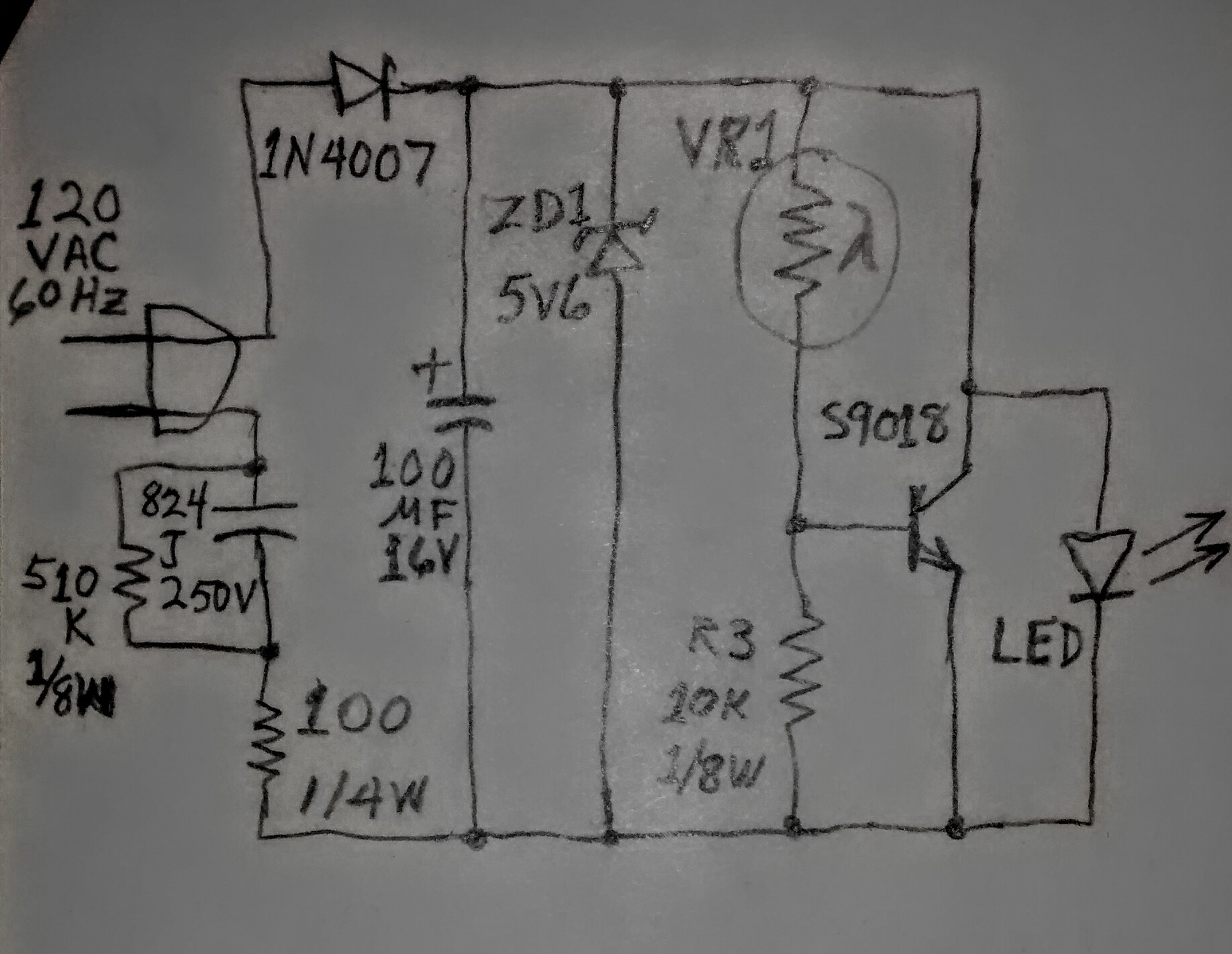
I traced the circuit and drew a schematic of it. I was disappointed, but not surprised. The way the CdS photocell works is not what I had hoped for. In the daytime, light hitting the photocell reduces its resistance. The increased current through the photocell turns the transistor on, and the current through the LED instead goes through the transistor, and the LED goes dark.
The point is that this does not save power by turning the LED off and reducing the current. Instead the current from the AC line actually increases slightly while it’s ‘off’ So the nightlight is using the same or more power when the LED is not on. This won’t get an Energy Star efficiency rating, and I give it a poor design rating.
I will say a good thing or two about it. It uses a half watt, which is much less than the 7 watt incandescent nightlight. And because it is a LED, it will last much longer – several years – than the incandescent light. It should more than pay for itself in electricity savings over its lifetime. But it could save much more electricity if it shut completely off instead of shorting out the LED. Another thing is it was inexpensive; four lights for under five dollars.
I also noticed that when I moved my hand in the light, I got the strobe effect of the LED turning on and off at 60 Hz. The circuit schematic shows a 100 uF capacitor that is supposed to filter out the AC, but it is far from adequate to do the job. It would have to be ten times more capacitance to do the job.
Several years ago I traced the circuit of another LED nightlight. It used a photocell and a 555 chip as a comparator, to shut off current to the LED. My guess was that the 555 used a lot of power, perhaps as much as the LED, which used only 20 mA at 3.3 volts, or 66 mW.
One other thought. Why bother to shut off the LED in the daytime? Just let it run all the time and save money by leaving out the parts.
I could remove the photocell, the transistor and the 10k resistor, and it will still work just fine, but it won’t go off during the daytime. That would be okay with me. There may be someone who wants a 5mm diameter photocell, 10k, 1/8W resistor and S9014 NPN transistor for a project, and can remove them without disabling the nightlight.
Update Nov 17 – I opened one up and unsoldered the photocell, now it doesn’t turn off in the daytime, which is what I want it to do. It is going in a light fixture along with a string of lights so th e other lights will no longer cause the photocell to turn off the nightlight. The whole circuit is on a light switch so daylight is not an issue.
On second thought, the circuit does have one positive use. It disables the LED during the daytime, and reduces the time the LED is on, which increases the night light’s longevity, the number of years that it will put out adequate light. The LED’s output diminishes over time: after thousands of hours the LED’s light output slowly drops and eventually the LED becomes too dim to be useful. Not leaving it running all day extends the night light’s lifetime.
One other thing I should mention (I have blogged this in the past) is that devices like this should use a capacitor that is X2 rated. The 0.82 uF (824J) capacitor is not rated X2. Sometimes a capacitor connected to the AC line will get a high voltage spike, and this causes an arc in the dielectric. A regular capacitor may short, causing overheating and a fire. X2 capacitors are made to arc without causing a short, and without overheating or fire. These X2 caps are used in the power supplies of computers and most digital equipment.
