default

2016-12-05 Regenerative Receiver

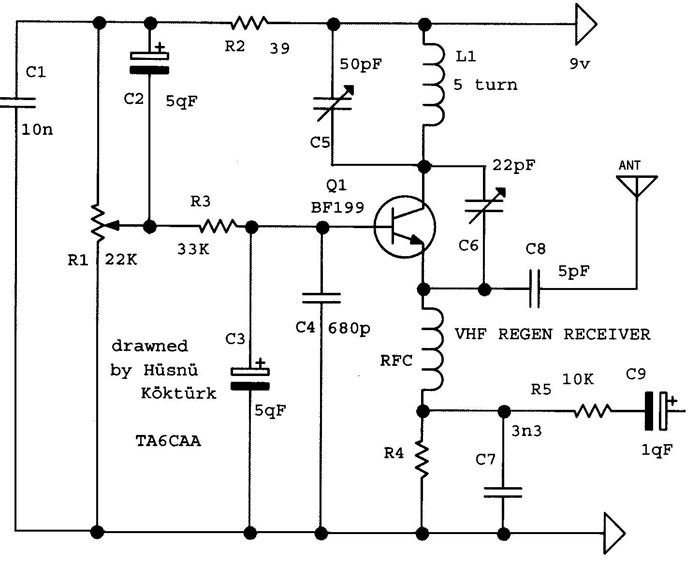
After I unsoldered the parts from my failed ‘noisy regenerative receiver’ circuit, I decided to build a more conventional regenerative receiver, one that uses a single transistor for the regenerative stage. I chose the circuit from a website that I had found, and saved the schematic. But I forgot to document the URL of the website. So I’ve attached the schematic which has the author’s name and ham call letters to identify it.

image

I used the following values for the parts.

C1 100 nF
C2 not used
C3 4.7 uF
C4 1000 pF
C5 27 pF fixed, 4 to 14 pF var. cap in parallel.
C6 25 pF mica variable capacitor
C7 two 2.2 nF in parallel.
C8 5 pF variable capacitor set to max
C9 not needed, already in the audio amp

R1 10k, 25 turn trimpot
R2 0 ohms (not used)
R3 44k – two 22k in series
R4 no value given, used 1k in series with a 5k pot, giving 1k to 6k
R5 10k

L1 14 turns 20 AWG on 3/8 in. diam. wood dowel – about 0.8 uH.
RFC1 33 uH RF bead with several turns threaded through the center hole
Q1 I used a C9018 VHF transistor.

I reused my amplifier and earphone from the nonworking regenerative receiver. The supply is a three AA cell holder, so fresh cells will give a bit more than 4.5 volts.

I got noise from the regenerative circuit as soon as I powered it up. With a little tweaking, I tuned it, and got noise but received no communications. I did hear bursts of RF coming from my cell phone. The antenna is only about 7 inches long. I think the receiving frequency is not in the CB band. My dip meter showed the coil as resonating at about 27 MHz. I guess I’ll have to make a transmitter that puts out a known frequency in the 27 MHz band. I looked for some schematics of VFOs that hams build and I found one that is supposed to be very stable if it is built properly.

Update Dec 7 – I mounted most of the pieces on a piece of plywood, and put a piece of sheet metal on it for a front panel. I got the Batteries, audio amp and volume pot mounted. I drilled a hole in the plywood that is the size of the dowel that holds the coil, and I can press the dowel into the hole so that it fits snugly. I have to rearrange some of the parts so they aren’t in the way. The RF part is sensitive to movement, so this ‘breadboard’ should help a lot in making it more stable. I measured the total battery drain at about 2.5 mA.

I changed the fixed resistor R4 to 1k and a 5k pot in series and mounted the pot on the front panel. I get hiss, but I still haven’t received any signals. After adjustments my dip meter said the coil was resonating at about 27 MHz, but the meter isn’t accurate and is probably off a bit. When the dip meter is on, it quiets the hiss, so I guess that means the regenerative circuit is doing something.

I have been looking at other regen schematics, and I found that the ones that use a JFET do not need a diode detector, but the others that use a BJT have a diode as the detector. Except for the one I’m experimenting with, which is missing the diode. I think I’m going to have to add a diode somewhere, and I’ll have to do some experimenting to find out where.

Update 2017-01-22 I’m building another FM regenerative receiver, see here.

default

2016-12-01 NEJM Antivaccine Article

Whole article from
https://web.archive.org/web/20140423082318/http://www.nejm.org/doi/full/10.1056/NEJMp1010594

***Begin quote***:
“Perspective

The Age-Old Struggle against the Antivaccinationists

Gregory A. Poland, M.D., and Robert M. Jacobson, M.D.

N Engl J Med 2011; 364:97-99January 13, 2011DOI: 10.1056/NEJMp1010594

Share:

ArticleReferencesCiting Articles (41)

Since the introduction of the first vaccine, there has been opposition to vaccination. In the 19th century, despite clear evidence of benefit, routine inoculation with cowpox to protect people against smallpox was hindered by a burgeoning antivaccination movement. The result was ongoing smallpox outbreaks and needless deaths. In 1910, Sir William Osler publicly expressed his frustration with the irrationality of the antivaccinationists by offering to take 10 vaccinated and 10 unvaccinated people with him into the next severe smallpox epidemic, to care for the latter when they inevitably succumbed to the disease, and ultimately to arrange for the funerals of those among them who would die (see the Medical Notes section of the Dec. 22, 1910, issue of the Journal). A century later, smallpox has been eradicated through vaccination, but we are still contending with antivaccinationists.

The Cow Pock — or — the Wonderful Effects of the New Inoculation.

Since the 18th century, fear and mistrust have arisen every time a new vaccine has been introduced. Antivaccine thinking receded in importance between the 1940s and the early 1980s because of three trends: a boom in vaccine science, discovery, and manufacture; public awareness of widespread outbreaks of infectious diseases (measles, mumps, rubella, pertussis, polio, and others) and the desire to protect children from these highly prevalent ills; and a baby boom, accompanied by increasing levels of education and wealth. These events led to public acceptance of vaccines and their use, which resulted in significant decreases in disease outbreaks, illnesses, and deaths. This golden age was relatively short-lived, however. With fewer highly visible outbreaks of infectious disease threatening the public, more vaccines being developed and added to the vaccine schedule, and the media permitting widespread dissemination of poor science and anecdotal claims of harm from vaccines, antivaccine thinking began flourishing once again in the 1970s.1

Little has changed since that time, although now the antivaccinationists’ media of choice are typically television and the Internet, including its social media outlets, which are used to sway public opinion and distract attention from scientific evidence. A 1982 television program on diphtheria–pertussis–tetanus (DPT) vaccination entitled “DPT: Vaccine Roulette” led to a national debate on the use of the vaccine, focused on a litany of unproven claims against it. Many countries dropped their programs of universal DPT vaccination in the face of public protests after a period in which pertussis had been well controlled through vaccination2 — the public had become complacent about the risks of the disease and focused on adverse events purportedly associated with vaccination. Countries that dropped routine pertussis vaccination in the 1970s and 1980s then suffered 10 to 100 times the pertussis incidence of countries that maintained high immunization rates; ultimately, the countries that had eliminated their pertussis vaccination programs reinstated them.2 In the United States, vaccine manufacturers faced an onslaught of lawsuits, which led the majority of them to cease vaccine production. These losses prompted the development of new programs, such as the Vaccine Injury Compensation Program (VICP), in an attempt to keep manufacturers in the U.S. market.

The 1998 publication of an article, recently retracted by the Lancet, by Wakefield et al.3created a worldwide controversy over the measles–mumps–rubella (MMR) vaccine by claiming that it played a causative role in autism. This claim led to decreased use of MMR vaccine in Britain, Ireland, the United States, and other countries. Ireland, in particular, experienced measles outbreaks in which there were more than 300 cases, 100 hospitalizations, and 3 deaths.4

Today, the spectrum of antivaccinationists ranges from people who are simply ignorant about science (or “innumerate” — unable to understand and incorporate concepts of risk and probability into science-grounded decision making) to a radical fringe element who use deliberate mistruths, intimidation, falsified data, and threats of violence in efforts to prevent the use of vaccines and to silence critics. Antivaccinationists tend toward complete mistrust of government and manufacturers, conspiratorial thinking, denialism, low cognitive complexity in thinking patterns, reasoning flaws, and a habit of substituting emotional anecdotes for data.5Their efforts have had disruptive and costly effects, including damage to individual and community well-being from outbreaks of previously controlled diseases, withdrawal of vaccine manufacturers from the market, compromising of national security (in the case of anthrax and smallpox vaccines), and lost productivity.2

The H1N1 influenza pandemic of 2009 and 2010 revealed a strong public fear of vaccination, stoked by antivaccinationists. In the United States, 70 million doses of vaccine were wasted, although there was no evidence of harm from vaccination. Meanwhile, even though more than a dozen studies have demonstrated an absence of harm from MMR vaccination, Wakefield and his supporters continue to steer the public away from the vaccine. As a result, a generation of parents and their children have grown up afraid of vaccines, and the resulting outbreaks of measles and mumps have damaged and destroyed young lives. The reemergence of other previously controlled diseases has led to hospitalizations, missed days of school and work, medical complications, societal disruptions, and deaths. The worst pertussis outbreaks in the past 50 years are now occurring in California, where 10 deaths have already been reported among infants and young children.

In the face of such a legacy, what can we do to hasten the funeral of antivaccination campaigns? First, we must continue to fund and publish high-quality studies to investigate concerns about vaccine safety. Second, we must maintain, if not improve, monitoring programs, such as the Vaccine Adverse Events Reporting System (VAERS) and the Clinical Immunization Safety Assessment Network, to ensure coverage of real but rare adverse events that may be related to vaccination, and we should expand the VAERS to make compensation available to anyone, regardless of age, who is legitimately injured by a vaccine. Third, we must teach health care professionals, parents, and patients how to counter antivaccinationists’ false and injurious claims. The scientific method must inform evidence-based decision making and a numerate society if good public policy decisions are to be made and the public health held safe. Syncretism between the scientific method and unorthodox medicine can be dangerous.

Fourth, we must enhance public education and public persuasion. Patients and parents are seeking to balance risks and benefits. This process must start with increasing scientific literacy at all levels of education. In addition, public–private partnerships of scientists and physicians could be developed to make accurate vaccine information accessible to the public in multiple languages, on a range of reading levels, and through various media. We must counter misinformation where it is transmitted and consider using legal remedies when appropriate.

The diseases that we now seek to prevent with vaccination pose far less risk to antivaccinationists than smallpox did through the early 1900s. Unfortunately, this means that they can continue to disseminate false science without much personal risk, while putting children, the elderly, and the frail in harm’s way. We can propose no Oslerian challenge to demonstrate our point but have instead a story of science and contrasting worldviews: on the one hand, a long history of stunning triumphs, such as the eradication of smallpox and control of many epidemic diseases that had previously maimed and killed millions of people; on the other hand, the reality that none of the antivaccinationists’ claims of widespread injury from vaccines have withstood the tests of time and science. We believe that antivaccinationists have done significant harm to the public health. Ultimately, society must recognize that science is not a democracy in which the side with the most votes or the loudest voices gets to decide what is right.

Disclosure forms provided by the authors are available with the full text of this article at NEJM.org.

SOURCE INFORMATION

From the Mayo Clinic Vaccine Research Group (G.A.P., R.M.J.), the Department of Medicine (G.A.P.), and the Department of Pediatric and Adolescent Medicine (G.A.P., R.M.J.), Mayo Clinic, Rochester, MN.”
***End quote***

default

2016-11-25 Screw Hole Photo

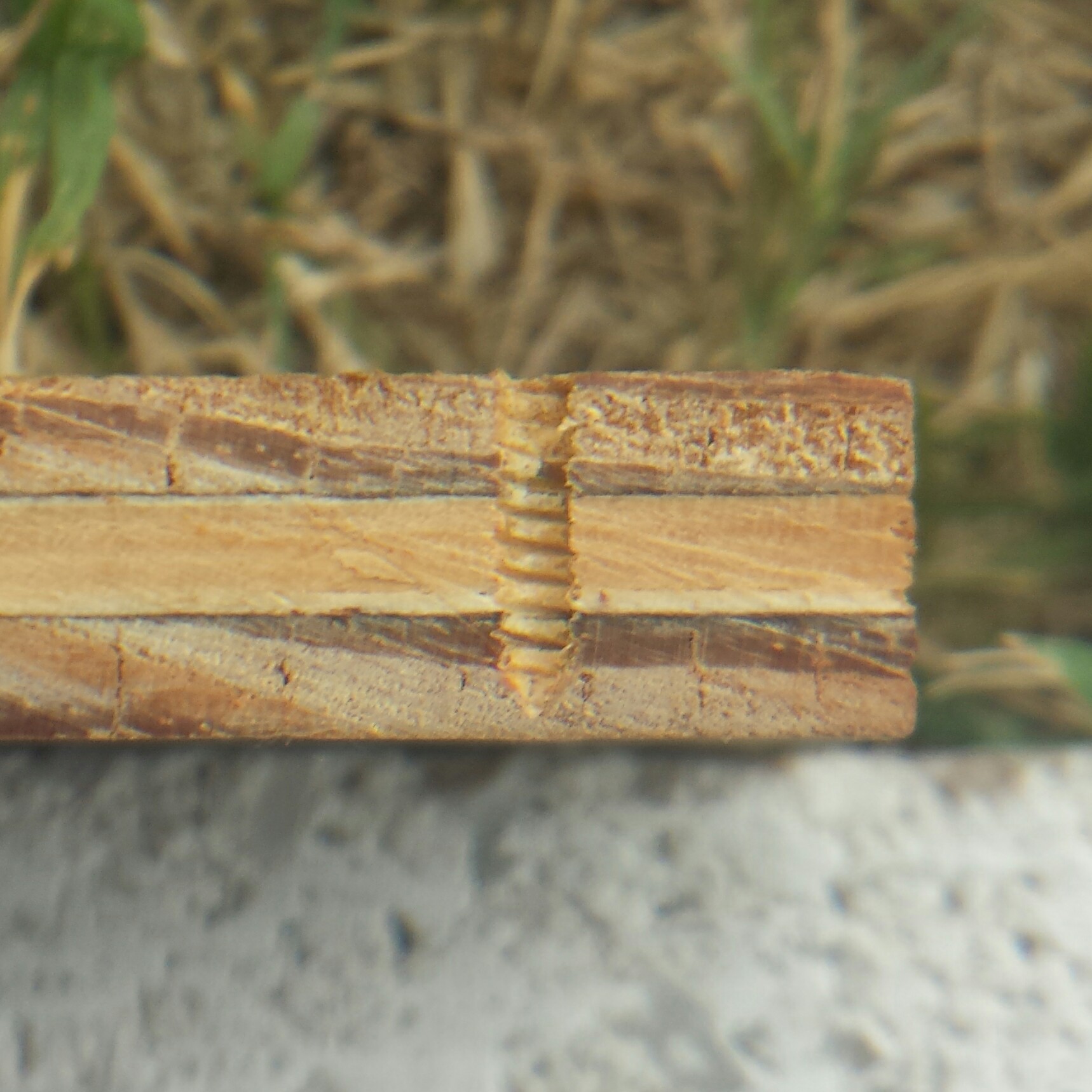
I cut a piece of plywood and very neatly exposed a screw hole, and I thought it would make an interesting photo. The screw was small, a #4 sheet metal screw about a half inch long. I had to used a magnifying glass lens to get a closeup.

image

default

2016-11-22 Coil of Wire Is Air Core Inductor

I bought two of these ‘roll of wire’ on sale at goldmine-elec.com.  They came with the wire ends on the same end of the reel, the start end was sticking out of a hole and standing straight out, and the end of the wire was held to the reel with tape, exactly half way around the reel, diametrically opposite from the start.  It was obvious that these were meant to be inserted into a circuit board.

I measured both of them with my LC meter, and both measured about 0.93 millihenrys.  My meter tends to be off a bit in the millihenry ranges, so I will round off these to 1 millihenry each.

The core of these inductors is air, which cannot saturate like a ferrite or other magnetic core.  This type of inductor is most often used for crossover netwotks for speakers.  Since a speaker may have to handle high power, tens of watts or more, the crossover network’s inductors must be able to handle high power, using heavy wire and an air core to prevent saturation.  So I believe these ‘coils of wire’ were originally made for a speaker crossover network.

default

2016-11-21 Goldmine Giant TO92 Semiconductor Asstmt G21402

I got a few of these just to satisfy my curiosity, and to waste ten bucks each and waste time sorting the transistors into piles of the same number.

My general observations
Most of the datasheets for these transistors can be found online.
Most of the transistors are PNP.  I got several dozen, maybe a hundred of the 2N6726, which is a PNP high current 2 amp moderate gain BJT (bipolar junction transistor).  This and its NPN complement might make a good headphone amplifier.

I got a few dozen of the MPSW92, a 300 volt, 1 watt BJT in a lengthened TO92 case.  This might be good for a low power SMPS type converter / AC adapter. It’s not a general purpose transistor. Along with these I got a dozen or so MPSA92 transistors, which seem to be the same but in the standard TO92 package so they handle less power.

I got a few dozen MPSA63 PNP Darlington BJTs. I seldom use Darlington transistors, but if I need one I can connect two regular transistors to make one. Darlington transistors are not useful for low voltage circuits such as a Joule Thief.

I got a dozen or so PN2907 or PN2907A PNP general purpose BJTs. These are common and very useful, if you need a PNP. They are the complement to the ever popular PN2222.

I got a few dozen of the PN4124, which is a lower voltage version of the most popular 2N3904. Along with these I got just a few of the 2N4125, the lower voltage, lower gain version of the popular 2N3906 PNP BJT.

I got over a dozen of 2N5087 high gain, low noise PNP BJTs. Their maximum current is only 50 mA. They might be good for a microphone preamplifier.

I got quite a few 2N5222 BJTs. These low current, low power BJTs are for VHF Radio Frequency circuits up to 200 MHz.

The 2N5818 NPN BJTs in the assortment are NPN general purpose, and look like they might be good for a Joule Thief. But there were only a few of them.

I got a few BC368 BJTs. One box had 1 BC369, which is the PNP compliment of the BC368. Both would make a good choice for a Joule Thief – they can handle up to 1 amp current.

I got a few of 2SC1213 Hitachi transistors. These could be used for a Joule Thief, but they have the odd Japanese pinout, which puts the collector lead in the center. If you put this BJT into a PC board made for E B C, the collector has to cross over the other lead. This means an insulated sleeve has to be put on the collector lead to prevent it from contacting and shorting out to the other lead.

There were several other types of transistors but there were only one or a few in each package and not worth talking about. Many of the transistors came on tape, and were pulled off the tape by hand. This caused the leads to be bent, and could cause them to break later. the ones still on the tape showed that the tape was torn, meaning that they were handled roughly. The workers could have at least used scissors to cut the tape, a less stressful treatment of the transistors.

I would rate these Transistor giant bargain assortments as a very mediocre bargain, with the cost per transistor about the same as buying from a dealer. The selection was a limited assortment, both in quantity (few types, each of large quantity) and in polarity (mostly PNP). I would not have purchased or I would have purchased fewer if I had known the selection was this limited.

default

2016-11-20 Books, Movies, City Lights

This is my answer to a question on Facebook about what movie have you watched five or more times.

I think I watched UP! more than once.  And Wall-e.  But I can’t see spending that much time watching a movie when I know pretty much how it’s going to be after the second or 3rd time.  Besides, there are hundreds of other very good movies out there that are waiting for me to watch.  And I don’t enjoy watching movies as much as I do reading a good book, especially if a good movie was made from the book.

In that case, I would say that most people that have seen The Lord of The Rings trilogy have never read the books.  I would also say that there is so much more in the books that they are missing if they don’t read the books.

I seldom go to the movies, but when I have, I have paid $8, $10 or more for a single view.  I can buy many popular (used) books on Amazon for *one cent*, plus $3.99 shipping.  I can also download classics for *free* from Gutenberg, Amazon, etc.

You can go to YouTube and watch many of the movie classics such as Charlie Chaplin’s ‘City Lights’, #35 on IMDB’s top 250 movies of all time.  I don’t think I will ever watch a movie more than twice when there are so many excellent ones out there that I haven’t seen, and should watch.

default

2016-11-18 Vaccines Compared To Other Environmental Effects

There are constantly and totally exaggerated complaints about vaccines not being safe, and vaccination and its negative effects on people. I have written earlier blogs here and here about vaccines, and this blog may be thought of as another in the series about vaccines.

Air Pollution
I was watching TV and the program stated that 3 million Chinese people would die prematurely each year due to the effects of air pollution. I looked this up online and found studies that say in one year worldwide, 7 million people died prematurely due to air pollution, and about 1/3 of those were in China.

The researchers didn’t have to count every death to come up with this figure. This figure was from determining the percentage of air pollution deaths among a smaller population of thousands of people and then applying it to the total deaths yearly.

Cancer Deaths Due To Smoking
The researchers did not count every cancer death due to smoking, they compared cancer deaths between two groups of thousands of people, one group smokers and the other group nonsmokers.

These figures do not prove that if you smoke you will get cancer, the figures prove that if you smoke your chances of getting cancer are much greater than if you do not smoke. The same thing applies to you if you step off the curb and cross the street: your risk of being injured or killed are greater than if you’re on the sidewalk. Also your risk is greater when there is a lot of traffic compared to very little traffic.

Vaccinations
Vaccines use the body’s own defenses to protect itself. The skin where the shot was given sometimes gets red and tender. This shows that the vaccine has caused the body’s defenses to think there is an infection there, and the body’s defenses come there to attack the vaccine. This is the whole idea behind vaccination: to fool the body into believing it has been attacked by the disease, and to arm itself and fight back and protect the body against this disease.

Vaccinations use your immune system to make protection against certain diseases. More than a hundred years ago, before scientists knew how the immune system worked, they had found a way to make vaccines that protected the person against the disease once the person was given the vaccine. Researchers have done many studies of vaccines to find an optimal point where the vaccine dose is effective and safe for individuals of each age group and size. Obviously a dose for an infant would not be the same as a dose for an adult. Too small a dose and the vaccine would not be effective; too large a dose could cause an overreaction to the vaccine, and possibly illness.

Thus we have a vaccine that is very safe and very effective. The researchers don’t claim that the vaccine is 100% safe or 100% effective, but it is as good as it can get.

The antivaccine people distort the truth, claiming that vaccines are poison. Well they are poison, to the diseases. Vaccines stimulate the body to make protection against a disease, lasting for years or even for life.

Vaccines, like smoking or air pollution, are not risk free or totally effective. The risk of being vaccinated is extremely low, where the risk from air pollution or smoking is much greater. There are some people who might smoke all their life and never get cancer. There are some people who never smoked but were exposed to second hand smoke when they were young, and later die from cancer.

The diseases that vaccines protect against are dangerous and deadly. Vaccinating everyone against a disease makes it much safer for everyone, and the vaccination is so much safer than the disease that the choice is plainly obvious. By being vaccinated you are protecting yourself and you are preventing the disease from spreading to others who have not been vaccinated. It is the right thing to do.

Antivaxxers and Spurious Claims
The antivaccine people are causing many people to die of diseases in order to save a few who might have an adverse reaction to vaccines. The antivaccine people claim that “Big Pharma” wants people to get vaccinated so they can make a lot of money. This claim has no basis. Early in the production of vaccines the makers were being sued, so many makers stopped making vaccines because they were losing money. Finally there were only 2 makers left, and one of them was going to stop, so there would be only a single maker left. The US government stepped in and created the VICP to protect the makers from having to stop losing money. This program gives those who claim they were harmed by vaccines the right to receive compensation from a special administrative proceeding.

It’s important to remember that vaccination is now more important than ever. The overuse of antibiotics has caused the effectiveness of antibiotics to drop to where many germs are now resistant. The only way to protect yourself from dangerous and deadly diseases is to get vaccinated.

Your doctor or healthcare provider should give you advice on vaccination. It is prudent and wise to take his or her advice.

The researchers are finding ways to vaccinate people to prevent cancer. As more knowledge of cancer is gathered, more methods will be found to prevent it, rather than try to cure it. Vaccines will help us live long and healthy lives, cancer free.

default

2016-11-17 Soldering With Sunlight Again

I blogged this subject recently, but I am now using a bigger lens.  The 3 inch lens was having a difficult time heating the two leads.  This time I used first a 4 inch lens, then a 8 by 10 inch fresnel lens made for reading a whole page.

The 4 inch lens was not much better than the 3 inch, but I think part of the problem is that I did this later in the afternoon with less sunlight, and the wind was blowing enough to cool off the wires as they were heated.  Then I used the much bigger fresnel lens, and the solder melted easier, but the wind cooled off the wires as they were heated.  The quality of the solder joint was not good, so I gave up and planned on trying it when it isn’t windy.  It’s been windy the last few days, so I’ll wait.

I thought about this problem as I was trying to focus the light.  What I need to do is enclose the work area with a box to keep the wind out.  Also I should mount the lens on the box to hold it steady and at right angles to the sun.  I could also put a window in the box to allow the work to be seen.  I think it might be a good idea to make the window take out most of the sunlight like the sunglasses I wore.  But the biggest problem is holding all the tools and parts in place.  The parts need to be held where they are going to be soldered, but they need to be moved it relationship to the sunlight so the parts are in the hot part of the beam.  And then when the parts are ready, the solder has to be added and the joint has to cool and be checked to make sure it’s a good joint.  It would really help if I had an extra pair of hands!

Update Nov 23 – Today I used the big fresnel lens to melt a candle and spread the wax inside the compartments of a wooden battery holder I made. I use these for Joule Thief batteries, and occasionally a battery will get so discharged that it will leak. With wax in the cell compartments the cell fluid will dry up without soaking into the wood.

default

2016-10-30 Bluetooth OBD2 Diagnostic Tool

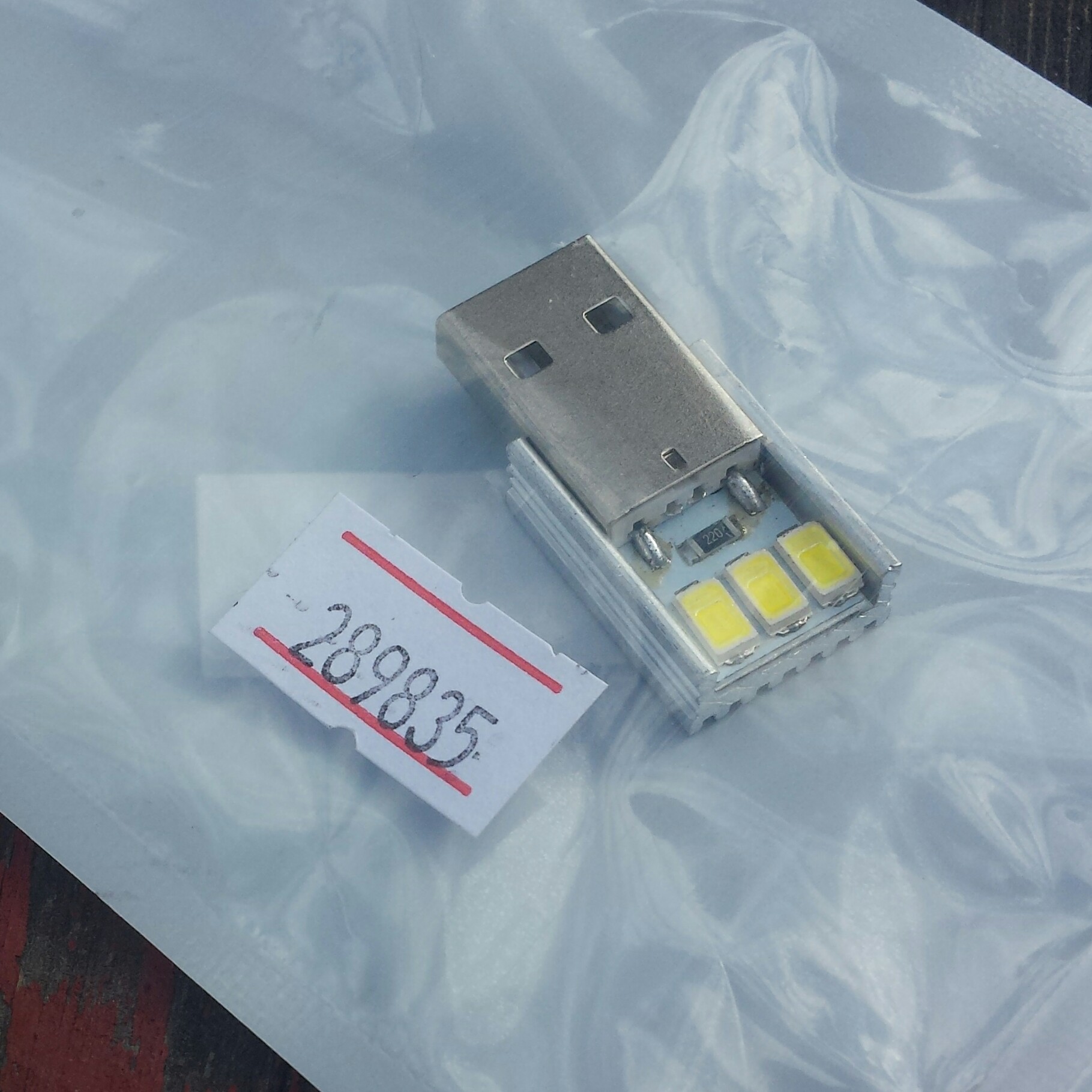
I was on DXSoul.com buying some more of the USB LED lights (see photo). I noticed they have these OBD2 Bluetooth diagnostic tool devices for less than six dollars. I thought about buying one, but then I thought about some of the ramifications of using one.

They are great because the device eliminates the wiring and interface device for a standard OBD2 diagnostic tool, which saves a lot of money – that’s where most of the cost is. All you need is this Bluetooth device, a phone with Bluetooth, and the software.

The device is no bigger than the plug that goes into the OBD2 socket of the car. Therefore, in order not to misplace it, there is a great incentive to just leave it plugged into the car’s socket. That means the device can always be active. This raises more than one concern. One is that anyone could use a phone with Bluetooth and software that could do anything with the car. It could unlock the doors, deactivate the alarm system, disable any “lojack” type of locating devices, start the car, and even drive a driverless vehicle.

Another problem could be the device and software might be able to take control during normal driving and cause the car to turn off, and possibly cause an accident. Almost as bad, it might be able to enable or disable the brakes or accelerator, either of which could cause an accident. And the driver losing control could have some serious psychological repercussions. It’s a seriously scary thought!

I have seen a demonstration on the news where a car is stopped when the brakes are applied remotely while the driver is in the car, without the driver doing anything. This is not just a possibility, it’s reality.

So these should all be considered. Also it would be foolish to buy one of these devices if the only way to use it is to pay a lot of money for the software. If the software is nearly the same cost with or without the standard diagnostic cabling, then it would be better (due to the above issues) to use the cabling instead.

Below: Go to dxsoul.com and search for the number shown. Less than $3.00, free shipping.
image

default

2016-10-26 Why Separate Power Supplies Are Needed

Peter asked a question about why is there a need for two separate power supplies for the same project.  I guess it never occurred to me to explain this simply, so everyone can understand it.

I have often had to use a separate power supply for one part of a circuit, with a second supply for the rest of the same circuit.  When I built both parts using a single PS, I found that the circuit had a tendency to act unstable or sometimes it would “motorboat.”  This is caused by feedback from one part of another through the power supply.  In order to quickly eliminate the problem, I used two separate power supplies while I was working on the circuit.  This completely eliminated any coupling between parts of a circuit.

As an example, suppose we have an audio amplifier with three stages of amplification. The first stage is a high gain microphone preamplifier. The second stage is a voltage amplifier, and the third stage is the power out to drive a speaker.

Each stage inverts the signal so that a positive going signal at its input is negative going at its output. So the microphone input is positive going, the preamp output is negative going, which is also the input to the second amplifier stage. And the output of the second amplifier stage is positive going, which is the same as the positive going microphone. The result is that the output of the second stage can go back through the power supply line and cause the two stages to oscillate. This is usually at a low frequency, because the power supply has large value capacitors. Thus it can sound like a motor boat putt-putting. The oscillations can be in bursts, and can be heard and seen on an oscilloscope.

An easy solution is to isolate the power to the stages by using separate power supplies. If this fixes the problem then the solution is to use a resistor and capacitor in the power supply line between the first and second stages. If it already has the resistor and capacitor, then this low pass filter is not low enough, and should be lower.

The third stage is the power amplifier stage and draws heavy current to drive the speaker. The power supply may consist of a transformer secondary winding, a bridge rectifier and a large filter capacitor of several thousand uF. When the amp puts out high power to the speaker, it draws high current from the transformer, rectifier and capacitor. The supply voltage drops, and the supply to the first and second stages also drops. The signal of the first stage is inverted compared to the power amp, so probably it won’t cause motorboating. But the second stage is in phase with the power amp, so it could be the cause of motorboating. We could put a resistor and capacitor between the second stage and power amp, be the supply voltage to this second stage must be high enough to drive the power amp to full power. If the resistor drops too much voltage, the drive won’t be high enough. One solution may to use a diode in place of the resistor, so the voltage drop will be less than 1 volt. And the filter capacitor for this second stage should be large enough to hold the voltage high during the time the power amp is sucking a lot of current from the power supply. A separate supply would be the best choice for this second stage. But designers will not be able to spend the extra cost to do this, so they will compromise and settle for less power, and use the resistor.

I have only discussed the feedback through the power supply. There are other ways the signals can leak out of a high power stage and get back into the earlier stages. One is by induction. The high currents generate magnetic fields that in turn induce currents in other components, especially if they are electromagnetic. These could be chokes, transformers, or even long leads. If the high power stage has high voltages then the stray currents might be induced electrostatically. The small capacitances between wires can be enough to cause feedback, especially at high or ultrasonic frequencies. This is why low level signals are run through shielded cable.

Also I haven’t mentioned ground loops. When the high power signals return from the speaker, they may go through the same ground wiring that is used by low level signals. The induced currents can cause major problems. This is where a separate power supply may help isolate the ground currents. The usual solution is to run separate grounds for the low level signals all the way back to the rectifier and first filter capacitor.

The schematic may not show all the design changes that were made to keep interference from causing these problems. The troubleshooter may see these modifications in the circuit board when he traces down the circuit. Sometimes pieces of metal shielding cover parts of a circuit board. And for shock and safety protection, the circuit board may have slots cut between parts of a power supply to isolate the high voltage from other circuits.

Separate power supplies are a quick way to get a device running. In a piece of commercial equipment, the designer may use them at first but eventually the design will have to be changed to operate from a single well isolated supply.

© RustyBolt.Info/wordpress
CyberChimps