default

2018-02-28 Pension Unfunded Liability Article

From From FB group Orange Talk

Also see LA Times article

http://www.latimes.com/projects/la-me-pension-crisis-davis-deal/

This was from the .PDF document here

 http://www.ocgrandjury.org/pdfs/2015_2016_GJreport/2016-06-15_Website_Report.pdf

“Here were the Grand Jury’s findings about how the entire county should deal with pension reform:

RECOMMENDATIONS

In accordance with California Penal Code §933 and §933.05, the 2015-2016 Grand Jury requires

(or as noted, requests) responses from each agency affected by the recommendations presented in

this section. The responses are to be submitted to the Presiding Judge of the Superior Court.

Based on its investigation titled “Orange County’s $4.5 Billion Unfunded Pension Liability &

Retirement Plans”, the 2015-2016 Orange County Grand Jury makes the following seven

recommendations:

R.1. The County should encourage the OCERS Board of Retirement to maintain financially

sound assumptions and to oppose any relaxation of current assumptions. (F1)(F3)

R.2. The County should establish and adopt a plan, working with OCERS, to increase the

pension percent funded liability to 80% from its current level of 70% by making additional

payments to OCERS. This plan should be developed as part of the County Strategic

Financial Plan is being updated in late summer 2016. As the 2017-2018 budget is being

developed, the first advance payment of the Plan should be included. (F1) (F2)

R.3. The County should develop a policy to continue issuing short term Pension Obligation

Bonds, so long as the discount from OCERS is available and there is enough net savings

(which should be defined) after paying for cost of issuance and underwriter’s discount. (F4)

R.4. The County should direct its lobbyists or work through the California State Association to

find support in the legislature for a bill with additional pension reforms, beginning with the

next legislative session that would further reduce the impact of unfunded pension

liabilities. (F6)

R.5. The County should conduct a thorough analysis including the financial impact of

implementing a Defined Contribution Retirement Plan or a hybrid plan, replacing the

current Defined Benefit Plan, before January 2017. (F1) (F7)

Orange County’s $4.5 Billion Unfunded Pension Liability & Retirement Plans

2015-2016 Orange County Grand Jury Page 24

R.6. The County should review the current practice of using taxpayer money to benefit eight

non-County employees through the 401(a) retirement plan by the end of 2016. (Executive

Director LAFCO; Executive Manager- Children & Family Commission and six OCERS

executives). (F8)

R.7. The Board of Supervisors should, by the end of calendar year 2016, publicly revisit and

determine if the Executive Compensation package 401(a) supplemental retirement plan for a County elected officials and top executives is still justifiable. (F8)”

default

2018-02-14  LED 2nds, Factory Rejects

I’ve had several LED purchases that were LEDs of poor quality, actually factory rejects.  The sellers may not have known that the LEDs had “chipped chips” missing a piece, or bubbles or inclusions, but even more commonly, the LED chip is off center so the beam pattern is distorted.  I let the sellers know, and they made good on fixing the problem.

The reason why I bring this up is that a lot of the LEDs that are sold at prices that are not much lower than the going prices, are actually ‘seconds’ or worse.  I just put a kit together and it has four red 3mm LEDs and they really aren’t even indicator grade.  The one for the power on LED was so dim I had to replace it, and the red high brightness LED I used was dozens of times brighter even though the current is only a milliamp.  So the only way you should buy LEDs is on tape and reel.  That way, you know you’re getting parts that have not been tested and rejected.  But even that may be too optimistic.

default

2018-02-04 AT&T Breakup Speculation

From FB group Bell Telephone of …

From a customer viewpoint, I’d agree with Trevor Hammonds.  Glenn Peters said, “…there were some gains, but more losses.”  Gains or losses for whom?

Looking back at what MCI did – selling long distance minutes for half the price – I think that CLECs would have independently introduced newer technology to their customers and AT&T would have had to cut prices for old technology or else introduce new technology at a loss of profit (AT&T had amortized equipment over a very long time).   In the end, AT&T had to go bankrupt and was absorbed into the SBC megacorp.  When we look back, it’s hindsight is 20/20.  But it was what it was, and it’s just speculation as to what would’ve happened if things were different.

default

2018-01-31 1kHz Wien Bridge Oscillator Kit

Also photo posted to FB group Building Transistor Radios.

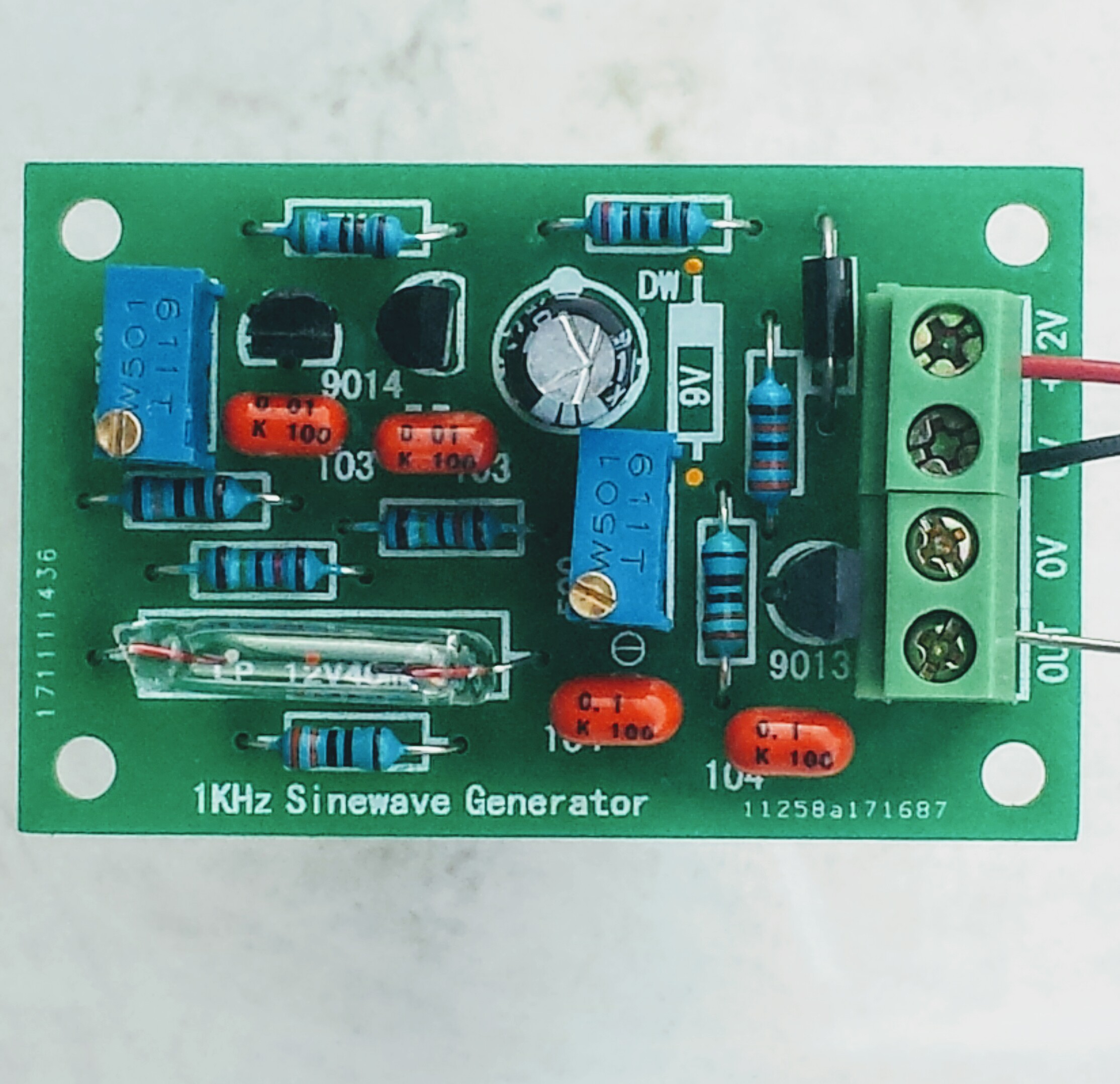
I got several of these Wien Bridge Oscillator kits from an eBay seller in China.  They are built using the circuit from http://redcircuits.com/Page13.htm

More information can be found on the wiki for this oscillator.

The kits come with no instructions, so to assemble it, use this red circuits link above.  The resistors are all 1%, and the frequency was 1027 Hz, which is fairly accurate.  The output level is adjustable with a 500 ohm multiturn pot.  The frequency is fixed, there is not enough room on the PC board to add capacitors or resistors, however the existing ones could be replaced.  

My one gripe is that the circuit actually works on 9 volts, but the supply says 12V, and three volts are dropped across a 200 ohm resistor which is part of the shunt regulator.  The other part is the 9 volt Zener diode to limit the voltage, sort of.  I didn’t solder in the Zener diode because I’m going to use a 9V supply.  When I connected it to the variable supply, I had to turn it up to more than 12V in order to get the voltage to 9V.  In other words, more than 3V was being dropped across the 200 ohm resistor and polarity protection rectifier.  This means very little or no current is flowing through the 9V Zener.  The 200 ohm resistor gets quite warm.  And to get the regulation, this resistor needs to be lower, maybe 100 ohms, depending on the supply voltage.  The Zener has a 100 uF capacitor across it, to filter out any hum from the supply.  This might not be enough.  The PC board is small so there is very little room for adding parts.

default

2018-01-30 Elijah And His Unique Keyboard

At the college I worked at, they had a part-time internship program where students could get on the job experience for a semester.  One of our employees got her son a job as an intern in our department.

His name was Elijah, but he didn’t like being called that, and went by “EJ”.  He was a good typist, learned from plenty of previous experience on PCs.  They gave him a shared space to consider as a landing strip between rounds as a helper and troubleshooter.  But he wasn’t pleased when he came in and found others using ‘his’ PC.  So one day, we came in to find that all of the keys on the keyboard had been switched around, which was total nonsense.

We put up with the inconvenience for awhile.  But then EJ went back to the storeroom and found a bunch of used, defective keyboards.  Suddenly each of the rows of ‘his’ keyboard said “(expletive) you!”  I thought it was amusing, but apparently others didn’t so he had to get rid of that.

But EJ turned out to be a full-time employee at our other campus.  A few years later he left for a better job(?) or possibly he got tired of others not wanting to put up with his shenanigans?  I’ll never find out.

default

2018-01-29 Sperti-Faraday Relay for Telephone Line

default

2018-01-29 Battery Capacity Testing

From FB group

Another FB member, who’s not in the groups, has also built a battery capacity tester.  I think he uses a 10 ohm resistor.  The typical testers found online apparently use what the battery makers say they use in the data sheets.

This link is for the .PDF of the apps manual for Eveready Alkaline AA cells.

http://data.energizer.com/PDFs/alkaline_appman.pdf

….

BTW, IIRC, the battery capacity tester this member built uses an Arduino to monitor the battery voltage as it is discharged, and the times and voltages are logged to a file of values in CSV format, which are later imported into a spreadsheet.  I believe the Arduino only switches the discharge on or off, it doesn’t control the discharge current.

default

2018-01-28 Getting Reputable Rechargeable Cells

From FB group Hobby Electronics

When a manufacturer purchases parts for the product they are making, they expect to receive what the engineers department had specified in the department’s documents.

When the parts are received, the Quality Control department is supposed to check to see if the parts received meet the engineering documents.  I know QC can check for physical aspects, but they usually don’t have the expertise to determine electrical specifications.  So it would be up to engineering to determine if parts are electronically suitable.

In the case of rechargeable batteries, the engineering might take some random samples and test them for capacity.  After finding that an excessive amount do not meet specifications, the distributor might end up refunding or replacing the defective cells.

So the buyer should use suppliers that are reputable and are servicing industry.  Then they can expect a better quality product.

Also there has to be an accurate measurement of capacity, so tests have to be done with a meter and procedure that is accepted by industry and by calibration laboratories.  

default

2018-01-26 Transistors, Labeling and Numbering

From FB group Building Transistor Radios
The silicon transistor wafers may have been made in the US, but the wafers were shipped to foreign countries to be assembled into the actual transistors.  The wafer is cut up into tens of thousands of individual transistors, and after assembly they are tested and separated by the results.  All the transistors that meet certain specifications might be labeled as 2N3904, a number registered in the US.  Or the same transistor might be wired differently inside, and then labeled as a BC547, which is a number in the Pro Electron series, which is used by European countries.  Or it was connected another way inside, and then labeled as 2SC945, which is a number registered in Japan.  Or some large company might order a hundred thousand of a particular transistor and have them labeled with a house number that was assigned by the company in their specification sheet.

The point is that the transistors aren’t American or Japanese, they were labeled that way by some foreign company, which might be in Hong Kong, Taiwan, or China.  

default

2018-01-25 Public Pensions Aren’t The Problem.

From FB group Orange Talk

Karl Seppala

You are complaining about the wrong group.  First off, the state employees are getting what they are allowed to get.  The pension reform act did away with a lot of the cheaters.  If you don’t like it, the legislature is the ones who can change the laws.  And as far as “covered by the taxpayers”, the money paid in pension benefits is split up into the part that employee and employer, by agreement, pay into the system, and the rest of the benefits were paid by the earnings on investments.  The Great Recession reduced that from 75% to 61%, and the difference is supposedly ” unfunded liability” that the taxpayer supposedly is going to pay.  But as the economy recovers, the investments recover and the unfunded liabilities are funded by investments.

And you whine about this, but you put no blame on the damn financial institutions that got us into this mess.  That’s the problem, not the victims, which are the pensioners and their pension funds.  And that includes private as well as public pensions, including 401k, IRA, etc. 

And then others complain about the public employees.  They have to be hired from the same pool as private employees, and they have to get competitive salaries and benefits as the rest of the industry.  If not, then the qualified employees will go elsewhere.

The public and private funds have been complaining by way of their shareholder votes to the boards of directors of many corporations.  The issues are the exorbitant salaries the chief executive and others get, compared to the other employees.  There is the real problem: get rid of overpaid executives in private industry and a there will be a lot less problems with the industries, and more equitable salaries for everyone.

Again I ask what you asked, “Where’s your brain?”

© RustyBolt.Info/wordpress
CyberChimps