default

2016-09-07 Light Bulb Conspiracy Pt. 2

Continued from 2016-09-03 post.

Back to the light bulb. To clarify, we are only discussing the original incandescent light bulbs, not the newer ones. This also applies to the 115 volt AC light bulbs. Other voltage lights would have to use different values.

Warning! Also you indemnify (hold me harmless), me, the author, against any claims for any harm. I can’t prevent you from doing something stupid like electrocuting yourself.

I want to tell you a secret. There must be a conspiracy among light bulb makers to have kept this secret for so long, that almost no one knows about it. And the light bulb makers have prevented the US consumers from taking advantage of it by conspiring to prevent consumers from obtaining them. Why? Because if they could, any consumer in the U.S. could buy a light bulb made for 230 Volts AC and put it into a light socket that has 115 volts AC, and it would last for many, many thousands of hours! Maybe it would work for decades! There must be a conspiracy! :-O

I have never seen a 230 volt light bulb sold in any store here in the U.S. Of course, the light from this bulb might not be acceptable to consumers because it would be dimmer than a regular 115 volt light bulb. But there is another way to get longer life out of a light bulb. All you have to do is lower the voltage. There are several ways to do this, but I’ll discuss one simple way. You can put a resistor in series with the light bulb. I calculated that by adding a 15 ohm, 10 watt resistor in series with a 75 watt light bulb, it would lower the voltage by about 10 volts. The light should have about 105 volts AC across it. You could increase the resistance a few ohms to reduce the voltage a bit more. This should extend the life of the light bulb to about double its rating. This also has another small advantage. The added resistor reduces the surge current when the light is first turned on, so there is not as much stress on the filament. This may help extend the life somewhat.

You could get 10 watt power resistors online, but they aren’t easy to find in stores, so another way could be to use another light bulb in place of the resistor. It would have to light up at 12 volts, and draw about 2/3 of an amp. A car light can be used. The lower power (tail light) filament of the 1157 stop and tail light uses 14 volts at about 8.3 watts, which calculates to about 0.6 amps. But because tungsten changes resistance depending on the temperature, it is hard to say what the current will be when it’s in series with a 115 volt light. Also the 12 volt car bulbs have a thicker filament which takes longer to heat up, so the full 115 volts may be across the 115 volt light when it’s first turned on, and that is the time when a filament has the most stress and usually burns out. So this may not be as effective as a resistor. Also, the 1157 filament will eventually burn out, but it’s hard to predict how many hours it will last.

However, you could also get extended life from your lights by using a transformer. Let’s say I have a transformer that has a primary that takes in 115 VAC and a secondary that puts out 12 VAC at 1 amp. I connect the primary to 115 VAC, and the I connect the secondary in series with the ‘hot’ or line side of the 115 VAC. There are two ways to connect the secondary, series aiding, so the voltage is 115 plus 12 volts AC or 127 volts AC, and series opposing so the voltage is 115 minus 12 volts AC or 103 volts AC. Bingo. You can connect the light to 103 volts AC and the light will last many times longer than at full voltage. However it would cost much more than the resistor and more than the cost of many light bulbs, so it would probably not be cost effective. It does have one good use. If you have Japanese appliances that use 100 volts AC, this is a good way to make them run properly on 115 VAC.

I might add that this does not work with the newer CFL and LED lights because they have a power supply that may work all the way down to 85 volts AC, so the light will just take more current at a lower voltage and stay the same brightness. Or if they are really cheaply made, the light may not work at all.

I continue this on my next blog.

default

2016-09-06 Supercharged JT Shutoff

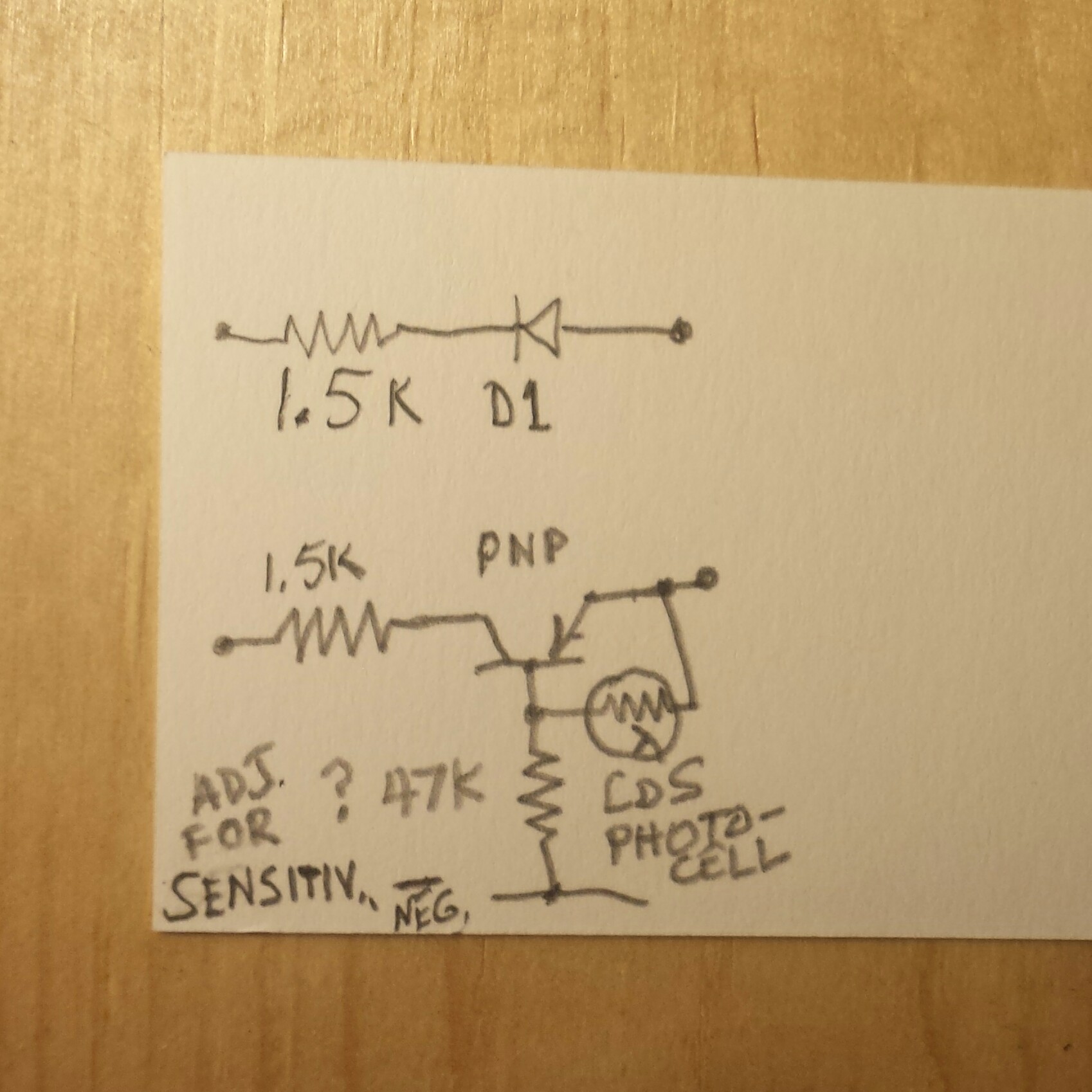
I had a hard time editing the reply to #2 of the comment, besides it’s a good blog. The following applies to my Supercharged Joule Thief.

image

But you really don’t need to use a MOSFET. Any PNP transistor, 2N3906 or BC557, will do the job, and the current will be relatively low. Replace the diode with the transistor. Put a 47k resistor from its base to negative, and the photocell from base to emitter. The collector goes to the resistor. See the schematic photo.

I’ve never tried this circuit. Right now, the PNP makes sense because it should act like a diode. The PNP may have to be changed to NPN and flipped around and negative changed to the coil and collector as the diode, but that would seem to me like the NPN would then be reverse biased.

Anyhow I would want to modify one of my SJTs to see if it works. There may not be enough current to shut the NPN off, and what there is may cause the SJT circuit to not shut completely off.

I’ll update when I experiment.

default

2016-09-05 Ferrite Cores At Radio Frequencies

I have always thought that using ferrite toroid cores for radio projects at HFs and above was not necessary, because all of the RF circuit parts lists call for low permeability powdered iron cores. I’ve never given it much thought; about the only thing that crossed my mind was that the powdered iron cores may have less temperature coefficient than ferrite because they have much less influence on the magnetic field (a -0 core is non-magnetic and is the same as an air core, so it has almost no thermal coefficient).

In this blog post, at the end, below the cat pics, the author compares the characteristics of two types of cores. He doesn’t say anything about thermal coefficient. But the -43 ferrite medium mu core compares favorably with the other core at HFs and above. This is the first time I’ve seen any comparison of a ferrite core, even though it is not complete.

I just bought some powdered iron cores, just to see how they work in RF tuned circuits. Now that I’ve read this article I may also try some of the ferrite cores that I’ve used for Joule Thiefs.

default

2016-09-03 The Light Bulb Conspiracy – Not Really

There may be a Light Bulb Conspiracy, but it’s not what you think! First, let’s discuss the Light Bulb Conspiracy claim. They said that years ago, incandescent light bulbs lasted for 2500 hours, but now they last for only 1000 hours. They claim that this is a conspiracy to sell more products “by planned obsolescence.” We have to look at more than just the light bulb to find out the reality.

At one time in the past electricity costs were much less than they are now. At that time it made economic sense to sell a longer lasting incandescent light bulb, even though it used more electricity to make a given amount of light. But as the cost of electricity rose, the long life lights cost more in electricity consumption than the cost of the light bulb. Manufacturers increased light output and lights had a shorter lifespan. But now the consumer could use a 75 watt light instead of a 100 watt light, and save 25 percent on the electricity, which more than paid for the cost of the shorter lived light bulbs.

You may think, why would the electric company want the consumer to spend less money? That doesn’t make sense. But the local, state and federal governments mandated that utilities reduce consumption to reduce air pollution, toxic waste (coal ashes have mercury), and other reasons (dependence on foreign fuels, greenhouse gases, etc.).

These environmental concerns are also a reason for laws to develop renewable energy resources such as hydroelectric, geothermal, wind and solar power.

The incandescent light manufacturers have saved the consumer money by making more efficient (brighter) lights, at the cost of a shorter lifespan light. This cannot be called a conspiracy.

In the last few years – 2010 to 2015 – the sale of most incandescent light bulbs has been outlawed, so consumers now have to buy LED lights for most lighting. This has saved the consumer much more, since LED lights use less than 1/6th as much electricity. The LED lights cost more but quickly pay for themselves in electricity savings. And they can last much longer, 22 years or more if kept cool.

So the incandescent ‘light bulb conspiracy’ is no longer a concern. However, there may still be a conspiracy going on. The makers of these slickly produced hour-long conspiracy theory videos seem to have been well financed. The money may come from those who have an interest in selling more electricity. Electric utilities have trade associations that promote their agenda. Could they be involved in spreading these conspiracy myths? That may be difficult to prove.

References

The second part of this lengthy blog is here.

Update Sep 8 – I spent the whole hour watching the full length version of The Light Bulb Conspiracy, which is about ‘planned obsolescence’. They talk about light bulbs, but much of the program is about other consumer goods, such as women’s nylon hosiery. I have a huge amount of skepticism about what they say.

Here’s an example. Yesterday I saw a Toyota Corolla in a parking lot, and I drove around and looked at it from all sides. It was old, probably from the ’70s, and brought back many memories. This was the car that stole the car sales away from the U.S. car makers. The Japanese company just took the business away from GM, Ford and Chrysler by giving the consumer a better, higher quality car. I thought about the times when I saw the US cars fall apart after a few years due to plastic parts, glued on with glue that would come loose over time. The little Corollas were well made and cheap, and cheap on fuel, too.

I think that ‘planned obsolescence’ would not be able to stand up to competition for the consumer’s money; the consumers would vote with their feet and choose another product. Advertising has some influence. But then so do the tests of products done by Consumer Reports, a well-known testing company.

Assuming these external forces continue, the only way to cheat the consumer would be to form a cartel or trust where the manufacturers conspired to fix prices and cheat the consumers. This is against the law, of course. Companies have been tried and convicted of doing this.

Back to the light bulb. I’m going to continue this on my next blog.

default

2016-08-27 Toroids.info

I ordered a few toroid cores today, and I used this toroids.info to find the turns and inductance for some cores. It has a basic calculator that can give the information for the cores in the list. Most of the cores were chosen for RF projects, so some very large cores are shown. The T cores such as T-50-6 are powdered iron cores, with low permeability. The FT cores are ferrite cores, the permeability is medium to high. The FB are ferrite beads, usually smaller than a toroid. The BN are baluns, also called multiaperture cores — they have more than one hole.

The -0 core is tan / tan, but it’s actually not magnetic, it’s just a core made of light brown phenolic plastic, to hold the wire in a ring.

I have used quite a few FT-37-43 cores for Joule Thiefs. They work nicely. The equivalent is Fair-Rite 2643002402 and they call it a ferrite bead, even though it looks like a toroid. The Fair-Rite 2673002402 looks the same but has a higher permeability.

These cores a small and they typically cost less than a dollar. As the cores get bigger, the cost goes up, until cores of 2 inches or 50 mm cost several dollars apiece.

default

2016-08-20 Blue Blinky Gets A Different Timing Capacitor

It has been a long time since I designed Blue Blinky; I just wanted to update it.  I have used a 1 uF electrolytic capacitor for the timing capacitor, and it works just fine with the two 680k resistors to give about 1 per second flash rate.

I got a bag of hundreds of multilayer ceramic capacitors rated at 0.56 uF, 200 volts. The ‘K’ tolerance is 10%, which is better than many electrolytic capacitors, which are typically 25% or more. Using these .56 uF capacitors should give a more accurate flash rate.

I unsoldered the 1 uF electrolytic capacitor from one of my Blue Blinky circuit boards, and installed the .56 uF. I removed one of the 680k resistors and put in a 1.2 Megohm resistor. The total is .68 M plus 1.2 M = 1.88 M.

I connected the modified Blue Blinky up to an AA cell, and put it on a table. The flash rate was not stable, but I thought that was caused by the daylight detector getting too much light, so I darkened the room. It blinked for awhile but after a few minutes the flashes got longer. Normally the flash is quick, with nothing in between, but this changed to where the flashes were on 1/4 or more of the time. The flashes got longer until the LED was on constantly, so I just left it alone. Later the next day, the flashes started up irregularly, then the flashes got shorter until the flashes are now short and stable, like it should normally be.

I checked the AA battery’s voltage, it was 1.19 volts. This is basically a dead battery. The normal voltage is about 1.5 volts, and when the voltage drops to 1.3 volts, most of the battery’s capacity has been used. But this battery has gone well below that.

The problem I see with this modified Blue Blinky is that normal battery voltages above 1.2 volts cause it to become unstable and go on continuously. I’m going to have to put it on a variable power supply and find out what’s causing this odd behavior. I think the first thing I’ll try is to remove the light sensing diode to see if it or its transistor is causing the problem.

default

2016-07-26 Surge Protectors

I have read about, discussed and experienced how surge protectors work and don’t work, and have written about it before, but Ill try again to explain.

Ripoff
The most egregious thing surge protectors do is take your money. One of the highest, if not the highest profit margin devices in your home is a surge protector. A regular power strip without surge protection may cost ten dollars. The same power strip with surge protection may cost thirty dollars. The difference is the maker added two small coin sized varistors and a few capacitors and/or inductors that cost altogether less than a dollar, and it triples the price of the power strip. Most of the time, surge protection is not needed.

Go to a store and buy a new computer, printer, or similar, and the salesman will try to sell you the surge protector. You tell him no, and he will try to twist your arm, explaining how important it is, etc. You have to be insistent to keep these salesmen from pushing a high profit item on the sale.

A Very Interesting Question
This deserves to be thoughtfully considered. If surge protectors were really necessary, wouldn’t the makers of electrical appliances put them in the appliance? The answer is some have surge protectors or something similar. In the case of switching power supplies, used in computers, and many other things, the power supply makes a lot of electromagnetic interference so the incoming power has to have a filter to keep the interference from going out of the power supply and disturbing other things.

Other appliances don’t need surge protection. Coffee pots, toaster ovens, microwave ovens and other high wattage appliances may put too much load on a surge protector, causing the circuit breaker to trip.

Damage Control
The “overflowing sink” theory that surge protectors are based on is correct, but the actual devices fall far short of the theory. They use a varistor that is the size of a small coin, and there are two, one from line to ground and one from neutral to ground.

There are several problems. One is that after they have absorbed a surge, the heat may damage the varistor and it can no longer do its job. So now you have a power strip with no surge protection. Nothing warns you that this has happened.

Dysfunctional
Another reason surge protectors may not work is that they need to have a good ground. The surge protector lets the surge go from the power wires to the ground wire. This would work very well if the ground wire from the surge protector’s plug went straight to a ground rod driven into the ground. But it doesn’t. The ground wire goes all the way through your house to the electrical panel, where there is a ground.

To make things worse, many older houses came with two prong outlets. The outlet may have been changed to three prong outlets, with the third ground pin. Sometimes the ground pin is connected to a ground wire that goes all the way back to the electrical panel, and to a good ground. Sometimes the wiring is so old that the ground pin inside the outlet goes nowhere. Sometimes a two prong to three prong adapter is used, with a short green wire that is supposed to be connected to ground. Sometimes the outlet box is not grounded, or sometimes the green wire is not connected to anything. In either case, without a ground, a surge protector cannot protect! So if you want to depend on a surge protector you must make sure that it has a good ground.

Insurance
The package gives some specification of how many Joules of protection this surge protector has. But that has been determined in some testing laboratory. Have you ever seen or read that lightning behaves like it should in a laboratory? Lightning goes where it wants to, when it wants to. Something the size of a coin doesn’t have a snowball’s chance in hell of stopping a surge from close by lightning.

The package tells you this product is guaranteed with an insurance policy to protect the homeowner. If the surge protector fails and causes your house to burn down, you’re protected. But if you read the fine print, you will find so many restrictions and caveats that it is very unlikely that anyone will be able to collect on the policy. As I said earlier, the insurance may require a proper ground, and your house may not have it.

Finally, the surge protection should not be installed in a power strip. The surge protection should be installed at the main electrical panel where power comes into the house. This must have, and already has, an adequate ground where a surge may go and be safely dissipated. It costs a lot to have an electrician do this, but the surge protector will really do a good job of protection.

default

2016-07-19 Vaccines And Autism

This is my opinion and does not represent anyone else’s opinion. I seldom discuss politics here, but this political problem puts the whole world population at risk. Contagious diseases know no borders, do not discriminate, and are equal opportunity killers in all countries. They are helped by people who think they are doing good, but who are actually creating a breeding ground for an epidemic that will kill people.

http://www.sacbee.com/site-services/databases/article90300877.html

This article tells only a small part of the truth about Autism.  It does say that there has been an increase in the number of people diagnosed with autism.  But there lies the murkiness.

I have a relative who is a caregiver for an autistic boy.  It is obvious that he is handicapped.  But his sister, also diagnosed with autism, works at a supermarket.  You wouldn’t know it from talking to her.  She wouldn’t have been diagnosed until recently.  Maybe she just had mild symptoms like learning difficulties or a below average IQ.

Autism is like many other disabilities, it is very costly long term, and families are negatively impacted by it.  They struggle with the economic impact.  They are desperate to find a way to relieve this stress.

A Dr. Wakefield somehow got a faulty research paper published in The Lancet, the UK medical journal, and a whole ‘industry’ grew up around this ‘proof’ that autism was associated with the MMR vaccine.  Dr. Wakefield was found to have a conflict of interest in that he was involved with getting a single dose type vaccine accepted, and other breaches of ethics.  The UK revoked his medical license and The Lancet withdrew his publication; his research was seriously flawed.

It has only been recently that the ASD (autism spectrum disorder) has been defined.  I have read that a large part of the autistic people were previously undiagnosed, and these newly diagnosed were responsible for the large increase in people with autism.

Just because event B follows event A does *not* mean event B was caused by event A.  But people interpret this as ‘bad luck’ or any number of other associated reasons.  This is subjective logic.

Subjective opinions are opinions where there is uncertainty and disbelief. We can make a statement of opinion, and measure its uncertainty and whether or not to believe the statement. In the case of vaccines causing autism, the one research paper that associated vaccines with autism has been invalidated. Other researchers have not been able to find any association between the two. Therefore the statement that vaccines cause autism is not believable, and the certainty is high that the statement is false.

If I make a statement, no one can be 100 percent certain that it’s true. But there are many people out there who believe that president Obama is a Muslim, even though he said he’s a Christian in his book (Audacity… p.206). It puzzles me why so many people are persuaded into believing that he is not what he said he is. These people are very certain about their belief, even though the certainty of it being true are so low, nearly zero, and there seems to be almost no reason to believe he is a Muslim. Are people really that foolish? Obama was reelected for a second term, so it is obvious that the radical ‘fringe’ extremists who believe he’s Muslim are a small minority. Whether he’s Muslim or Christian doesn’t make any difference in his ability to do a good job. The law says one cannot discriminate on the basis of religion. So what’s their problem? They have been brainwashed.

Back to vaccines. Those who believe that vaccines will do harm are believing an unproven myth, and it is absolutely true that getting the disease will do much more harm than the vaccines.

I believe the reason why so many people believe vaccines cause autism is because they want to persuade other families with autism to take advantage of the vaccine insurance program. This program was set up by the federal government to solve the problems of lawsuits filed against the vaccine makers for claims of adverse reactions to the vaccines. The program allows a patient with a claim of adverse reactions to file a complaint with the court, and if it meets the requirements of the program, the court will find in favor of the patient’s claim.

One thing that is not on the list of adverse events is autism. But mental disabilities are on the list.

The vaccine opponents (let’s call them anti’s) are a minority, but a very vocal minority. They have tried very hard to get others to believe them, it is a leading cause for their campaign against vaccines. But as seen above, their efforts are severely hampered by the people’s lack of belief that there is something wrong with vaccines, and by the very high uncertainty that their ‘proof’ has any validity, especially after the only research paper was invalidated.

There are many illogical conflicts that the anti’s can’t explain. Here are some.

Vaccines are designed to protect you, not harm you. Nothing is 100 percent safe, but vaccines have been tested on hundreds of millions of people and found to be many, many, many times safer than having the disease itself.

Every day your body has to battle with foreign invaders called germs. Isn’t it foolish to go into battle without any weapons? The immunity given by vaccination is your weapon to fight disease. Or looking at it another way, pregnancy used to be a leading cause of death among women. Today’s medical advances, that is no longer true — pregnancy is much safer. Would you refrain from having a baby if you knew the chances were 1 in 10 it could kill you? How about 1 in 1000? Yet getting vaccinated is still much much safer than pregnancy.

Do you believe your doctor adheres to the Hippocratic oath? If so then if vaccines are bad for you, why does he recommend that you get vaccinated??

I shake my head in disbelief when I read the hatred that comes from people’s mouths in the name of humanitarianism. But all they speak is rubbish. The unfortunate part is they actually believe it. I just wish we had a mirror, like in Harry Potter, that one could look at and see what they really are. They might be shocked at what they see. This reminds me of the question: If vegetarians eat vegetables, then what do humanitarians eat?

I had to give the dog some antibiotics. I had to put him on his back in my lap, with my arm between his legs to keep him from squirming out and running away — thankfully he’s small. As soon as I came close to his mouth with the eyedropper, he clenched my arm with both legs, clamped his mouth shut and bent his head as far from the eyedropper as he could go. I had to force the tip between his lips and teeth just to get a few drops of this medication in his mouth. From his reactions one would think that I was feeding him poison. If he had been a cat, I would have been scratched to death. But the medicine did the job and the infection is gone.

This reminds me of the anti’s. They are fighting against something that is making their lives safer. But they struggle to distance themselves from safety. They also distance themselves from common sense. How foolish can one get?

Did it ever occur to them that their family tree might be missing leaves or even branches if it wasn’t for vaccines and modern medicine? After reading their antivaccine BS, others may have wished that the anti’s leaf had fallen off!

One thing I would like to find out is what’s necessary to say to someone who believes in something that isn’t true, to convince him or her that they are believing a lie.

The anti’s claim they should be able to choose whether or not to vaccinate. But is choice acceptable when they choose against vaccination and then they become a person carrying disease, and spreading it to others? At one time people with a disease were banished to a colony to prevent spreading it to others. The disease was leprosy. Does society have to give the anti’s a choice? Choose to get vaccinated, or else go to a colony where they will not infect others? They seem more and more willing, like the dog, to go to any length to get away without getting vaccinated.

The more I try to rationalize with these people the more they deny that what I’m saying is true. Perhaps I should leave them alone and let them learn from experience. It’s very sad to know that that experience might lead to death or disability of a loved one.

Update Aug 5. – I had a thought about the perfidy of humans. People will go to a store and fight over the last item just to save a buck. But when the tables are turned and there is a ton of extra items, people get very suspicious and think that it’s because that product is flawed.

The organization ACT UP was formed to light a fire under the bureaucracy to get more research done to find a cure for AIDS. They staged protests and held news conferences to get their message to everyone.

Because of the great demand for, but complete lack of a solution, the solution had an extremely valuable worth. Thousands of people were HIV positive and were doomed to die, and many others had already died. There was a tremendous fight to stop the deadly disease.

On the other extreme, when the healthcare industry and government have determined that the best, cheapest and most effective method of preventing diseases is by vaccination, some of the people fear for their life and believe they are being herded into gas chambers for a lethal dose of medicine.

It will take another epidemic like AIDS to wake these paranoid people up and make them realize that what they cause when they refuse to be vaccinated is a refuge for humans carrying diseases. They are becoming the vector, just like mosquitoes, for the spread of disease.

Whenever another mass shooting occurs, there is a great uproar of people who demand gun control. The government then gets hammered by gun rights advocates using the Second Amendment.

Just like the AIDS, Ebola, West Nile, and now Zika spreading throughout the world, there will be a time when the majority of people will demand that the government do something to stop the spread of disease. The government will offer everyone vaccines to prevent the disease. The epidemic will go away because most will get vaccinated. But those who refuse will continue to spread the disease. When the government researchers show the problem is those who are not vaccinated, then there will be a public outcry to force them to be vaccinated. In this case, they will not have a constitutional amendment to protect them.

Update 2016-09-08 – Dr. Bob Sears, of Capistrano Beach, CA, is in hot water for gross negligence and inadequate record keeping among other things. He may get reprimanded, or worse.

http://m.ocregister.com/articles/sears-728409-medical-board.html

Somewhat harsh criticism (quack dr.)
http://scienceblogs.com/insolence/2016/09/09/the-medical-board-of-california-initiates-disciplinary-action-against-antivaccine-dr-bob-sears/

I have written another blog about vaccinations dated 2016-11-18.

default

2016-07-13 Bar Code Scanners

The thought comes to mind about why do the scanners at the checkout counters use a red laser light to illuminate the UPC barcodes (history and technical data here).

I can point my phone camera at the QR codes on advertising and it will read the ‘barcode’. The camera doesn’t need a laser, it just uses the room lights.

The barcode scanner uses hardware to sequentially scan the barcode, and the camera uses software to scan the image of a barcode in memory. Long ago, when UPC labels were standardized, the microcomputer was not a small handheld unit like it is today. The electronics of the early 1970s did not have a microprocessor, which was being developed about that time. The hardware depended upon much simpler electronics, with error detection and corrections added to the bar codes. The electronics were not able to be ‘programmed’ by software like modern devices. Hardware was defined before manufacture, so the UPC labels had to be standardized so the hardware was not confused.

At that time when the standards were finalized, there were no cameras available for this app. This is why they standardized on using a laser to illuminate the barcodes.

One very important attribute for barcode labels is error detection and correction. It’s very important that the scanner get the barcode correctly or reject it as having errors. The wrong barcode could overcharge or undercharge the customer and show errors in the inventory.

Today, things are dramatically different. One can download an app for scanning a barcode or QR code, and when the software is working, it can try over and over to make sense out of the printed label. The software can scan and read multiple label types.

Originally UPC labels only had 12 digits, nothing else. A QR code can have all characters. I went online and created this QR code with a QR code generator. Here’s the URL for this blog.

image

https://rustybolt.info/wordpress/

I think that in the near future, we won’t have a person at checkout counters. Some stores have already eliminated most of their clerks and gone to automated checkout. The only thing that seems to be a hassle is getting those plastic bags to open up so the items can be put inside. They are going to have to do what Costco does: stop supplying bags and use the leftover cardboard boxes.

default

2016-07-11 Bad Science By Goldacre

I got this Bad Science book by Goldacre last week, and I’ve been reading it. It was published about a decade ago, so some things have since changed. It is a paperback book.

He points out how the pseudoscience supporters go about this, and the mistakes in their logic.

© RustyBolt.Info/wordpress
CyberChimps