default

2017-10-07 9V Battery Substitute – FB

posted to FB group Vintage Transistor Radios today.

I got tired of spending a lot of money on new 9 volt batteries, so I built a dc-to-dc converter, that takes two AA or AAA batteries and converts 3 volts to 9 volts DC.  One problem is that I got it to put out about 10 milliamps or 90 milliwatts, so it’s not powerful enough to run a 9 volt radio. But it works great for digital multimeters and other small test equipment.  The converter fits where the 9V battery goes, so I had to put the battery holder on the outside of the case.

These have cut down my costs for 9V alkalines.  But the converter draws some current when the meter is off, so it needs its own on/off switch.  Another solution to low current 9V battery is to use three CR2032 coin cells in series.  This gives 9V at a few milliamps, and will fit inside of the battery compartment.  It’s not for long term use.  I had some CR123 cells, so I connected three in series, and these can power a radio, which might take 20 to 30 milliamps.  But CR123 cells are expensive.

One thing I’ve noticed is that I’ve never seen an alkaline button cell leak.  👍

default

2017-10-02 Ripped Off By eBay Seller?

I bought a few Arduino Nano plus breakout board “kits” from an eBay seller in Las Vegas, Nevada.  The seller seems to be a coin dealer.  They advertised the Nanos as Mega328, but the ones I got were Mega168, which have half as much memory.  I don’t know if the seller knew they were inferior (could be the seller is clueless), but the goods were not what was specified in the advertising.

I filled out a return request and received a free shipping label, and shipped them back to the seller.  What makes me angry is this is the second time in a month I have had to return the goods to the seller because the goods did not meet the advertising.  These bloody sellers are trying to rip off the customers, and I hate it.

Another thing that bugs me is that I can choose to return the goods, but the return cancels the sale.  There is no way to give the seller a negative rating.  If I decide to keep the goods and give the seller a neutral or negative feedback rating, then I’m stuck with the goods and I don’t get my money back.

When I request the return, they allow only a few choices of reason for the return.  Some returns don’t fit into any of the choices.  You have to lie to make up a reason.  They allow a few lines of text to describe, but it’s difficult to squeeze that reason into a few lines.  I don’t remember having these many problems years ago, I think it’s gotten worse over the years.  Maybe someone will fix this, but I’m not holding my breath for that to happen.

Update Thu Oct 5 – This Afternoon I got an email from eBay saying the seller had refunded the money to my PayPal account.  The seller must have received the package back.  The seller didn’t give any further information.

default

2017-09-30 Zenith Royal 500 Radios  Pt. 02

Posted to FB group Vintage Transistor Radios  Oct 7 and after.
Yeah, it’s a bit confusing because the number of IF transformers is one more than the number of transistors.

When you work on IFs, what do you use for alignment?  I got Zenith Royal 500s that the previous owner apparently fiddled with the IF cores.  I guess I need a sweep generator.

Phillip Grace replied 

Yes, a simple fixed frequency generator is all that is needed, along with a DMM to read the DC voltage at the detector that drives the AGC circuitry. You can also use a generator with AM modulation along with the DMM set to AC to measure the audio level, or a scope. A sweep gen can come in handy when tuning sets that have wide bandwidth IF stages, but not necessary.
Me:  Thank you for the informative replies.  I read some docs online about alignment of AM radios.  I have done FM alignment with a sweep generator.  One of the radios tuned in 640 kHz with the tuning cap set at 780, so I retuned the LO coil to get it back down to 640.  Another one looks like the cores on the IF cans have been messed with, so I think that may be the problem.  But many of these have a bad volume control, so I’m going to work on those to get the audio stages working.  Just getting the battery holder contacts restored is gonna take a lot of time.  So I have to do a lot of TLC that will take time.

default

2017-09-29 Zenith Royal 500 Radios Pt 01

I bought a bunch of Zenith Royal 500 and similar AM transistor radios from an eBay seller.  These were made in the late ’50s to early ’60s.  They all use air variable capacitors like the 5 tube sets.  They all use four AAA cells for power.  The cases on some say unbreakable nylon, but there are chips and cracks.  They are relatively easy to work on.  I got fifteen for about $15 apiece.
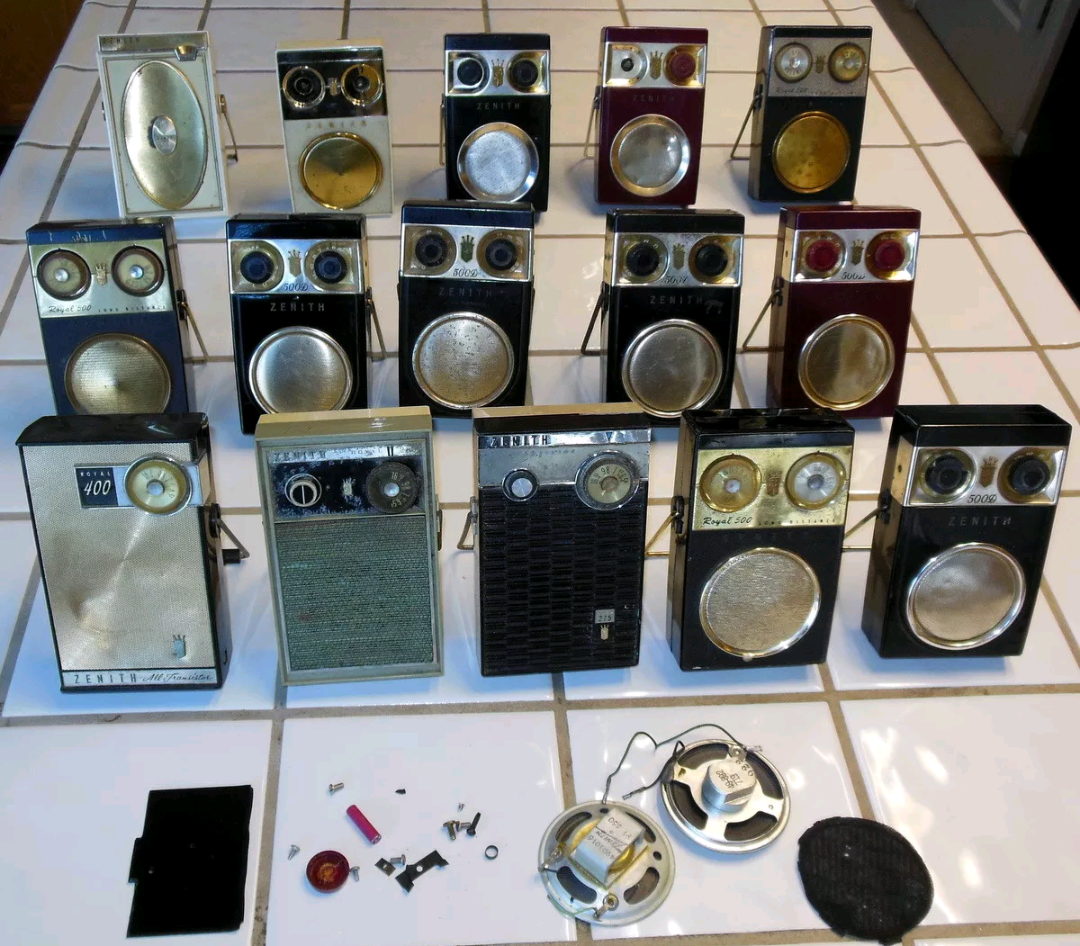
The seller did not put enough packing around the radios, but they survived the shipping.

So far I have downloaded several schematic diagrams for them.  I have an old Zenith TransOceanic Royal 1000, but I had never seen these smaller Zenith radios until now.  They have an RF amplifier stage, oscillator, mixer, IF, driver and push-pull output stages.

I opened most of them up.  The first one I worked on was the one with the oval speaker in the upper left corner.  Most of the problems seem to be mechanical.  The battery holders have corrosion from leaky batteries.  And the volume controls get worn out from use. 

I couldn’t power up the radio because the negative battery contact was mostly eaten away.  The other contacts were in much better shape.

I disassembled the radio, unscrewed and unsoldered the battery holder and drilled out the rivet holding the negative contact.  I cut out a similarly shaped contact out of a can lid, using a pair of scissors.  I used a 2-56 small screw and nut to hold the replacement contact in the battery holder, and reconnected the battery holder to  the circuit board.  Using a power supply, I powered up the radio and found that the volume control was defective – it was dead until turned nearly fully on, and then the radio was playing full blast.  So I unsoldered and removed the volume control, and tried to clean it.  But that didn’t help.  I opened it up and found the carbon element was falling apart.  It had to be replaced.

I spent hours looking for a replacement potentiometer.  I quickly found a guy on eBay who machined replacement pots, but he sells them for $26 apiece, which is nearly twice as much as I paid for each radio.  Someone suggested trying Parts Express, but they didn’t have anything close.

I tried Mouser’s search engine to see if I could find something close.  They have all those filtering  choices so I limited my choices, and it came back with nothing found.  I had to turn off one filter after another, and finally it gave me a few poor choices.  So essentially Mouser doesn’t stock anything like it.

 I tried DigiKey.  They had lots of filtering items to choose from, but the most important, the risistance, wasn’t anywhere to be found.  That was really dumb!

I thought I might be able to use a 10k slider pot, so I looked in my box of potentiometers and I found some 10k miniature pots with the 1/8 inch diameter shaft.  The threaded shaft was extra long for mounting in a very thick panel.  So I decided to try one to see if it would work.  I had to saw off and file the D shaft to get it to fit into the knob.  After a few times of adjustments to get it to fit, I soldered the wires on and powered it up.  It worked, but there is no on/off switch.  It was a linear taper, so to “delinearize” it, I put a resistor between the wiper and common.  I tried some values and found that about 680 ohms seemed to work good at making the volume spread out over its rotation.  I will explain this in my blog in the near future.

I tried to tune in some stations but I heard very little.  I found one strong one on about 820 on the dial.  I listened for awhile and heard 640 KFI, but it was way off.  I think someone had played with the adjustments.  I used a tiny screwdriver to adjust the RF osc coil to get this 640 station back to 640 on the dial.  That helped, but it still needs the other adjustments adjusted.  It needs to have a realignment like they would do at the factory.  

default

2017-09-23 Cellphone Charger Secret Circuit

Posted to FB Arduino group Sep 23

Mbihi Oliver

Four hours is twice as long as 2 hours with the correct charger.  Here is a secret many don’t know:  Smartphones don’t necessarily charge at maximum, especially if they’re charged by a charger not made for their phone.

Smartphones often have a sensing circuit that checks to see if the plug’s two data pins are connected a certain way, such as two resistors to + and -.  If so it tells the phone that it’s the correct charger and it will accept full current, 1.5 amps or more.

But if these pins are open or the wrong resistance, then it charges at a half amp, because the original USB port is only specified for 0.5 amp.  So it won’t blow out the USB port on your MoBo.

Does your homemade charger have this??  😱  😈

default

2017-09-21 Kid Was Totally Into Telephone Central Offices

Posted to FB Antique Telephones group as a reply to Kevin J. Fitzgerald 

I helped some students in our computer lab, and one high school kid, I think his name was Robert, was totally into phones.  He had written a Basic program that printed a list out, with the various exchanges in the 714 area code, and what type of exchange they were.  He could tell me what type of equipment the CO had, etc., etc.  He knew, just by listening to the call progression what it was.

I called him up one time, and put “dial tone” on the line, and he didn’t know that I had built two oscillators 350 and 440 Hz, that generated the dial tone.  But he tried the touch tones, and when nothing happened, he figured out that I was making the dial tone.  😄

default

2017-09-20 Use LM7805 To Charge Phone?

I posted this comment to FB Arduino group 2017-09-22.

“Can I use a 7805 (regulator IC) to charge my cell phone?”

The output is 5 volts, which is what the phone needs to charge.  But the average smart phone will take more than 1 amp, up to 2 amps to charge quickly.  The 7805 can’t put out that much current.  So your phone will take a lot longer to charge.

The 7805 is a huge power waster.  It works by wasting the excess voltage as heat.  You will have to use a large heatsink, because the 7805 will have to dissipate a lot of heat and it will get very hot.  If it gets too hot, the thermal protection that’s built in will shut it down and that will slow the charging down.

It’s better to use a DC-DC buck converter, which takes 12V at 1 amp and converts it into 5 volts at 2 amps, so your phone will charge much faster.  And there will be very little power wasted, it will not get so hot.  They are cheap, only a few dollars (US).  To find one, search for DC-DC buck converter USB.

default

2017-09-19 Giant ‘Analog Meter’ For Clock Display 

FB comment

“Brilliant!” Preet Sangha said, and I agree, but since I have a hard time seeing small meters across the room, I thought up another, bigger meter.  How about this?

Instead of meters, use a printout of a meter face, full page size.  There will be one for each hour, minute and second.  These will be attached to a thin board mounted in a picture frame.

Instead of the meter needle, attach a thin pointer to the rotor of a servo, and mount the servo where the meter movement would be, but behind the board.  The servo may be capable of rotating the needle through a larger portion of the circle than a meter, which might help increase resolution.  The whole setup would be controlled by an Arduino.

Also, I believe there are some meters that can rotate through 270 degrees, so use a printout of one of those.

Update – here’s a website where custom meter faces can be made.

http://meterbuilder.com/mb1/custom-meter-scales.html

default

2017-09-18 Telephone Auto Ringdown Circuits

From my comments on FB Telephone group 2017-09-23

Hot ringdown?  We had dozens of elevator lines that were configured to call an answering bureau as soon as the phone went off hook.  I don’t know what the technical term for them is because our account reps weren’t the brightest and gave us some other term, like automatic ringdown or whatever.  The ladies who ordered them wrote up the order so it said configured like so-and-so existing line.  It was my job to test them before calling the telco, because they would charge us $95 for just coming out.

I had one line that was going bad, and it kept going off hook intermittently.  Accounting told us that they got a bill for scores of calls, each one cost $.80, so the bill was costing a lot.  I got that one moved to a good pair that saved a lotta money.  😱  👍

default

2017-09-17 Telephone Loop Current And Security – DSL 

From comments in FB Telephone group 2017-09-24

Mark Grady

I remember the site we had across the street from the Santa Ana Bush St. CO.  Just for grins I checked the loop current:  Fifty-five milliamps!  Couldn’t get any closer than that!  The problem is that all the switching equipment in COs seem to have been eliminated and replaced with pair gain, and everything terminates in some remote CO nowhere nearby.  But thanks to demand for faster DSL speeds, most of the phone line pairs only make it to the local pair gain equipment down the street, where it turns into some bits in a bitstream with thousands of other bits on a fiber optic cable.  I guess that’s security by obscurity?  😎

More from same thread

Ray Vaughan:  I’ve seen an RT in the sidewalk in front of a CO.  I would like to hear the reason for that.

Me:  Perhaps it was put in before there were any inside?  Or the racks were filled up in the CO, or the equipment was a pilot program to see how well it worked with distant lines?  Or it was installed as equipment for training purposes.  

For security and testing reasons we put in a few DSL lines for the website developers.  We had a Lightspan 2000 in the comm room and Pac Bell could have added DSL lines to it.  But instead they installed them from the CO.  I asked why, the answer was it would cost thousands to add the equipment to the Lightspan.  👎

Then we cutover the MPOE to the new bldg.  We worked weekends with a guy named Dave from Pac Bell’s construction dept.  We got the DSL lines moved over and had dial tone okay.  But the DSL modems were showing nothing.  Turned out they had assigned the DSL lines to pairs that still had loading coils on them!  So Dave had to go to some vault in the middle of a busy street and remove the loading coils.  Duh!

© RustyBolt.Info/wordpress
CyberChimps
