default

2017-10-24 AT&T And The Breakup

From FB group Bell Telephone…  Oct 29, 30

to Ronald Cooper

Yeah, Touchtone is an excellent example of AT&T’s holding back technology.  Besides the customer paying them for a service that benefitted AT&T more, making the customer pay so much ($1.20 a month, when my phone bill was $10 to $15 a month), they gave the customer the ‘option’ of not having the service, which meant that the technology really was held back.  See back then you had no choice as to what phone you had installed.  If you chose to save $1.20 a month and not have Touchtone, then Ma Bell installed a rotary dial phone.  This meant that *no service* could be universally implemented!  The other services we take for granted today could not be implemented because only a fraction of the telco customers had Touchtone.  The list is endless!  VM, Answering Machines, Tellerphone banking, other forms of banking, many, many other services such as Rx reordering,  and the Big One that stabs at the heart of AT&T’s Cash Cow, the long distance phone cards.  It’s obvious that AT&T was trying to keep those from siphoning away their LD business.  I remember when Radio Shack, et al, sold Touchtone dialers to hold against the mouthpiece.  So in reality, AT&T never was willing to play on a level playing field.  “Have it our way, not your way.”
I had no intention of any political inference.  I’m not sure what you mean by ‘even without competition.’  AT&T was subject to tariffs, like the competition.  Tariffs were a double-edged sword.  They forced competition to charge the same price for a service thereby eliminating pressure to compete on price.  The consumer was paying $50 for a 1 hour call to another area code only 30 miles away.  Now my whole phone bill is only $35 a month, with nationwide free long distance.  That was not the way AT&T wanted it, and it was due to competition.

BTW, I heard that T-Mobile and Sprint are trying to merge.

default

2017-10-22 Royal 500 Battery Holder Contacts 

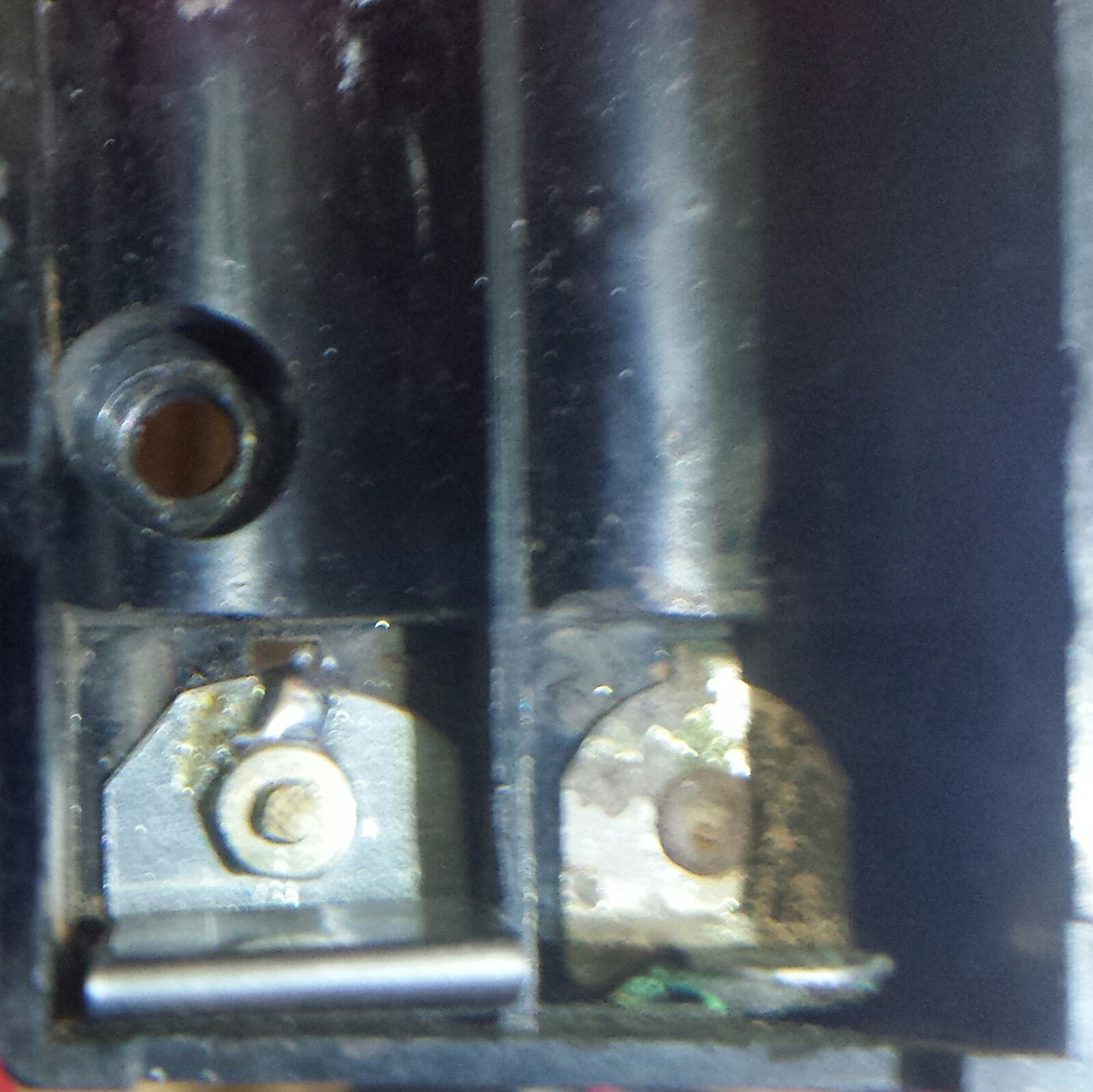
Here’s a photo of one contact I made from a tin can lid.  I cut it out with a scissors, and flattened and bent it with a hammer on a heavy block of steel.  It’s a bit blurry because I used a magnifying glass to get closer.

default

2017-10-21 Zenith Royal 500 Radio Problems

From FB group Vintage Transistor Radios

Jim LaFrance:

I’ve never found a Zenith that was not worthy of repair. Good solid builds!

me:
I agree; they’re solid, well designed radios.  Now that I have a bunch, my supply of old germanium transistors that I had accumulated seems inadequate, so I may have to start experimenting with silicon.  Rebiasing doesn’t seem to be a problem, but other considerations, such as higher gain and neutralization become important.

One thing I did see was the old carbon composition resistors go out of tolerance.  I found one that was labeled 1k, 10%, and it measured 1200 ohms.  Close enough to make the circuit seem to work, but not work very good.  So keep that in mind.  👍

default

2017-10-19 Santa Ana College Early History of Datacomm

From my post to FB group Bell Telephone…

We were having problems with one of our 4 wire point to multipoint datacomm circuits.  Every morning at a little after 9 AM the circuit would go down.  I called in the problem and a Pac Bell tech came out, but couldn’t find a problem.  Next day, same problem – another trouble ticket.  No problem found.  After the third time, the tech said to call it in as a chronic, and gave me his pager #.  Next day, I got him to come out when it was down, and he connected his butt set to see if he could hear some data.  Instead we were hearing a conversation, with someone at a bank!  I guess it was caused by a cable pair that appeared at more than one address (we were using almost all of 53 cable, and part of another cable, too.  We finally got a Lightspan to alleviate the cable overload.)

I think for my first ten years, my pursuing telco trouble tickets and keeping on top of the issues were paying for my salary.  We had dozens of dumb terminals around town all connected to the mainframe computer, when we lost a line, we might have a dozen or more employees sitting with nothing to do.  No wonder we were willing to pay hundreds of dollars a month for those lines.  We started out with a single multidrop line, and a few years later we split it into two lines due mainly to load, and eventually we ended up with four lines, all starting with 74FDDA.  When I came in 1980, the line had been in (and out of) service for probably 6 months but due to outages, those off campus sites were not able to depend on the data entry terminals, instead they just bundled up all the applications and paperwork and sent it over to the college for data entry.  Once I got the problems with the lines straightened out, the offcampus sites started to use the data entry terminals, and became dependent on them, and they put the off campus workers to work doing the data entry.  This, along with our programmers developing more applications, put more load on the whole system.  We had to upgrade the Honeywell Bull mainframes four times during the mainframe years, along with the other infrastructure.  The telephone key systems and switchboard went out and we put in PBX nodes, which still depended on Centrex features form Pac Bell’s Central Office.

This first datacomm line in 1980 was the start of our datacomm metropolitan area network.  We also had dozens of lines on campus that were also multidrop, through telephone cables between bldgs.  That’s how I started out learning about telephones and telecom infrastructure.

default

2017-10-18 USS Ticonderoga Comm System

From my post to FB group Bell Telephone…

Around 1967 I was on leave from the army, and our mentor took a friend and I down to San Diego to troubleshoot the comms system on the USS Ticonderoga.  Here I was on leave from eating in a mess hall, and we ate lunch in the ship’s mess hall.  They had Strowger switches, and I nosed around and found out what was causing the constant alarm condition: it was a piece of a cleaning rag stuck between the contacts!  Here was an example of cleanliness causing problems.  Our mentor went about his business doing other things, and between us we got things straightened out.  And our mentor ended up collecting a nice bit of $$ for a day’s work.  I guess this was my first intro to telephone switching equipment, if you can call the ship’s comm system a central office.

I just remembered that one other thing our mentor did was clean the contacts of the generator / interruptor that generated dial tone, busy signal, etc.

default

2017-10-16 AT&T Breakup

From comments on FB group Bell Telephone..

Ed Vaughn said:

That story makes me ill.  Why break what was perhaps the best-run machine in the world?
I replied:

Why?  Well, it wasn’t the first time AT&T was forced to comply with government’s decisions.  Like you said, it was a machine, and whether or not it was run well wasn’t the problem.  The problem was technology marched ahead, but AT&T was stuck with 30 year amortization of equipment that was obsolete after 5 years.  MCI ran rings around Ma Bell, charging less than a nickel a minute for long distance when AT&T was charging a dime.

To me, AT&T was a pioneer in research, but too old and stodgy – not progressive enough – in the use of their research and patents.  Many experts believe that had things remained the same, we would never have advanced technologically to the point we’re at today.

The deed was done and there’s no going back.  The breakup benefitted the consumer in many ways.  The same thing happened to Standard Oil.  It will happen again some day.

default

2017-10-15 Royal Transistor Radio Making Battery Contacts

I have had to make several contacts for the Zenith Royal 500 transistor radios, and I’m only on the second radio refurbishing.  Most of the problems have been mechanical – worn volume controls, tuning capacitor shorted because the screw for the trimmer capacitor was grounding, and bad battery contacts.  The battery contacts have been horribly corroded, to the point where they are disintegrated or fall apart.  There was nothing to repair.  So I have been replacing them with sheet steel I cut from a tin can lid with scissors.

The first two I made were single thickness, and work okay.  The third one I made this morning by folding the sheet in half and flattening it, then bending it to shape and drilling a hole for the screw.  The spring is twice as strong but it seems to work okay.  Since it is two layers, the battery liquid will go between the layers and quickly corrode it.  It will have to be replaced even more often.  But these radios were made around 1960 and have lasted more than 50 years, so I don’t think that’s a big problem.

I made this double thickness contact in the wrong order.  The right order is the following.

Cut the steel lid a bit wider than the original contact.  The excess will be trimmed off later.  It should be about 2-5/8 inches long.

Use a hammer and pound the sheet flat on a smooth, flat surface.  File off the sharp edges.  Then using sandpaper, sand off any paint or varnish.

Measure and fold the sheet in half.  Flatten with the hammer.

Make the 90 degree bend farthest from the folded end.  Then make the 170 degree bend close to the folded end.

Drill the hole for the screw in the 90 degree end.  This hole should be slightly bigger than the 2-56 screw.  Check the size and trim excess with the scissors.

Before putting the screw in, put the solid copper wire through the hole and solder it to the contact.  After it has cooled, secure it with the 2-56 by 3/16 inch screw and nut.

Repeat as necessary.  So far I’ve only had to replace the contacts closest to the bottom probably because the battery juice runs downward.

default

2017-10-13 Fri 13 More Telephone Tales

FB Telephone group

My least favorite part of the job was doing the crossconnects after new underground cables were installed.  The contractor’s guys had punched down the cables and spread icky pic all over everything, walls, backboards, blocks, everything!  I’d do some work and go to lunch and have to wash that jelly off from all over!  Messy, messy, messy!  And then after lunch another bath in the stuff.  People must’ve thought I was weird!

default

2017-10-12 Telephone 66 Blocks

More from FB Telephone group.  Continued from yesterday’s thread.

Yeah, those numbers sound familiar.  When we cutover to the digital PBXs, all those key systems were abandoned, and all of the hundred pair cables between bldgs were only partially used.  I pulled of most of the crossconnect wires, so there wasn’t much need for more pairs.  I just had to remember that all those bare 66 blocks were bare *for that reason*.

And then there was the time when they built an addition into the main bldg where the MPOE was.  The foundation contractor augured through the conduits and phones in other bldgs went dead.  Since they goofed and I wasn’t dealing with underground cable, they got a contractor to fix the cables.  Oh, well…

default

2017-10-11 Telephone PBXs and Heat

From FB group Bell Telephone 

Yeah, that’s the problem.  Them fans whining all the time, and having to rinse out the filters in the bathroom every 6 months to keep the PBXs from overheating.  I had to get the a/c guys to come to the phone room often and blow out the mold clogging the condensate drain pipe.  There was a float switch that shut off the a/c, and the water would back up and shut down the a/c.  In an hour or so we’d get complaints from users of dead phones, and I’d go to the MPOE and find it 100 plus degrees inside.  Sometimes I could get a fan to blow some outside air into the room and get things running again.  It’s always the weakest point that causes big problems.  “For want of a nail, the race was lost.”

Another comment 

I started seeing  correlation between the fields of the various colors of the mushroom holders and the way things were done with digital configuration.  I never had to learn what all those meant because the key equipment was abandoned when I took over.  But like when we moved into the old Wells Fargo Bank bldg on the corner of Main St (Broadway) and Santa Clara in Santa Ana, each floor had a closet with 20 linear feet of backboard covered with green, blue, pink fields of 66 blocks.  Most of the copper cables had been scrapped, so I did a lot of demolition just so the crossconnects could be removed.  Made it a lot easier to track down problems.

Another comment

The only thing I noticed was the 66 blocks were different.  Some were 6 across, and were great for punching down phone lines going to multiple bldgs.  But there were mostly ‘split’ 66 blocks, 25 pair on each side.  One time I punched down a 25 pair, and then found out the block was all four pins connected across.  Aww, spit!  I had to repunch it down to another split block.  😥
Pac Bell did the installation of the key system in a bldg complex in Centennial Park.  I took over the support in 1990.  I found that a whole bunch of 100 pair underground cable was not being used, and the unused part was always on the right side of the blocks.  But I could get dial tone on them.  Short story is the 66 blocks they installed on the far end were not split, so the lines were going from the MPOE to the far end on pairs 1 thru 25, and going thru the unsplit blocks and back to the MPOE on pairs 51 thru 75!  So half the 100 pair couldn’t be used because someone screwed up and used the unsplit blocks! 

© RustyBolt.Info/wordpress
CyberChimps