default

2012-04-02 News Media Facts

on April 2nd, 2012 by - Comments Off on 2012-04-02 News Media Facts

Perhaps this is the reason why things aren’t the way they should be.  The media is totally filled with ‘news’ of Trayvon Martin, a single unjustified death, while thousands are being killed in Syria and it hardly makes the news.

It may also be the reason why elections turn out the way they do.

default

2012-04-02 E85 and Biodiesel – The Law Of Unintended Consequences

on April 2nd, 2012 by - Comments Off on 2012-04-02 E85 and Biodiesel – The Law Of Unintended Consequences

I finally received the books I ordered from Amazon, one of which is Cy Tymony’s Sneakiest Uses For Everyday Things.  In the section Sneaky Energy Projects and Simulations he gives some interesting information.  One such tidbit: currently in the U.S. less than 4 percent of the car market is diesel, while in Europe over 50 percent of the passenger vehicles are diesel powered (see note at end).

In this section he illustrates the Biodiesel Carbon Cycle.  He shows that the renewable source for the fuel, such as Canola oil, is removing CO2 from the atmosphere, so the carbon dioxide ‘greenhouse gas’ is being removed as it is generated by the vehicles.

In the next section he discusses “E85”, also known as Gasohol, and how ethanol is made, which also requires the use of plants; at this time it’s mostly made from corn.  It’s my understanding that the government passed a law that required vehicle makers to manufacture a certain percentage of vehicles, that were “Flex Fuel”, which means they can run on either gasoline or E85.  As I drive down the road on occasion I see a car with the Flex Fuel emblem on the back, so these vehicles are out there and ready to run on E85.  But in Southern California, I have never seen a gas station that sells E85.

And I believe this is the way it should be, and I hope it stays that way.  Why?  Because the whole E85 or gasohol idea has obeyed the law of unintended consequences (see note below).  As a result of the drive to get more vehicles running on Ethanol, plants were built to process corn into ethanol.  More corn was diverted to the plants, which increased the demand for corn.  The price of corn went up, and other food products using corn became more expensive.

The price of corn that was being produced increased, so agribusiness (farmers) saw an opportunity to make more money by growing corn instead of other crops such as wheat, so they switched to corn.  As a result, the supply of wheat and other crops was reduced, and their prices in turn increased.  So consumers had to pay more for such things as bread.

As the supply of other grains in the U.S. became smaller and more expensive, the grains that were being exported from the U.S. to other countries was reduced as other less expensive grain sources were found.  The world supply and demand of these commodities was being changed.

As the world population grows past the 7 billion point, the demand for commodity food such as these grains has been on the increase.  But the supply of grains for food has been diminishing because of the above fuel demands, so there is greater pressure on the increasing prices.  In many countries, the amount of farmland has been decreasing because of desertification caused by global warming, and because the suburbs of cities have sprawled into the country, causing farmland to be lost to urbanization.

But people don’t realize that there are penalties for growing these crops.  Here in the U.S., the crops require fertilizer, herbicides and insecticides.  All of these chemicals are made from fossil fuels such as petroleum.  And these crops have to be cultivated, harvested, transported and converted into biodiesel and ethanol, which is done by machinery that runs on non-renewable fuels.  So in reality, the ethanol that is being used is only partly from renewable sources and partly from non-renewable sources.

Do we all get the picture?  The biodiesel and ethanol fuels aren’t as ‘green’ as they’re made out to be.  And the law of unintended consequences has given us a change that has caused negative results for the population of the whole world.

Note: In his statement I smell some weasel words.  When he says passenger vehicles, that could be a very wide selection of vehicles.  For instance, isn’t a bus a passenger vehicle?  How about a passenger train?  In Europe, gas is twice as expensive as here in the U.S., so there are fewer cars, and more people take public transportation, so even though over half of the passenger vehicles are diesel, it seems that that doesn’t necessarily mean that over half of the cars are diesel.

Wikipedia gives three definitions for The Law Of Unintended Consequences, and this is the one I had in mind:

“A perverse effect contrary to what was originally intended (when an intended solution makes a problem worse), such as when a policy has a perverse incentive that causes actions opposite to what was intended.”

The reason I wrote this blog was not to show just how this law applies to biodiesel and E85. I also meant it to help people realize that it also applies to other technologies that we are deploying.  For instance, what is the real cost of solar electric power, in the amount of non-renewables it takes to build a large solar electric generating plant?

Update Aug 4, ’12 – I was watching America Revealed, where they trace sources of the foods we eat. They said that in the supermarket, one third of the items are made with corn.  Also, California farmers use 80 percent of the state’s water. The remaining 20 percent has to meet a growing demand from an ever growing population.

Then there’s the European corn borer worm, which can ruin the corn crop.  This requires the farmer to spray insecticide over the fields.  So now that ‘renewable’ ethanol that’s made from corn really is using non-renewable fossil fuel, used to make the insecticide, and also the fertilizers used in the corn fields.

They said those round crop circles are watered by well water, which comes from the Ogallala aquifer deep underground.  All that irrigation for the corn is depleting the aquifer, so there is another non-renewable resource that will disappear.  And the water has to be pumped by powerful pumps, which again use non-renewable energy.  You can now see the law of unintended consequences creeping in.

default

2012-04-01 BC337-40 Joule Thief

on April 1st, 2012 by - Comments Off on 2012-04-01 BC337-40 Joule Thief

I got a bunch of BC337-40 transistors; I don’t know why since I already have hundreds of BC338s and I haven’t really used a lot of them in years (see note).  I have been using the BC337-25s because I felt that it was more representative of what the average transistor is going to be when the average experimenter gets hold of a transistor.  The difference is in the current gain: the -25s have current gains centered around 250, the -40s are centered around 400.  If I pick a 2N4401 or a PN2222A, it is going to be closer to the BC337-25 than the -40, so comparisons are going to be more equal, without a big advantage for the BC337-25.  If you want to see the actual specifications, do a search for the two words BC337 datasheet or PN2222A datasheet etc.

I reckoned the BC337-40 was going to be a hotter performing transistor in a JT.  So I heated up the soldering iron and put one together.  For the core I used a 1/2 inch core from All Electronics, cat. no. TOR-23 (no longer sold).  I bifilar wound about 13 turns of 24AWG solid insulated telephone wire, and measured the inductance of each at 83 microhenrys.  I used a 1k resistor and a white LED.  At 1.5V supply V, it drew 140 mA, and the frequency was 43 kHz.  In comparison, the -25 usually draws about 100 mA at this voltage, so as I said, this -40 is hotter performing.

I didn’t put a 1 ohm resistor in series with the LED, so I couldn’t measure the LED current, but it was very bright, and from past experience I guesstimated that the current was well above 20 milliamps, so I decided that I had to reduce it some.  I put a 100k (logarithmic audio) pot in series with the 1k, and powered it back up.  I adjusted the pot until the supply current was under 100 mA, and powered it down and measured the total resistance at a little under 5k.  I powered it back up, and adjusted the pot to its maximum resistance and the LED went dark.  As I turned the pot down, the LED started to light and the frequency was over 180 kHz.  As I further reduced the pot, the LED brightness jumped, and the frequency jumped, too – there were some kind of mode changes as I adjusted it.  Further reduction brought the supply current up to about 80 mA, where the frequency was 60kHz and the LED was bright.

Conclusion  If the BC337-40 is used for a JT, the 1k resistor will give greater than average LED and supply current.  The resistor should be somewhere around 4000 to 5000 ohms, with 4.7k seeming to be a good choice.   I’ll have to try a few more to confirm these results, but I can say that the results are right about where they would be expected to be, all things considered. And it confirms my ‘theory’ that the BC337-40 is a hot performer.

I measured a couple BC337-40s on the cheapo DMM’s hFE range.  The first one measured over 600, the second one measured over 650.  That’s very high, but the measurement is taken at low current.  It’s not representative of the gain of the transistor in the JT because the current is much greater.  I measured a few BC337-25s and they were about 350 to 400.  In contrast, a few PN2222As measured around 200.

Note: A long time ago I ordered a hundred of the BC337s from Futurlec, and they sent me the BC337-25.  I didn’t know which ones they would send because they don’t say in their list.  Later when I got the BC338s, they were genuine Philips, and not marked with a dash suffix.  Theoretically I should have received an even distribution of all three gain ranges, -16, -25 and -40, in the mix.  But since they were from an eBay seller,  I could not be certain they were evenly distributed.  I do know that the BC338s perform as expected in a JT circuit.

Back to experimenting…

default

2012-03-31 Screwdrivers Screws Etc.

on March 31st, 2012 by - Comments Off on 2012-03-31 Screwdrivers Screws Etc.

Bill ‘Botronics‘ Sherman said he was reading a sample page from “Unscrewed” on Google Play Books. There was a note about the Phillips screw.  Long ago, a guy once told me that it would be torture to change the screws and screwdrivers on their assembly line from Phillips back to blade screws.

But every telephone and piece of equipment in the ‘Bell System’ used blade screws.  I believe that they solved this problem on the production lines by using blades that were recessed inside of a sleeve, to keep the blade centered in the slot.

The techs in the field used a regular blade screwdriver.  It used to be that the telephone wiring was terminated with blade screws.  Ma Bell was known for doing work efficiency studies, so it seems odd that the Phillips driver was not used sooner.  However they developed the IDC connectors, insulation displacement where the wire is not stripped, but the tool forces the wire into a slot that cuts though the insulation and terminates the wire in a gas-tight connection.

And one of the biggest labor saving and frustrating additions to the telephone wiring was invented by Ma Bell.  The modular connector started out as a larger connector, then became what it is today.  And everyone has had the experience of dealing aith its inherent weakness, that little clicker that breaks off and lets the plug slip out of the jack.  Recently I saw a telephone with a dozen layers of adhesive tape over the jack where the coiled cord went into the handset.  It’s really frustrating to have to listen to someone when there are constant interruptions caused by an intermittent connection in a modular plug.

What I find frustrating is when someone breaks the clicker off a plug and then plugs it back into a patch panel or switch port.  I do some work on an unrelated connection in the patch panel or switch, and we later get a complaint of another outage in the same panel.  Well, all one has to do is move the wiring a little bit and that other broken plug wiggles out of its jack, all because someone was lazy and didn’t fix the patch cord with the broken plug.

Then there is this contractor that installed a 48 port patch panel.  The patch panel was made by CDT, which has unique connectors on the back of their jacks.  Some companies put snap-on covers over the connectors, but this company went to ridiculous lengths.  Each of the four pairs of the cat5 cable must be threaded through four holes in a red termination bar, which is then snapped into the connector before the wires are terminated.  This takes considerably longer than it would for the connectors from other manufacturers.

Well, the installer put one of the connectors in with the red termination bar, and seeing that it was going to take a long time, went and did the remaining 47 without the red bar.  A year or less later, we get a complaint that one workstation was down, unable to get on the network. I go into the patch panel to fix the loose wire and find that the problem was on one of the 47 that were terminated without the red bar.  I talked to my boss about it, and I recommended he get the contractor out and fix all 46 remaining ports; he sounded unsympathetic.

Less than a year later, we get another complaint about a workstation in the same location that can’t get on the network.  I again go into the patch panel and find that the loose wire is again caused by another one of the same 47 that were missing the red bar.  By this time I’m really angry because the problem was caused by someone else’s poor workmanship and more of the same problems are going to happen in the future.  I had to go on the warpath and email the contractor more than once to get them to send out a tech, who spent the better part of a day replacing all of the connections with the red termination bars.  We haven’t had another problem since.  And my boss complained that I was “always complaining about the contractor.”  That boss is no longer a boss. 🙂

Back to the screwdrivers.  I found this completely amusing.

default

2012-03-30 16 LED Keyboard Light, HP 721 P.S and eBay

on March 30th, 2012 by - Comments Off on 2012-03-30 16 LED Keyboard Light, HP 721 P.S and eBay

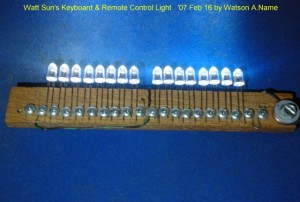
I made this and I used an old HP 721 power supply set at 31 volts to power the LEDs.  The 8 LEDs on each side of the middle are in series and add up to about 25 volts.  The two sides are then connected in parallel. The 721 PS is set for 30 mA constant current and the power supply adjusts the voltage to give about 15 mA per LED string.

I mounted the wood strip on a piece of 8 gauge solid copper wire, which I clamped to the edge of the desk.  I can bend the copper wire like a gooseneck lamp to direct the light to wherever I want.  The individual LEDs can be positioned (bent) to adjust the light pattern to an area a few feet away.

About the only complaint I had when I made it several years ago was that the price of good quality white LEDs was at about a dollar apiece.  So this light cost $16 just for the LEDs.  I think I paid less for the HP 721 PS if the shipping isn’t included.  Well, actually, I did pay more for the 721 at first.  I won the bid on eBay, and the seller claimed it worked.  But the seller sold me a lemon.  The voltage on the meter could be adjusted with no load on the output.  But when I put the slightest load on it, the voltage would plummet from 9V for example, down to just a volt or so.  It wasn’t regulating.  I opened it up and put a 470 uF electrolytic capacitor across the main filter capacitor, and connected the load.  Bingo!  It was regulating great.  So I soldered the cap in, and put some silicone seal to hold it in place.  That was the nice thing about that ancient power supply: there was plenty of space inside for an extra capacitor.

I complained to the seller.  I think he knew all along that there was a problem – in fact that was most likely the reason he sold it.  So after a few haggling emails back and forth, he agreed to refund some of the money.  So I guess the final price was a bit less than what the LEDs cost.

I checked eBay recently and I can’t believe that there are sellers trying to sell these ancient power supplies for a hundred dollars, and shipping brings the cost up to $120 or more.  And to top it off, they stopped putting these up for bid; instead they sell at a fixed price (“buy it now”), with the “or make offer”.  I see some that have more than one offer, but I’m certain that the offers are far below $100.00.  Also, they say “The item may have some signs of cosmetic wear, but is fully operational and functions as intended.” and the power supply has a knob that is broken or missing.  That’s a bit more than cosmetic wear!

The 721 also had a good, strong aluminum case.  Then HP came out with the 6214 and 6216, etc. series of power supplies with a plastic case.  These HP 6214 power supplies are built with all discrete semiconductors (no chips), and are well designed, but they have one fatal weakness.  After 10 years or so the plastic turned brittle and if you try to snap off the plastic ring to open the case, it would most likely shatter.  That’s why you might see these power supplies held together with duct tape(!)  The case would break too.  I won a bid for one 6214 from a stupid seller, who packed the power supply in a cardboard box that was not much bigger than the power supply.  There was no padding around the power supply, so when I opened the package, I found a hole in the case big enough to put three fingers through, and plastic pieces all over.  I took a picture and emailed it to the seller, and I sent it back and got a refund.

I won a bid on another 6214 power supply from a local seller, and I made arrangements to go over to his house and pick it up and pay for it.  While I was there,  I talked to him about the brittle plastic problem, and he said he knew about it, too.  He showed me a couple power supplies that had a shattered case.  We made a deal, and he sold them to me for some extra cash I had in my pocket.  So I now have a couple spare power supplies laying in pieces in a box. Those are my spare parts if something goes wrong with the ones that are still in one piece.  The problem is that it’s most likely that if I try to take one apart ti fix it, the case will splinter into pieces.

Other HP power supplies that I’ve bought on eBay have had the same electrolytic capacitor problem.  After a dozen or so years the electrolyte leaks out and/or dries up and the capacitor acts like an open.  A few dollars worth of electrolytic capacitors fixes the problem.  But the sellers lie about the power supply working, and you won’t know until you plug it in and test it with a load.

Back to experimenting – and swearing that I will never, ever buy another used item from eBay.

default

2012-03-29 Aztec Computer

on March 29th, 2012 by - Comments Off on 2012-03-29 Aztec Computer

Quantsuff sent me a pic of an Aztec PC.  I don’t see any CD/DVD slot or button, leading me to believe that this was just a drawing from someone’s imagination.  But it looks cool in a Steampunk kind of way.

Speaking of Mayan Calendars, isn’t this year, according to their calendar, supposed to be the end of the world?

I once saw that calendar, cast out of bronze, more than a meter across and probably weighed a quarter ton, hanging over the headboard in a bedroom.  Scary thought in So Calif, where an earthquake might cause it to turn you into a grease spot in your own bed.  Mitigating circumstance: the concrete house was built by a wealthy oil magnate by the name of Carbon Dubbs, who sandblasted the wooden forms before the concrete was poured in, making the concrete walls take on a wood grained appearance.  Cool!  The house was built stronger than a brick outhouse, so that kind of weight on the wall was not a big thing.

I found it amusing when I read about the archeologists’ explorations in the pyramids of Mexico.  It turned out that the builders built pyramid upon pyramid, each bigger than the rest.  Wouldn’t it be really weird if you opened up this computer, and inside found an Apple 2?  Then you open the Apple’s lid, and find a calculator built by Babbage…


default

2012-03-27 Peltier Thermoelectric Generators

on March 27th, 2012 by - Comments Off on 2012-03-27 Peltier Thermoelectric Generators

Andy asked me about Peltier junction TEGs (thermoelectric generators) in the Yahoo group Joulethief.  The only thermoelectric generators I’ve experimented with are the thermocouples used in natural gas  appliances to shut them off if the pilot light goes out.  Nowadays these may be getting rarer because the energy efficiency is seriously reduced by a pilot light.  I have never experimented with a Peltier junction device, even though they have been around for a long time.  I think it’s obvious why few people have done any real experimentation with these.  I must also state that I am not a thermoelectric engineer or expert in this field so I can only summarize what others have stated about this subject.

HOT!  The first and probably main reason is that Peltiers depend on a large difference in temperature, which means that the most likely way to make them work is to make them hot on one side.  So we get into heating them with something that burns, and that can pose a fire hazard.  Along with that, there is the problem of the high temperatures causing corrosion and failure of the devices.  High temperatures and electronic devices do not get along.

Where?   I’ve looked through many electronics websites and I seldom see Peltiers.  They kind of remain a scientific curiosity, mainly used for training purposes – kits that people can assemble and make a motor turn with a candle, for example.  I’m not saying they aren’t used commercially.  I have read that some car makers are (or will) put TEGs on the exhaust system to recover wasted energy and generate electricity.

I have also seen them used in coolers to keep them cold.  But the way Peltiers work is to use power to move the heat away from the cooler.  The power needed to do this is added to the heat that is moved, so the Peltiers get hot on the outside, and that heat has to be dissipated.

Back to generation.   To make electricity we must have a steady and reliable source of heat.  We have a source of heat in the vehicle’s exhaust system, but it varies a lot and the vehicle is not running much of the time.

The flue of a heating system, stove, boiler or similar is another source.  But will this system be running year round?  To save on fuel bills, it’s likely the heat will be off a lot during warmer times (well, maybe not in Antarctica).  We could use a solar concentrator to get heat from the sun, but it’s not operating during the night time.  And I’ve also read that the cost of solar photovoltaic panels has dropped a lot in the last few years, so it would most likely be more expensive in dollars per watt to use TEGs in place of solar PV panels.

Old Fashioned?   Most people have forgotten that man’s first method of generating commercial electricity was with heat.  The heat was used to boil water, to make steam, to drive a steam engine, to turn the electric generator.  This is still how it’s done today, but the steam engine has been replaced with a turbine.  Are we old fashioned and should we convert to Peltier TEGs?  The old fashioned way is probably more efficient, and undoubtedly less expensive than Peltier TEGs.

Efficiency  I have read that Peltiers are not very efficient.  That’s not a problem if the TEG is being used where the heat is waste heat, in other words, the heat is a byproduct of some other process and is normally not used.  A good example is the heat from vehicle exhaust.  But if the TEG is going to be used in an electric generator where the fuel is expensive then the difference in efficiency could make the difference in whether or not the generator is capable of staying in business.  In that case, older technology such as the steam engine would be the choice.

As I said, I’m not an expert in this field.  But I have seen up close electric power plants that use heat to generate electric power, in megawatt quantities.  I see a typical emergency power plant that consists of a diesel engine of well over a thousand horsepower coupled to a generator that can put out a thousand kilowatts or a megawatt.  Along with the fuel tank the plant takes up room the size of half a small house.  These plants are for emergency backup purposes and efficiency is not a major concern because the plant may run for much less than a thousand hours over the period of its lifetime — a few decades.

Needs Radical Change  If it were to be used for a primary  electricity source, then efficiency would be a major concern.  In my opinion, I believe there could be improvements in the efficiency of this type of generating plant if it were radically redesigned to take advantage of modern engineering knowledge.

Since this is a fixed installation there are no concerns about weight and size.  I believe that the engine and generator could be more fully integrated so that less losses and hence more efficiency could be obtained.  I assume that is what the power plant designers did when they switched from engines to gas turbine generators.  This is a mature technology, but it seems to have never been applied to power plants less than a megawatt in size.  Why?  Is it that the industry has assumed that there would be no demand for smaller power plants?

It looks like I’ve strayed far away from the topic of Peltier TEGs, doesn’t it?  But could there be room for competition from another technology, called fuel cells?  These have few or no moving parts, like the Peltier TEGs.  There have been installations of fuel cells used for running industrial plants, but I have never heard of them being used commercially in homes or large scale power plants.  I guess one reason may be that they use precious metals such as platinum, so the expense may be prohibitive.

More later…

Send comments to my yahoo.com email address acmefixer.

default

2012-03-25 Joule Thieves

on March 25th, 2012 by - Comments Off on 2012-03-25 Joule Thieves

I get these Google Alerts for Joule Thief, and almost all of them are for the circuits that are discussed here.  But  lately some alerts have been for other totally unrelated Joule Thief stuff.  A few recent ones have been for some musical group, which has picked up on the Joule Thief name.  But this morning I got another unrelated one, involving real thieves.  Well, it’s nice to know that there really are thieves that steal Joules.


default

2012-03-24 Joule Thief Powers 120VAC LED Night Light

on March 24th, 2012 by - Comments Off on 2012-03-24 Joule Thief Powers 120VAC LED Night Light

I received a Google Alert with a link for this Youtube video of a JT powering a LED night light.  I have some thoughts that I’d like to share.

A LED or three in a night light may take only a quarter watt or less, if run from a battery.  But when run from the 120VAC, there is a huge difference in the voltage of the supply and the LEDs.  What do we do to allow the LEDs to be connected to 120VAC?  Well, the difference has to be removed, by dropping the difference across a resistance, reactance, or combination of the two, impedance, or by conversion.

Let’s look at conversion first.  If you plug your laptop or PC into the wall, the power supply or adapter converts the 120VAC to a dozen volts or so, or multiple voltages at 12 volts, 5 volts, etc.  This switching power supply does several funcyions, is too complicated and too expensive to be used to power a LED night light from the wall.

Instead, the other method is used to drop the excess voltage because it is cheaper and simpler.  A resistance or reactance, or both is/are connected in series with the LED or LEDs, and the voltage difference appears across this or these components. Picture this: a ‘voltage dropper’ and a LED connected in series and then connected across the power plug pins.

If a resistance is used, the circuit is very inefficient.  A LED typically needs 20 milliamps or 0.02 amp of current.  The voltage drop is 3.3 volts for a single LED.  So the remaining voltage, about 115 volts, has to drop across the resistance or reactance, or both.

Let’s do the math for a resistance.  The 115 volts at 0.02 amps is 2.3 watts, and for the LED, 3.3 volts at 0.02 amps is 0.066 of a watt. This comes out to 2.8 percent of the power in the LED, and the remaining 97.2 percent of the power in the resistance.  Essentially, the 2.3 watts is being wasted as heat.  This is very poor efficiency and wasteful of power.

How do we get around this waste?  If we replace the resistance with a capacitance, the excess voltage is dropped across the reactance of the capacitor and the capacitor dissipates almost no heat.  We can have our cake and eat it, so to speak.

Now for the Joule Thief  Instead of using a wasteful resistor, the LED night light uses a capacitor to drop the excess voltage.  When we connect the Joule thief circuit with its 700 or more turns coil to the LED night light, this capacitor is dropping most of the JT’s voltage and the remaining is used to light the LED.  The big difference between the power at the wall socket and the Joule Thief’s output is that the frequency of the wall socket is 60 Hz, but the Joule Thief is a thousand or more times higher, or 60kHz or more.

Since the capacitor’s reactance depends on frequency, and the frequency is much higher, the reactance is much lower, since a capacitor’s reactance varies as the inverse of the frequency.  Therefore since the frequency is a thousand times higher, the reactance is a thousand times lower.  At 60 kilohertz, it should take much less voltage from the Joule Thief to light the LED brightly.

Skip the following paragraph if you don’t understand the math.  The LED night light needs a capacitor to drop the voltage at 60 Hz.  This cap must have a reactance of 115 volts divided by 0.02 amps, or 5750 ohms.  The value of this cap at 60 Hz. is 1 divided by 2, divided by Pi, divided by 60 Hz, divided by 5750 ohms reactance.  This turns out to be 0.46 microfarad, or rounded to the nearest common value, 0.47 microfarad or 470 nanofarads.  If we look inside of the nightlight we should find a 0.47 uF capacitor in there.  It might be marked U47J250 or something similar.

At 60 kHz, the 0.47 uF capacitor has a reactance of 1/1000 of 60 Hz, or 5.75 ohms.  This is practically nothing when it’s in series with the LED.  The full 120VAC will not be needed to light up the LED night light; it should light up brightly at a much, much lower voltage with the 60kHz JT output connected to it.

But how will this higher frequency affect the rest of the LED night light circuit?  If the circuit uses a 1N4005 or similar rectifier, it will have a very slow reverse recovery time because it was made to operat at 69 Hz,  The 60kHz from the JT will be rectified very inefficiently, which could waste a lot of the power.

default

2012-03-23 Mondo Magnets: 40 .. Demonstrations

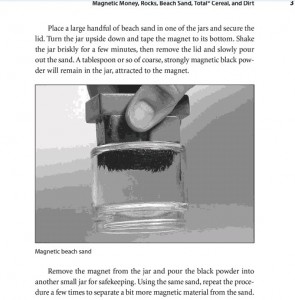
I was checking out the book Mondo Magnets… by Fred Jeffers on Amazon.  This book can be purchased used for a very reasonable price – I bought a different book for $.01, that’s one cent U.S.   I clicked on the “Search Inside” and read about an easy way to separate iron powder from garden dirt or beach sand.  I think this will interest a lot of experimenters because they can use this iron powder to make cores for coils.  The powder is mixed with a binder, such as glue or epoxy, and formed into the shape of the core.  But it may take a bit of effort to separate enough powder to make the cores for a project. so I thought I would show one of the pictures (it’s “fair use”) of how it could be done.

There are many cool experiments in this book.  I have  been disassembling hard disk drives (the data must be obliterated – see Note) and I’ve retrieved several of the magnets that are used to drive the heads.  They are so powerful that they can snap together and pinch your finger and draw blood.  Ouch!  I’m hoping I can put some of these to good use, because my fridge and desk at work are being covered with them.  And I’ve already given a couple dozen to the Physics Dept.

BTW, did you know that iron is fourth most abundant element on earth?  No wonder dirt has it!

Another interesting fact about iron. Iron is made by the stars, as are the other heavier elements.  Why is your blood red?  Because it has hemoglobin.  The hemoglobin is red because it has iron in it.  That’s why we are all made from stardust.

Note: We were required to, and have been using a program called DBAN to ‘nuke’ the disk drives. This is a program that uses Linux for the OS and  runs from a floppy, and back in the days of 10GB hard disks, we could put the floppy in, turn on the PC, and the disk would boot, and immediately start overwriting the hard disk multiple times with a pattern, making it impossible to recover any data from it.  As a result, it is thorough but slow, and would take a few hours for a 10GB disk.  When disks got to 40GB, it took 9 hours to wipe the hard disk – the limiting factor is the speed of the hard disk.  Nowadays hard disks have far exceeded that size, and it’s not practical to run it overnight or for a day or more when we have dozens of PCs taken out of service.  We have Dell desktop PCs and it takes only a minute to pop it open, unplug the hard drive and snap it out of the PC and put it in a pile with the others, so that’s what we do.  I’ve been disassembling the smaller 10GB or so disks and collecting the magnets on the sides of a file cabinet and desk.

© RustyBolt.Info/wordpress
CyberChimps