default

2015-06-01 Brains Of A Cricket

Late last month I had to discontinue my credit card for an unrelated reason and get a new one.  I had no problems changing with T-Mobile.  I called up the Cricket Mobile service and had them change the CC number.  But a day or so later I got messages to the contrary, so instead of spending time on hold, I went online and attempted to change it.  But I found that I had to delete my old autopay before it would let me put the new autopay CC number in.  So I finally got that taken care of, or at least I thought so.

Yesterday I got an email asking why I hadn’t answered texts.  I checked my phone and I had no service!  So I again went online to Cricket’s website.  It said I _still_ owed $40, which is what I should pay without autopay.  In other words, autopay was deactivated.  So I reactivated it and paid earlier today.  I still haven’t got service back yet.

This leads me to conclude that they have the brains of a cricket.  But this may be another way to screw the customers out of another $5.00.  I’m not sure but they may not give credit for a month if I miss an autopayment.  I’ll have to wait until the CC statement shows the charge.  They give $5 credit every month if the bill is automatically paid by CC, so my bill should be $40 minus $5, or $35.  If the bill shows $40, then I got shafted.  BTW, Cricket is a subsidiary of at&t, which has paid millions in fines for scamming their customers.  😯

default

2015-05-14 Heat Sink For 1 Watt LEDs

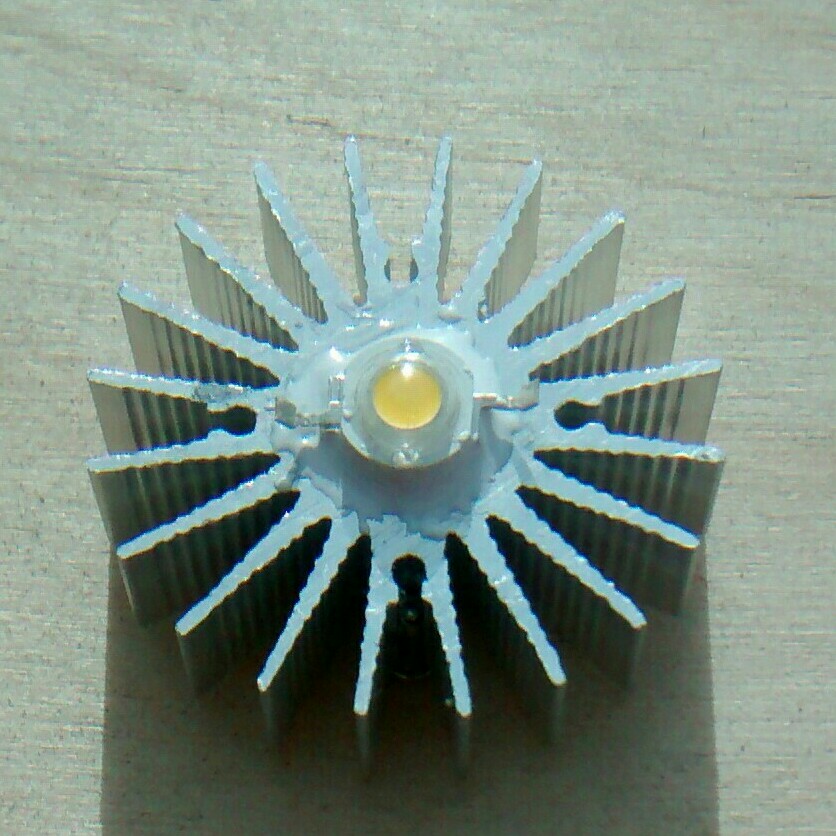
I got a bag of these heat sinks from a Chinese seller.  They come with twenty fins and four mounting holes, two tapped for metric screws, which were included.  They were meant to mount a Star LED to the heat sink.  However, since I used thermal glue to mount the LED, I decided to face the mounting screws towards the other side, to be used to mount the heat sink to the enclosure.

image

The LEDs are from Electronic Goldmine, SKU G18580A, a package of 5 which periodically goes on sale.  These are 1watt warm white, which make a good substitute for an incandescent light. But they have no mounting pad, so I have to mount them with thermal glue. This glue comes in two small syringes and hardens in 5 minutes.

The combination works quite well. I use one of these as a room light, shining up at the ceiling while the TV is on. I plan on connecting 6 of these in series and to a 20 VDC wall wart AC adapter and possibly a dimmer. They will be mounted to the wall close to and facing the ceiling.

default

2015-05-12 Inland Flashlight Is A Steal

While I was picking up some stuff at the local MicroCenter, I bought an Inland flashlight for $2.99 US.  The SKU is 398842 and it comes bare with no packaging.  It comes with a lanyard and key ring and it uses a single AA cell.

With a fresh alkaline cell it puts out a decent amount of light.  It has a single LED and an OP (orange peel) reflector.  This is similar to the higher end flashlights.  I should have bought a few more to give away as presents.

I went to their website and searched for the SKU but it said not found. So I searched for Inland flashlight and again said not found. So I searched for flashlight and I got over a dozen flashlights, but non of them were Inland. Lousy search engine!

default

2015-05-11 The Search For A New Machine

I was reading the above titled article in the May 2015 issue of Scientific American magazine.  Suddenly I thought about the SETI At Home Project of more than a decade ago.  This system is a distributed computing system where small pieces of a very large data set are sent to many thousands of computers around the world to be processed and sent back.

My thoughts were about the percentage of processing power being used at any time by the millions of personal computers around the world.  My guess is that less than 25 percent of the processing power is used on average.  Therefore more than 75 percent is unused and being wasted.  The actual amount used may be much less, possibly only a few percent, and even more CPU may be available.

This vast amount of processing power could be put to use, as it was with the SETI At Home project. There are some technical challenges that have to be overcome, especially in the area of security. But if a very large amount of processing power is distributed over a large amount of PCs, and can be harnessed to do a particular job, then there may be no need for larger, faster PCs.

This reminds me of Heinlein’s ‘The Moon Is A Harsh Mistress’, where all the computers on the moon joined together and became sentient. It’s a very interesting book.

Update 2015-06-30 – The news said that a hacker has been caught by the FTC for putting malware into smartphone apps. This malware turns the phone into a slave processor to ‘mine’ a digital currency called Dogecoin. With thousands of slave phones, the hacker has a supercomputer at his command.

default

2015-05-07 Flexible Flashlight

I was at MicroCenter buying a few items, mostly USB 3.0 cables.  I strolled down the aisle with the tools and this popped into my view.  At first I didn’t know what to think.  A flexible flashlight?  What’s that?  But that’s what it is and does.

Here’s a link to a photo. And another photo link.

As shown in the picture, you can bend it into a sleeve to give 360 degrees illumination, or you can bend it so that the 16 LEDs focus into a point in front of the LEDs.  It’s a great concept to be able to point the LEDs anywhere you want, but I don’t even plan on buying one for the $40 US they want, or even half that much, especially if it was made outside of the USA.

I think I could make my own by poking 16 5mm holes into a thick sheet of aluminum from a disposable baking tray.  Then mount 16 LEDs into the holes using silicone sealant on the back.  It might be easier to wire them up before putting on the silicone sealant.  But I’m wondering how the LEDs are connected up.  It looks like there are four AA cells in the battery box.  I assume they are all on series for 6 volts.  If each string of four LEDs are connected in series, the voltage would have to be about 13 volts across all four to get enough light.  So the circuitry may include a voltage boost circuit such as a Joule Thief.

Or the LEDs could all be connected in parallel. In that case, all that is needed is a current limiting resistor. At 20 mA or .02 amp per LED, that’s .32 amp current. Three AA cells could provide that. The fourth cell would be needed if the cells were rechargeable.

default

2015-05-05 Another Harmful Cause

I have been discussing political causes with a friend of a good friend of mine, and the latest heated discussion has been about the California Senate bill SB277.  California has a law that requires parents to vaccinate their children before they can attend school.  There are three exemptions: medical, religious and personal.  SB277 removes or restricts the personal exemption.

You can see both pros and cons about vaccinations here. The website takes NO stand on the issue, one way or the other.

Background

The reason for this is the vaccination rate is too low to prevent an epidemic of these diseases.  Literature says that studies show that if the vaccination rate is kept above a certain percentage, people will have ‘herd immunity’ and the disease won’t turn into an epidemic.  This percentage varies with disease but it is typically in the 90s.

I will use pertussis AKA whooping cough as an example, and use the information in Wikipedia.  Also, the short article in the May 2015 issue of Scientific American Magazine.

Sacramento, the California state capital, has recently  been the scene of protest marches against SB277.  There were hearings to let people express their opinion.  Many people came from all over the state to strongly oppose this bill.  Many professionals including doctors opposed this bill.

I have done a lot of reading about vaccination and I’ve found that the opponents minimize many facts in favor of vaccination and blow other minor disadvantages all out of proportion. My overall assessment is that no matter what the risks are, getting vaccinated is much safer than getting the disease. And many more people die from not being vaccinated and getting the disease than from getting vaccinated.

The excuses that I get again and again are as follows.

1. “The vaccine causes autism”
A. This was based on a flawed and withdrawn study. See Wikipedia.
“You are 100 times more likely to be struck by lightning than to have a serious allergic reaction to the vaccine that protects you against measles.”

2. “The vaccine has mercury, cyanide, arsenic and carcinogens in it”
A. Thimerosal (a mercury compound) has been removed or reduced to trace amounts in vaccines for children under 6 years old. The dentists used mercury in the fillings in teeth. This meant that people had mercury in their body, without being harmed by it. The food you eat and the water you drink has arsenic in it. Discussed in the Procon link above and in Wikipedia.

3. “The vaccine can cause birth defects”
A. Vaccinated mothers protect their unborn children from viruses that could potentially cause birth defects, and vaccinated communities can help eradicate diseases for future generations.
The vaccines have warnings that they should not be used by pregnant mothers. Obviously a woman should be vaccinated before she gets pregnant so she will not spread diseases to her unborn child, and cause possible birth defects.

4. “The vaccines are being pushed by the pharmaceutical industry”
A. The United States saves about $27 per $1 invested in DTaP vaccination, and $13 per $1 spent on MMR vaccination. But this has nothing to do with a vaccine’s effectiveness or ability to save millions of lives. The vaccination rate in some African countries is 99% and this has prevented outbreaks of diseases. Furthermore, this was done for humanitarian reasons: to save lives. See Wikipedia.

5. “The CDC is corrupt and is being pressured by the pharmaceutical industry”
A. See number 4 above.

6. “Fearmongers” who insist that vaccinations are worse than getting the disease
A. The whooping cough is one example. If a child gets pertussis (whooping cough) he could be sick for months, which is why pertussis is also known as the 100 day cough. There is not a chance that the child will be allowed to attend school while he’s coughing and constantly disrupting the classroom, even if he is not contagious. He will have to miss so much school that he will have to fall back a grade.

If an infant gets pertussis, there is a 1 in 66 chance of him dying. Those are not good odds and much, much worse than the odds of dying from vaccinations. It is heartbreaking to see an infant constantly coughing so hard that he does damage to his own body, such as breaking his ribs or tearing muscles.

7. “I got whooping cough (or other childhood disease) and I’m okay. So getting the disease is safe.”
A. That is a false logic. By the same false reasoning, I can say that I got vaccinated, and I’m okay, so therefore vaccinations are safe.

8. “Vaccines do not protect you for life like getting the disease does.”
A. That is why children and people should get booster shots to build up their immune system. See Procon link at the top.

9. “Kids get too many vaccinations.”
A. Booster shots and new vaccines for new diseases are necessary to prevent epidemics. See Procon link at the top.

10. The anti-vaccine propagandists use the VAERS to claim that vaccinations cause a disease.

A. The VAERS tells you that it does not say that vaccine is the cause of the adverse event.

11, etc. Other supposedly bad things that have nothing to do with the safety or effectiveness of vaccination.

The percentage of the population getting vaccinated must be kept high to prevent an epidemic. Some school districts have vaccination rates as low as 86%, which is not enough to prevent an epidemic. The death rate is much higher in unvaccinated children, so why would a parent want to expose their child to danger? It’s not necessary and foolish! It doesn’t make any sense! Save lives by getting them vaccinated!

Update 2015 June 30 – Gov. Brown signed the bill into law. All of the anti-vaccine people are lamenting how the state is going to hell and complaining that the next step will be mandatory vaccinations for adults. They will not just give up and stop shouting about something that people don’t want to hear.

default

2015-05-03 Light Emitting Paper

Quantsuff emailed us a link about a new material summarized at Newscientist.com.  I have a few thoughts that I’d like to add.

The stuff should be great for illumination.  But I have doubts about its use for display purposes.  Displays have millions of very small pixels.  If one or a few get contaminated with dust or dirt, they will not light, and the display will have a bad dark spot on it.  Displays are made in a dust free environment, and paper is a natural carrier of dust.  I doubt it could be kept clean enough to be dust free.

default

2015-04-29 Power LED Heat Sinks

I have been looking for something like this for awhile.  I bought a bunch of 1 watt LEDs without the ‘star’ mounting plate, and I have been gluing them with thermal glue to aluminum and copper heat sinks that I have made from scrap and 6 AWG copper wire.  I think these heat sinks from PowerLEDworld would be much more convenient.  The one concern I have is that the two LED leads are meant to be soldered to surface mount pads, so I may have to bend the leads up so they don’t touch the heat sink. Even if they can’t be bent, I have some star LEDs that I can mount on these heat sinks.

The website has many other things such as LEDs of many different sizes, light bulbs, accessories, etc. The column on the left has hundreds of various components. Click on the currency at the upper right for dollars, euros, etc. I read somewhere that it was in Hong Kong, so it may take a few weeks to arrive here. But shipping was free.

default

2015-04-29 Humongous Rectifier Diode

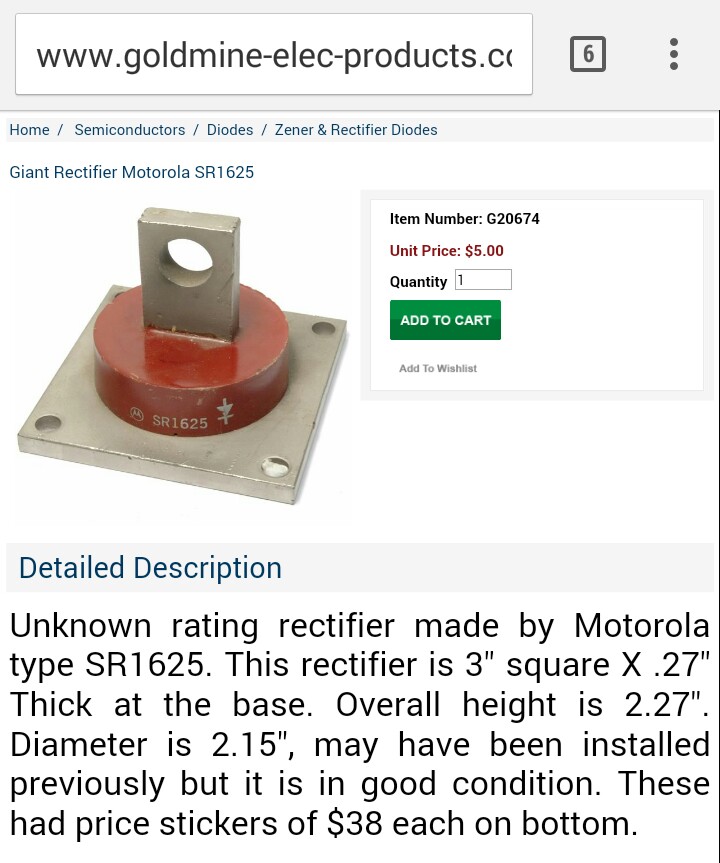
I ordered a half dozen of these huge, high current rectifiers from Goldmine for use as paper weights.  That’s about all they can be used for until I find some specs or a data sheet for them. The metal base is 3 inches or 76 mm square. I have seen rectifiers much smaller than this that can handle 35 amps, so I’m guessing that these can handle a hundred or more amps. I’m hoping that they are Schottky rectifiers that were used in a battery charger or an electroplating system. I intend to use them for connecting two or more lead-acid car batteries in parallel.

image

The case is marked SR1625, which could mean silicon rectifier, or Schottky rectifier. The rest of the numbers could be house numbers, in other words numbers that the company who bought them had put on. Those would not be traceable unless one had access to the company’s records. But these parts are so unusual that there are only a few other parts like them that were made. That makes it easier to narrow down to a lot fewer possible choices. I could just assume that they can handle 100 amps, and a few dozen volts, which would be good enough for connecting 12V car batteries in parallel.

In the ad, they gave some measurements of the package. I looked in an old Motorola data manual for the same size package. They match up with the MR1230 series of rectifiers, which are rated at 50 to 600 volts, and 300 amps!! Wow! The other similar but slightly smaller packages are rated a minimum of 200 amps. So it looks like I bought some excellent choices for paralleling car batteries.

Update Apr 29 – They emailed me that they are sold out of the giant rectifiers. It looks like my luck ran out. 🙁

default

2015-04-28 Variable Power Resistor

Often I have needed a variable resistor with a power rating of up to 10 or more watts and a resistance of several ohms up to 100 or so ohms.  These are expensive and hard to find.*  I’ll explain how to make an inexpensive one, but first I want to explain what I have used them for.

I have accumulated dozens of wall wart AC adapters, scrounged, or often bought for less than a dollar each.  These are often unregulated, just a transformer, rectifier and filter capacitor.  The output voltage varies widely with load. The output voltage is supposed to be the rated voltage at maximum rated current, but at lower current, the voltage rises; typically to 41% higher at zero current. And this doesn’t take into account fluctuations in the AC line voltage. 

I often use one of these to power a strip of LEDs, usually needing a few hundred milliamps.  But in order to get the voltage and current set right, I have to  put a current limiting resistor across the wall wart output.  For a wall wart rated at 6VDC unregulated at a half amp and a 1 watt LED using 200 to 350 mA, the variable resistor would be under 25 ohms.

Variable resistors or potentiometers this low are difficult to find and expensive, so a good substitute is a power transistor with a higher value pot between the base and collector. This pot may be 1000 ohms in series with a 100 ohm resistor, so the resistance may be varied between 100 and 1100 ohms. The 100 ohm resistor must be there so that the pot, when turned to minimum, has at least 100 ohms resistance, to prevent excessive current. As I said, this is connected between the base and collector. The power transistor may be the common 2N3055, a TIP31, a BD433 or similar. For short periods of on time, a heat sink may not be needed. The collector is connected to the positive lead of the adapter and the emitter to the anode or positive pin of the LED. The cathode or negative LED pin then connects to the negative lead of the wall wart adapter.

I forgot to put the DMM set to the current range into this circuit. It can go between the positive lead of the adapter and the collector. The adapter is plugged in and the 1k pot is adjusted until the DMM reads the desired LED current. If the meter reads only up to 200 mA, it may have to be set on the 10 amp range. Once it is set at the desired current, the adapter is unplugged and the DMM is removed, and the collector is reconnected to positive lead. The DMM is switched to 20 volt range and connected to both leads of the adapter. The adapter is plugged in and with the LED brightly lit, the adapter’s voltage is read. Then the DMM is connected across the emitter and collector and the voltage is measured.

Assume that the variable resistor was set for 200 mA or 0.2 A, and the voltage across the emitter and collector was 4 volts. Divide 4 volts by 0.2 A and we get 20 ohms for the resistance. Using the formula I squared times R, we get 0.8 watts for the power dissipation in the 20 ohm resistance. We could use two 10 ohm, 1/2 watt resistors in series, but each of the resistors would dissipate 0.4 watts, which is too close to their 0.5 watt maximum. It would be better to use two 10 ohm, 1watt resistors or three 6.8 ohm, 1/2 watt resistors in series.

The reason we measured the adapter’s voltage with the variable resistor load is to find what its approximate voltage will be when the 1 watt LED and two 10 ohm 1 watt resistors are connected in series across the adapter leads. The LED should light up brightly, but it may get hot. The LED should be mounted on a heatsink to prevent it from overheating and shortening its lifetime.

The transistor could be used permanently, if the pot was measured and replaced with a fixed resistance. Or the 100 ohm resistor and pot could be measured and then change the 100 ohm to that value. The pot can then be used as a dimmer.

Note: I was lucky to get a few 25 ohm, 50 watt pots long ago. I used them as a load resistance for testing audio power amplifiers. But I also use them for the above setup.

© RustyBolt.Info/wordpress
CyberChimps