default

2017-11-08 Using More Than 2 Phones As Intercoms

From FB group Bell Telephone…

While I see a discussion about connecting phones in a party line, I’d like some input on this.  It’s easy to connect two phones because they can be connected in series, and both phones have to be off hook.  But more than two phones, they can’t be connected in series because if only two of the three phones are used, the third would block the current if it was on hook.  I’ve seen more than one solution.  Obviously one is to connect them in parallel with a separate load resistor for each, and coupling capacitors between them.

Another solution is to connect them in series with a zener diode in parallel with each phone.  If one phone is on hook, the current can pass through the Zener when the voltage across it rises above its breakdown voltage.  The current will then go through the other phone when it is taken off hook, and all three phones will work.  The one disadvantage I see is the changes in voltage could cause a loud noise in the earpieces.

Any ideas how this is usually done?

Yes, I can see tying all phones together.  But the power supply has to be a current source.  If one or more phones are connected to a voltage source such as a normal power supply, any audio will be filtered out.  So there has to be a load resistor to make the supply look like a current source.

But differences between phones, or between the lengths of the loop, can cause one phone to get most of the current, or very little current.  This isn’t a major problem with Bell 500 or other sets, but for other phones, the sound levels may be too loud or soft.  So I would give each phone its own load resistor and put coupling capacitors between the phones.
Ed Vaughn said “The most perfect source for common talk battery is a 401A card in a 1A2 system.  It provides proper filtering and coupling for multiple stations off-hook.”
Glenn Peters said, “In real world that is not how it was done.  Sometimes you would have up to 8 parties on a single pair back to the CO in rural areas.  Other times you can have up to 4 different pairs tied to a single OE for 4 partys or more.  Most in use today are mainly 2 party, which can be either 2 separate cable facilities tied at the OE or a single feeder pair bridged at a cross box or a distribution terminal.  H88 cable loading maintained a maximum of -8.5 DBM loss at 1000 Hz to the station.  This provided proper signal levels across the National DDD Network.  No provision was made for more than one station to be off hook at a time per tariff.

Selective ringing was handled by a couple different ways depending on the telco.

More selective ringing methods were introduced using various technologies.

In the system of divided ringing, the ringing circuit was separated from the talking circuit by adding a ground connection between the central office and the subscriber stations for ringing. On the same subscriber line, one party used the tip side of the line and ground for ringing, whilst the other party on the same line used the ring wire and ground for ringing, to achieve full selectivity for two-party lines, in which only the selected station would ring. These names for the wires are derived from the paired cord plugs—used on a manual switchboard—composed of three parts: the tip and the sleeve separated by a narrow metal band called the ring, each of these three components being insulated from one another.[39] In the Bell System, the two stations were thus called the tip party and the ring party, In combination with code ringing, this method could be extended to four and eight subscribers to reduce the number of disturbances. In several variations of divided ringing, also called grounded ringing, the bells were activated with polarized current, so that full selectivity was achieved for up to four parties.

Another selective ringing system was based on using different ringing frequencies for each station on the party line. In North America, this was used mostly by independent telephone systems, while the Bell System abandoned frequency selective ringing in the early 1900s. Initially four frequencies were used, which were based on a system of harmonic multiples of a frequency of 16 2/3 Hz. Combined with divided ringing, this provided fully selective service for up to eight stations.

All fully selective ringing systems on party lines still brought the inconvenience of finding the line in use occasionally, by hearing talking, when one picked up the phone to make a call. All party lines also required special equipment to complete calls to another party on the same party line.”

default

2017-11-04 Zenith Royal 500 Fixed Part Way

I got another Zenith Royal 500 at auction, I think it was $20 but the shipping cost a lot.  I got it out and tried it out.  I found the battery contacts were in good condition.  The battery compartment was missing the cover.  It came with a leather case, so that will stop the batteries from falling out.

The audio was very weak, so I knew that the capacitors were bad.  I jumpered the 5 uF from the volume control wiper to the driver transistor with a 4.7 uF and the volume increased dramatically.  So I soldered the 4.7 across the bad capacitor – there was plenty of room behind the PC board.  The other capacitors seem to be okay.

Now I found that the stations sounded distorted.  Apparently someone tried to adjust the IF cans and made things worse.  This seems to be the problem with many of these old radios.  People who have no knowledge of electronics try to fix something and they have no idea that what they’re doing is worse than leaving it alone.  So I did a bit of adjustments to help.  I need to get a signal generator and do a proper alignment.

The other problem is the volume control is intermittent and noisy.  It’s worn and needs cleaning.  Considering these radios are over fifty years old, that is to be expected.  I’ll have to clean it with contact cleaner.

default

2017-11-04 Change a Princess Phone Light To LED

From FB group Bell Telephone…

a reply to Lucky225

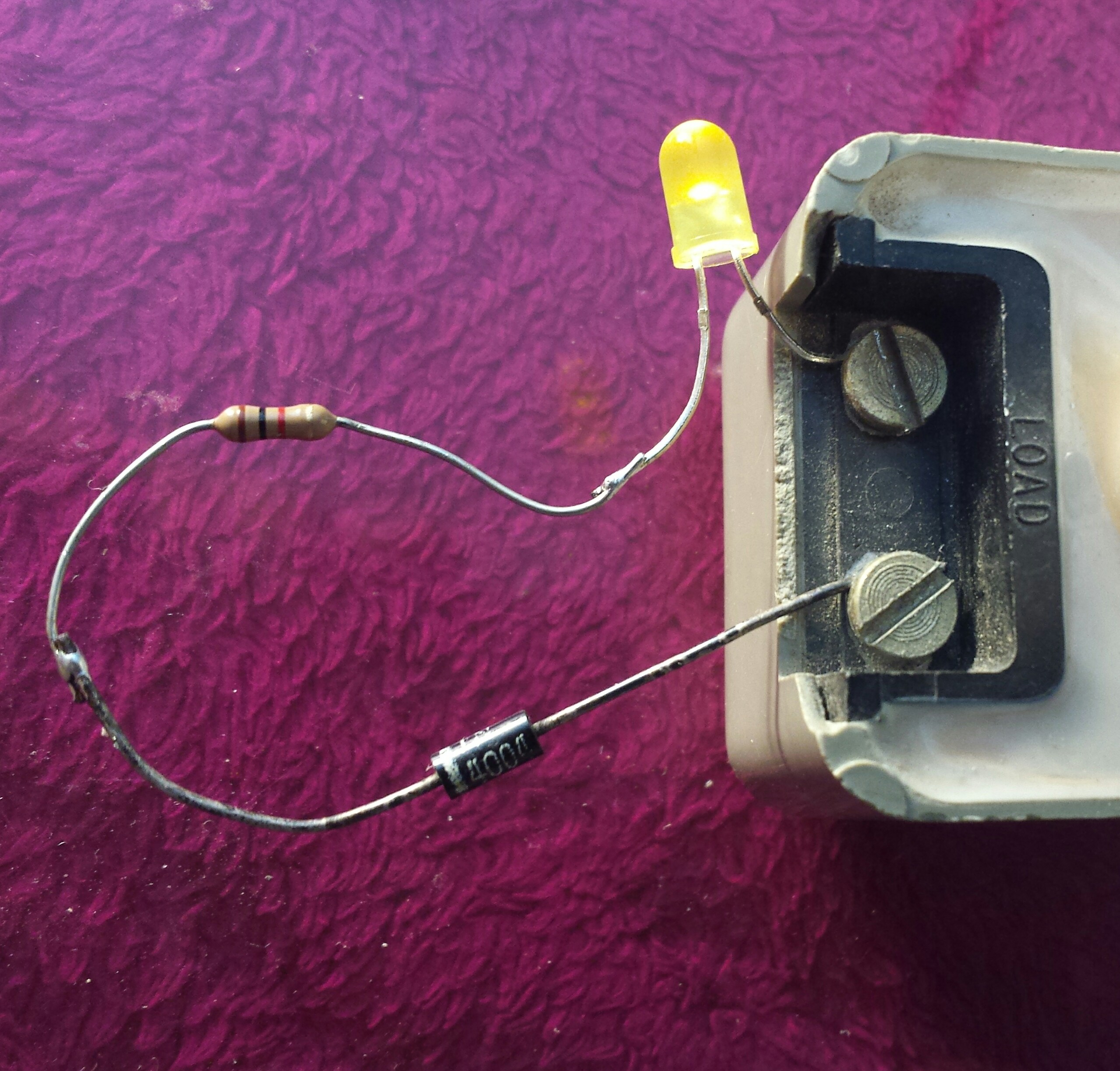
I fixed the same problem.  A single 1N4003 rectifier diode in series with the LED.  If you think there’s too much flicker, add a 220 uF capacitor across the LED.  The LED must have a resistor in series, start with 1000 ohms (brown, black, red, gold stripes).  Here is a photo.  The yellow LED is lit, it doesn’t look bright.  If you connect the LED backwards it won’t light, just try it the other way.  All the parts are available at an electronics store (if you can find a Radio Shack).  The rectifier might come in a package of a few and cost a dollar or so.  Same with the resistor.  You can order them on eBay for cheaper, free shipping, but it takes a week or two from China.  So use the original Ma Bell Trans, with the screw and holder clip.

I forgot to say, you don’t have to solder the parts.  You can connect them with crimp-on ‘beans’ or ‘mouse condoms’ or twist the wires, and cover the bare wires with tape or heat shrink tubing.  You could put the parts inside of the phone.  The color of the LED isn’t important.

default

2017-11-03 SAC Caused the Telco CO To Go Into Alarm! 

From FB group Bell Telephone…

Our Pac Bell account representative would meet with us typically monthly.  We had an IVR system with 36 lines for registering for classes.  We printed the students’ registration mail with one date and time for the opening day, usually a Monday at 10 AM.  Well, our account rep and another higher up rep came to one meeting and brought this up.  On Monday at 10 AM we caused the CO to go into alarm mode when thousands of students tried to register at 10AM!!

I can imagine the tech mumbling under his breath, “It’s the 564-6000 exchange?  Must be those idjits at Santa Ana College again!”

So we had to get the programmers to change the mail to print staggered times, like 8, 9, 10, etc. AM.  Bingo, no more complaints!

Reminds me of the time we ordered a WATS line, it was ‘area code’  888.  Well, publications printed ed 800 instead – that was back when 888 was new.  We started getting complaints from another company that they were getting hundreds of calls for us!  People were not happy campers…

default

2017-11-02 Dummy Batteries To Hold Power Supply Leads

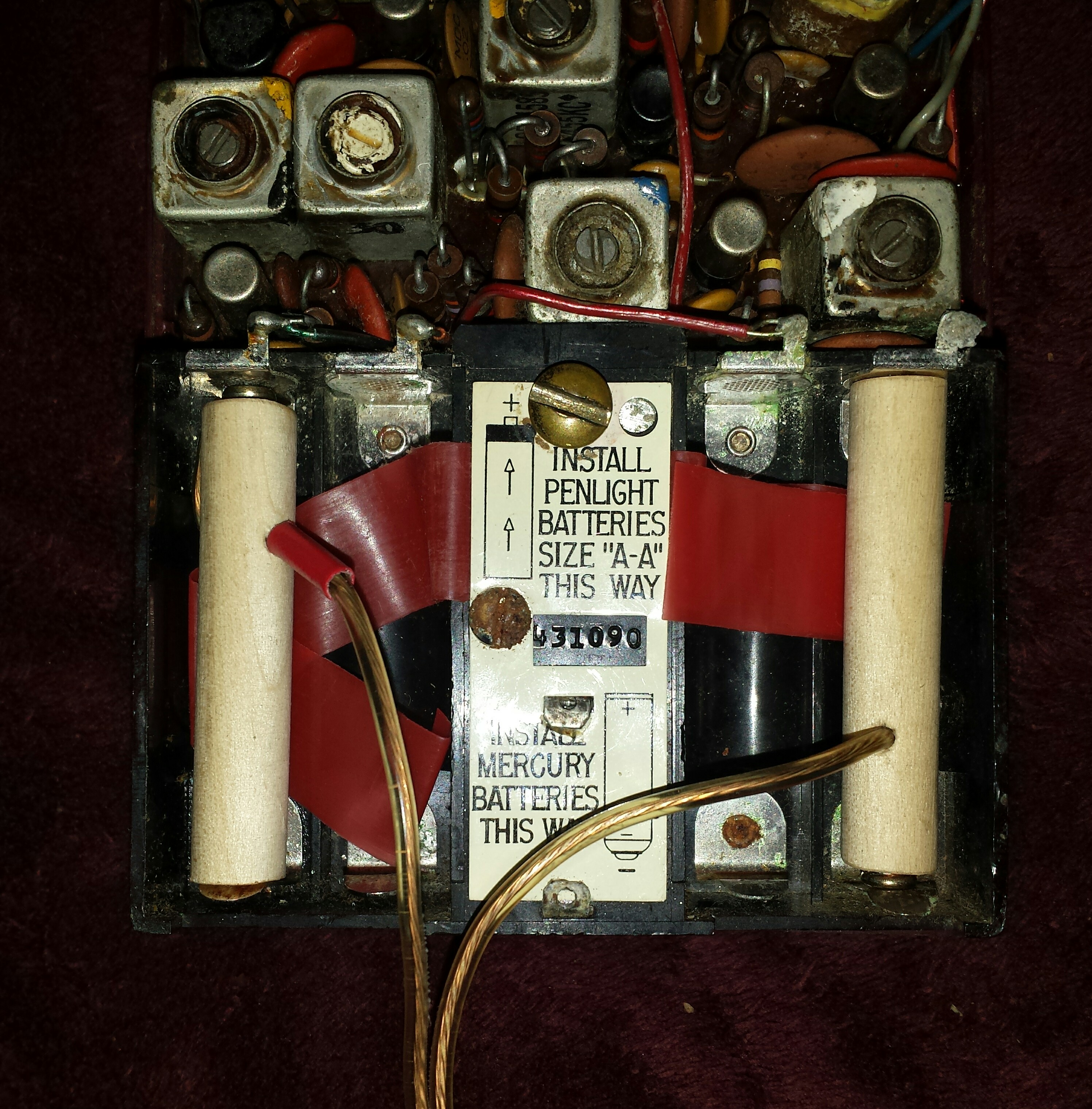
I made up these dummy batteries to hold the power supply leads in the battery holder.  I used alligator clips, but they pop off, and they can’t be used when the case is on.

I cut off short lengths of wood dowel, and drilled holes for the screw and for the wire to pass through.  The contacts are small #3 sheet metal screws to hold the wires.  The wires and/or dowels should be clearly labeled with the polarity.  

I still have to paint them with clear varathane sealer.

default

2017-10-29 Esther Had No Fingerprints 

From FB group Bell Telephone…

Speaking of federal contracts…  I had a neighbor, Esther, who was 96, and she told me about her husband’s company, Glaser engineering.  During WW 2, they were bidding on some government contract, so they had to be investigated by the FBI.  They had to have their fingerprints taken.  A few weeks later, the agents came to  investigate why all her fingerprints were smudged.  They examined her fingers and found that she had no fingerprints!  I said really?   She said sure, have a look and held out her hand.  Other than wrinkles (she was 96!) her fingers were completely smooth.  I said, you should’ve been a burglar!  I was surprised, but I forgot to ask if I could get a photograph.  But she died a few months later, and I didn’t have the opportunity.  The only person I have ever heard of having no fingerprints.  So if anyone tells you that everyone has fingerprints, call them a liar!

Also they lost a lot of money on the contract.  👎

default

2017-10-28 Old Telephone As Arduino Number Input

The old dial telephone uses pulses of current to dial phone numbers.  I thought it might be useful to enter digits into an Arduino.  I have to investigate if there is already a program that can do this.

The phone has to have some current, maybe 10 mA, flowing through it so that the pulses will develop a voltage across the phone or load resistor.  This should be from 0 th 5 volts maximum, with no switch bounces to give false numbers.  The voltages should be clamped to the negative and positive supply voltages.

I found an Instructable that does this.  It accepts pulsed input and puts out ASCII digits on the serial port.

default

2017-10-27 Telephone To Desk Light

From FB reply to video of a European gutting a 500 style phone to make a desk light:
​The ‘giant’ (mini) toggle switch wasn’t the pain;  it was the hole drilled right through the dial that made me cringe.  I would’ve used an invention I made for a project I built.  I put the switch inside and I straightened out a paper clip, and put the stiff wire through a tiny hole, with a small loop in the wire for a handle.  Pull on the handle to turn it on, push in to turn it off.  Another way is to use a reed switch inside and a magnet on the outside.

The removing of any part of the phone was not necessary.  The guy took out the network to make room for the AC adapter.  But the adapter could have been used on the wall as it was meant to be used, and not put inside of the phone.  Likewise, the phone wiring could have been left intact and heavier wires could have been used, through the phone and coiled cord to the handset.  The handset could have not been changed, but the LEDs could be mounted on a heat sink and mounted to the handset with small screws.  There are these shiny aluminum heatsinks that are great looking, very decorative, and about the same size as the round parts of the handset.

(to Trevor Hammonds)

The switch hook could be used, but not with its own handset, since it is on a ‘gooseneck’ that won’t go on hook.  One would have to have another handset or weight to hold down the hook switch.  And since the wiring would have to be modified, I thought that it would make it difficult to restore the set to its original state.  But I can see getting around the wiring modification with a bit of electronics.
Yeah, that would work, but that would go against my leaving the phone unmodified.

What would work well is a power MOSFET to control the DC and invert the signal.  The switch hook would ground the gate of the MOSFET, turning the light off when off hook.  The switch hook would open when on hook, causing the MOSFET to conduct and turn on the light.  There would be no connections inside the phone other than the tip and ring, leaving it unmodified.

default

2017-10-26 AT&T And Carterfone Decision 

From FB group Bell Telephone…

Ars Technica article link at the end.

Me:

You’re right, Ed.  I’m also on another old timer’s group and someone brought up the days we were coming in from gym class in high school, and we had a hard time breathing because of the smog here in the LA basin.  The car companies gave us a consistent product that worked.  And we would be still having difficulty breathing if the AQMD and CARB had not enforced air quality laws that made car makers put pollution control on automobiles.  Times changed and the companies weren’t keeping up.  I didn’t say AT&T was like VW and trying to get away with violating the laws.  I’m just saying it was more in the interests of the consumers the way it turned out.

I used to use a dial-up modem.  We might still be using them if things had stayed the same.

In fact, we might not have been able to use dial-up modems if the courts had not decided against AT&T in the Carterfone decision.  We might not have had even acoustic modems. 😱

I’ve been reading this 2008 article about the Carterfone Decision, and I found that its principles are *still* being applied to business by the FCC.  I quote (and I couldn’t have said it better):

“A 1999 FCC policy paper noted the significance and justly gave the agency credit for the proliferation of this application. “The Carterfone decision enabled consumers to purchase modems from countless sources,” the agency concluded. “Without easy and inexpensive consumer access to modems, the Internet would not have become the global medium that it is today.””

Further:

“But a good idea doesn’t enforce itself. If Skype’s petition to the FCC asking the agency to apply Carterfone principles to the mobile Internet prevails, it will be because hundreds of thousands of citizen/consumers have made it clear to the government that it must. It is not acceptable, as Skype argues, for the big telcos to use their influence over handset design “to maintain control over and limit subscribers rights to run software communications applications of their choosing.” But it won’t actually be unacceptable unless consumers exercise enough control over the regulatory process to make it so.

In the end, Carterfone says that it is our telecommunications system, not AT&T, Verizon, and Comcast’s. We finance the system with our subscription, application, and investment money. We support it with utility easements, regulatory breaks, and government contracts paid for by our taxes. We make it work because we are its workers. We make it exciting with our innovations, technical and social, big and small.

We do not begrudge the CEOs of these great corporations their legal positions. But they are, as Andrew Carnegie would put it, stewards of the system, not its owners. They are not there to tell us to Go Away. They are there to keep the system running while we discover it, use it, develop it, innovate it, game it, finesse it, and reinvent it to our heart’s content. The great enterprise of telecommunications is no better than our right to participate in it as individuals.”

https://arstechnica.com/tech-policy/2008/06/carterfone-40-years/

default

2017-10-25 Cisco VoIP Errors, Fax Jitter

From FB group Bell Telephone… Oct 28

Pat Chicas

We (at where I worked) used all Cisco 7900 sets.  You can tap the help “?” button twice during a call and see the statistics for the call, both for a time (per second?) and cumulative.  I would go to one bldg and make a call, and watch the errors accumulate.  One of our guys said that it shouldn’t go over 100, usually just a few.  Callers were complaining of ‘noisy handset’ like a bad coiled cord.  Instead I was seeing error rates way over 100, sometimes over 2000. I found out the phones buffer the packets, but if the delay is too long the packets get dropped, and the caller hears either noise or a gap (dropout).  The problems were from high traffic, caused by security cameras.  We had to add fiber links between bldgs and the data center.
Easy for you to say, Pat Chicas.  I was not involved with VoIP call manager, I was the guy who had to watch out that I didn’t get poked in the eye by a T-bar wire.  The switches we were using were Cisco 3650(?) with PoE, but we switched (no pun intended) to Brocades.  We had other problems like PoE overload, and one other really stupid problem with PoE injectors.  As far as I knew, the switches supported QoS, but when the pipes are too small, there’s nothing the switch can do about it.  😵
Joshua Perrella

VoIP Ugghh is right!

We had fax machines that were connected to the Cisco box in the data center.  Many of the faxes were big Xerox WorkCentre machines.  The cheap desktop faxes (Brother , etc.) would negotiate or renegotiate slower speeds if the VoIP system had too much delay or jitter.  But those Xerox prima donnas would refuse to go slower, instead retry to send the fax for *weeks*.  Really.  So we had to get the Xerox tech out to set (or reset after a software update) the maximum fax speed to 4800 bps.  Only then would they work halfway reliably.
Mike Sica

I don’t remember what the Ciscos were, might’ve been ATA.  As far as I was concerned the only thing I had to deal with was the 110 blocks on the back board.  And they were a pain, too, because they started out with port zero, not port 1.

As long as we kept the damn Xeroxes in line, things were halfway working.  But if the users wanted to fax to another campus (or any other fax within the district phone system), they had to use the 5 digit phone number.  If they dialed the full area code and number, the VoIP would use the path to the CO and back, thus it went through the ISDN trunks twice, and that caused too much delay, jitter, timing issues or whatever, and the fax would not work.  So I had to indoctrinate the users to use only the 5 digit number.
We had the all-in-one Xerox WorkCentres that let us scan in documents and send them through emails to anyone anywhere.  Much better than fax.  I thought these would put the fax machines out of business.  I thought the fax machines would be an anachronism, but they kept hanging on, due to state and federal grant requirements.  One of the concerns was about student ID privacy, where departments could not share fax machines.  

Mike Sica

We hired a guy who worked on the call manager for the local school district.  He helped me learn some, even though his new job was not involved with the network.  He told me that the school district was too cheap to upgrade the call manager software, so they were still running an old version.  I’m guessing this happens at a lot of other organizations, too.  We were buying new 7942 sets for a couple hundred apiece.  I went on eBay and found lots of ten used sets for the price of one new one.  I figured we could buy a used set, throw it away and keep the handset and it would still be cheaper than a new handset.  So rather than spend $$ on software updates, they were wasting it on phones.

© RustyBolt.Info/wordpress
CyberChimps