


Q Multiplier experiment in Yahoo group Regenrx2. You heve to join the newsgroup.

Q Multiplier experiment in Yahoo group Regenrx2. You heve to join the newsgroup.


This piece of oak serves as a quick way to swap parts for a Joule Thief.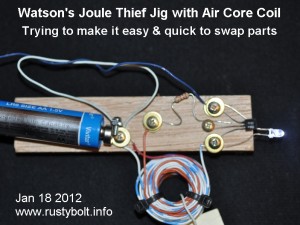 I have an air core coil connected to it, and a 3mm white LED which is tired from being used for a few hundred hours. The plus and minus wires are each wrapped around a steel screw and the nut is tightened to hold the wire. Then neodymium magnets are used to hold the screw to the battery. The positive end of the AA cell grabbed the positive screw in the board so I left it there.
The piece of paper attached to the coil said that it was ten feet of 24 AWG solid telephone wire and 32 microhenrys. Thatś kind of low for a JT, but it´s working. The transistor is 2N4401.
This article sounds very interesting and seems to have far reaching implications. BTW, boffin equals scientist.
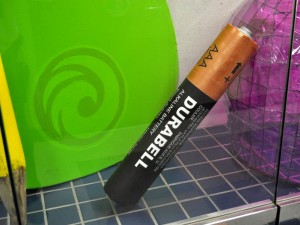 Last night I had some bad dreams. First I dreamed I was eating a giant marshmallow. Then I woke up and I couldn’t find my pillow.
I looked at the clock and it said quarter to three, so I went back to sleep. I had another nightmare. I dreamed I ordered a super high capacity AAA cell from a dodgy seller on eBay. When it arrived, it was this huge cylindrical shipping package. I unwrapped it and found this huge AA cell, more than a half meter long, maybe 24 inches (see the pic).
During the Xmas holidays I ordered five gift sets of two flashlights consisting of a Fenix LD01 and a Fenix E01, each for $32.00. I received a package a few days after Xmas and opened it up. I found five packages each consisting of a single LD01, but no E01s at all. Then I looked at the packages and three of them were missing the flashlight. I found that one of the packages had the plastic display thingy turned around so that the flashlight was not showing. But the other two were really missing the flashlights. I got on Amazon and went through all the hoops to start the claim process. My credit card had been billed by the seller for almost $165.00
First I had to wait for three days after the latest estimated shipping date they gave, which was Jan 5. So on Jan 8, I first had to contact the seller, which I did. I received a reply a day later. The seller replied with an excuse that it wasn’t his fault, someone changed the advert. But he didn’t answer the questions about why the flashlights were missing. I replied back asking why he had not answered my original questions. I waited for two days, and when I did not receive an answer, I went on Amazon and started the claim process. I will tell you that this was very user unfriendly. It looked to me as if they were trying to make it difficult for the user to get to the point where they could begin filling out the forms. Not only that but they make you read all these conditions and other stuff which seems unrelated to the issue.
Finally I submitted the claim. A day Later I got a call from the seller, and we discussed the situation. We came to an agreement that he would send me an additional four LD01s to make up for the losses. I should get those next week, then I promised to withdraw the claim.
Can you guess which of the paragraphs above are fictional? I’ll give you a hint… The first and second ones were supposed to be funny. The paragraphs following those were true, unfortunately. Thanks go out to the art students at Santiago Canyon College for their larger than life still life artworks.
I just had a brainstorm. If I had this high capacity battery, I could put several Maxwell 2600 Farad ultracaps inside, and it would be a real high capacity rechargeable electric energy store.
I have assembled several of my LED Fader circuits, and since I had so many orange and yellow LEDs, I decided to use those instead of the original red LEDs (each board takes 6 LEDs). The circuit uses one transistor and three RC sections to make a PSO (phase shift oscillator), and another transistor to drive the LEDs. I have been experimenting with the values of the resistors and capacitors in the three RC sections that make up the phase shift part of the circuit. I started out with 47uF and 33k for each RC section, and I changed the Rs to 39k for a bit slower frequency. Then the last one I assembled I used 4.7uF and 47k, but it was too fast and frantic so I changed to 82k, and the frequency was 1.6 Hz, which is more tolerable.
I decided that I should put some of these circuit to good use, so I thought about what I should do with hem. I´ve seen stage prop type of fires with fake flames. I believe they use a thin flap of translucent plastic above a small fan to give it motion, then some amber or yellow lights below to illuminate the flapping plastic. Instead of an open flame, I was thinking that I should aim for something more like a pot belly stove where the flames are light reflected off the inside and seen through the grating of the door. In other words, not so much moving flames but just the light from a fire, all without the toxic carbon monoxide that sets off the smoke detector. This would allow me to use LEDs of various colors with no moving parts.
The LEDs I´ve been using are directional, and six of them aimed in the same direction give a beam that is too tight, so I tried experimenting with a diffuser made of a discarded custard cup of milky plastic (washed out, of course). A lot of the light still shines right through the plastic and onto the ceiling, so I tried a second cup on top of the first. I still have a way to go before I get the effect I want.
I still have to come up with an enclosure. I thought that a pot belly stove was too big, so I should use something smaller, maybe a papier maché pumpkin for Halloween, but I don´t have one of those available, and I know I won be able to buy one until next fall. Maybe for now Iĺl cut out the bottom of a gallon plastic milk jug and put it over the whole thing, and see how it looks. This is becoming a work in progress.
The circuits take 9 volts DC at a few tens of milliamps, so I have to find a 9 volt power supply that really puts out 9 volts. Most unregulated wall warts put out half again as much, or 14 volts at low currents.I may stick a 7805 on the wall wart, with a pair of resistors just like a LM317. Some people don’t know that you can use a 7805 in this manner.
Back to experimenting…
The lifetime of white LEDs is touted by manufacturers and sellers as 100 thousand hours. From my own tests, I’ve found that to be far, far from the truth. I’ve purchased white LEDs on eBay from manufacturers in China and Hong Kong, and set them up on a power supply to test their lifetimes. I usually put four on so that I don’t get misled by a single bad one.
I have put the following types of white LEDs on 24/7 test:
3mm white LEDs
5mm everyday common white LEDs
8mm “superflux” four-legged white LEDs
“strawhat” white LEDs
10mm 5-chip, 1/2 watt white LEDs
10mm 1 watt white LEDs
Most of these were bought on eBay from foreign sellers, typically in China. I put them on a power supply set for constant current, typically at half their rated max current.
About 2 months after I have put the LEDs on 24/7, I found them to be getting dim. They have lost more than half of their brightness. A month is about 730 hours, so 2 months or actually 62.5 days is equal to 1500 hours.
To give you an idea, the lifetime written on the side of a 75 watt incandescent light bulb package is 1200 hours. The LEDs are not doing much better as far as lifetime is concerned. A CFL has a much greater lifetime, something over 10 thousand hours. This comparison shows the LEDs have very short lifetimes. The main difference is that incandescents and CFLs usually don´t fade away, they abruptly end their life with failure. Instead, LEDs just get dimmer until they no longer emit enough light to do the job.
Here is one of my blogs about the lifetime of 10mm1 watt single chip white LEDs.
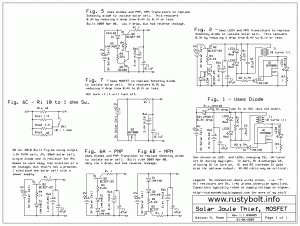 I did some experiments a few years ago with a photovoltaic solar cell charging 1 or 2 NiMH cells, and running a Joule Thief after dark. This is commonly known as a solar garden light. I tried to eliminate the drop across the isolation diode, which is about 1 volt for a 1N4148 or a half volt for a 1N5817 Schottky diode. My experiments were somewhat successful. I believe I wrote this up in my watsonseblog, but I haven’t been able to recover it. Click on the schematic a few times to enlarge it.
The 2N7000 MOSFET is fun to use in a Joule Thief, but requires 2 to 3 volts to turn on the gate, so it normally requires a 2 cell supply or about 2.4V. For a conventional JT, a single 1.2V cell will work okay, but don’t use a 2N3904 unless you want to have reduced light output; instead use a 2N4401 or PN2222A, or BC337-25.
At first I thought that I had drawn the red LEDs in Fig.1 with the wrong polarity. But then I read the note below, and remembered how they work. The red LEDs are exposed to the sunlight and act like micro solar cells; they generate a small current that puts a negative voltage on the 2N7000 gate, and keeps it turned off during the day. I used them similarly in the other schematics. A red LED is cheaper and easier to obtain than a CdS photocell, and with a transistor to boost the current, can do much of what a CdS photocell can do. Try it if you don’t believe me. It works.
Back to experimenting…
Most people with some exposure to technology have heard of Moore’s Law. Well, I for one had never heard of Haitz’s Law. It is basically similar to Moore’s Law but applied to LEDs.
I read the Wikipedia article in the above link and learned about not only Haitz’s Law, but that the luminous efficacy of LEDs will soon surpass other forms of lighting, so LEDs will eventually become the most efficient form of lighting.
Update Jan 24, 2012 – Last night I watched Frontline on PBS, the program called Nuclear Aftershocks. How does this apply to LEDs? Well, in the case of Japan and Germany, they may need all the help they can get to cut back on their electric consumption. In May, the Japanese may nave no operating nuclear plats whatsoever. And Germany has committed over the next few decades to completely end nuclear electric power.
One can argue that nuclear electric power is the only clean, non-polluting source of baseline generating capacity, but after Fukushima, the people will not support it. I found out that there is a single nuclear power plant being built in southeastern U.S.A. next to an existing one, but it is not likely that any more will be able to get started. You have to watch the program to see what I’m talking about.
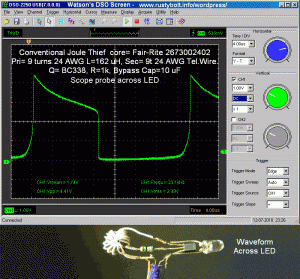 Here’s a screenshot of my DSO with the scope probes across the LED. The pic on the bottom is the actual Joule Thief. The capacitor that is half hidden at the bottom is a 10 uF bypass capacitor.
